ANPR + ADR code at the chemical terminal gate — a truck that does not add up does not get in.
The gate of a chemical terminal is the point where it is decided whether a hazardous load comes in correctly identified or an error slips through. iLEAN Vision reads the plate (ANPR) and the ADR panel in milliseconds, cross-checks them against the carrier's delivery note and holds the barrier if something does not add up. The safety officer signs off — the truck does not come in on its own.
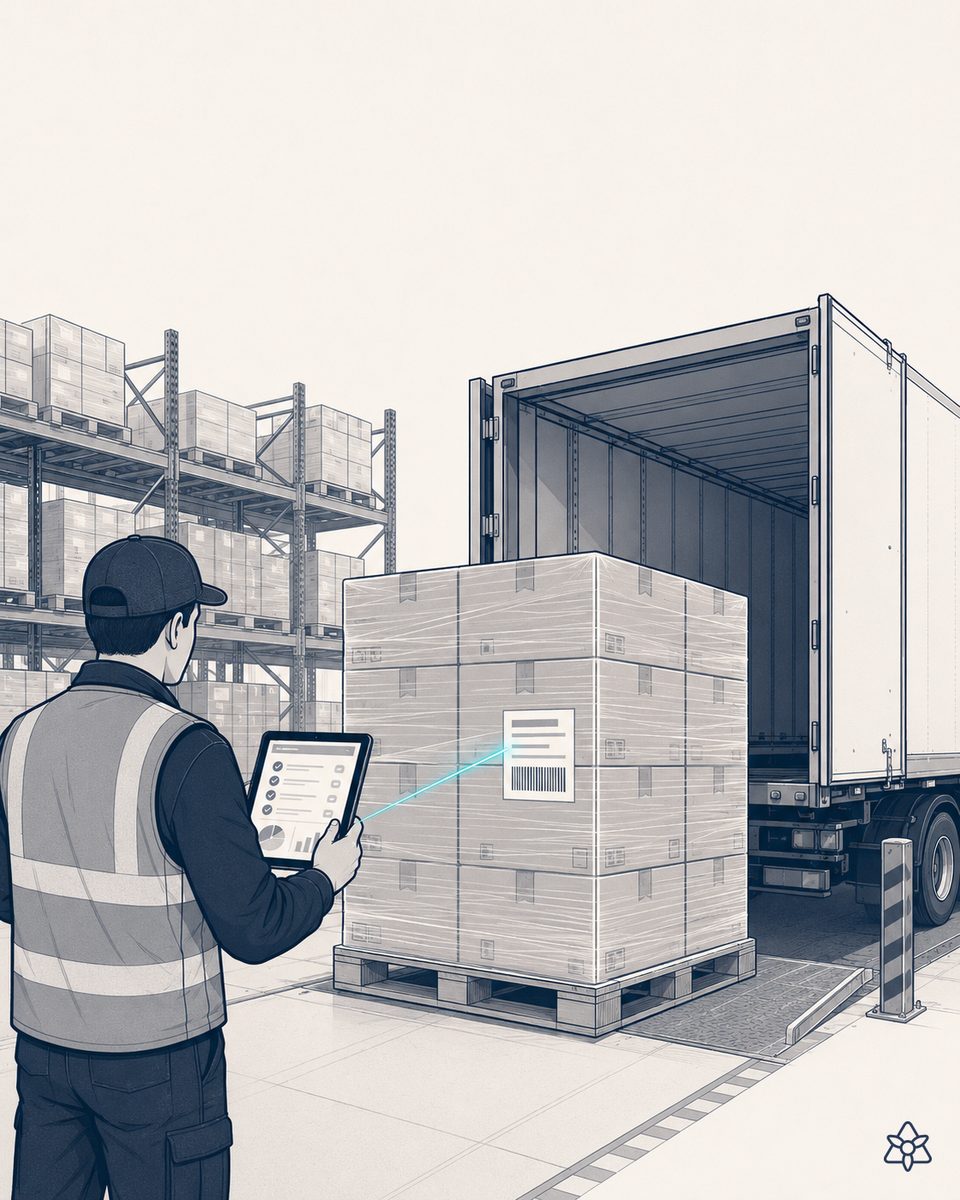
The tanker is already at the gate and nobody has yet cross-checked the three data points that matter.
At a well-run chemical terminal gate there are four sources of truth about every truck, and they are almost never in the same place at the same time:
- The plate of the tractor unit and of the trailer/tanker — to know which carrier it is and whether the tanker is the one that was authorised.
- The ADR panel on the tanker — the Kemler code on top and the UN number below: what hazard it carries and which exact product.
- The carrier's delivery note — what was loaded at origin, in what quantity and for which bund of the terminal.
- The history — whether that tanker is compatible with its previous load, which cleanings are declared for it, what past incidents there are with that carrier.
The officer in the gatehouse knows this, but cannot check all four at once in thirty seconds. The queue of trucks builds pressure, the driver shows paperwork and the barrier opens because "the panel looked like a match". The classic system works 99% of the time. That 1% is the incompatible mix in the bund, the ADR penalty or the picture that ends up in the press — and each of those, on its own, pays for several years of reinforced control.
iLEAN does not replace the gate officer — it puts the four cross-checked data points in front of them before the barrier opens.
The problem with access control at a chemical terminal is not a lack of data: it is information living in islands that, at the critical moment (thirty seconds at the gate, with a queue of trucks behind), does not reach the person deciding in time. iLEAN acts as the filler that closes those gaps, without asking you to change your TMS, your ERP or your gatehouse. See the category: full IRIS architecture.
Edge sees the plate and the ADR panel before the barrier. Connect reads the delivery note wherever it lives — TMS, carrier email, WhatsApp. The agent cross-checks against the tanker's history and, if something does not add up, holds access. The person signs off — never the other way round.
The three iLEAN pieces applied to ANPR + ADR control at a chemical terminal:
- iLEAN Vision (Edge) — one or two terminals with cameras in the truck waiting area. The CNN is trained to do ANPR and ADR panel reading in the same pass. It reads the Kemler and the UN number, identifies them as structured entities and triggers the barrier decision. It works with no network. If the line goes down, Edge keeps reading and keeps holding against the last valid synchronised list.
- Connect — captures the carrier's delivery note whether it comes from the TMS, from the email that lands at 06:00, or from the traffic manager's WhatsApp. It digitises it at second zero, without anyone forwarding anything. And it also captures what arrives from outside (a last-minute tanker swap by the carrier, a customs incident, an updated safety data sheet for the product).
- Agent — cross-checks the ANPR reading, the ADR reading, the delivery note and the history of the tanker and the carrier. If there is a deviation (a UN number different from the one declared, an unauthorised plate, a tanker with an incompatible previous load), it does not send an email after the fact: it holds access and presents the cross-check to the HSE person. The person validates and signs off — the barrier never opens on its own.
Manual ANPR + ADR control vs. cross-checked control with iLEAN Vision
| Aspect | Manual gatehouse + checklist | With iLEAN Vision + Connect + Agent |
|---|---|---|
| Plate reading | Officer types it from the gatehouse | ANPR in milliseconds, tractor unit + trailer |
| ADR panel verification | Visual from a few metres, no record | Structured reading of Kemler and UN number |
| Cross-check with the declared delivery note | Paper against paper, by eye | Automatic cross-check against TMS/ERP in seconds |
| Mislabelled or unauthorised tanker | Detected late or never | Barrier held before entry |
| Traceability for ADR audit | Reconstructed by hand, weeks | Dossier per entry with photo, reading and sign-off |
| Operation with no network | n/a | Edge keeps reading and holding on cabinet power |
Impact estimate for your plant — to be validated with your numbers.
The block below is an estimate to be validated with the specific figures of your terminal. We set it out so the committee has an order of magnitude; we refine it during the diagnostic.
- Chemical / petrochemical terminal with 60-150 tanker entries a day, ADR control done manually at the gatehouse today.
- Edge pilot at the gate (two cameras + integration with the TMS/ERP holding the delivery note). First expected value within a few weeks: an ANPR + ADR read rate that is genuinely useful at the gatehouse.
- Indicative payback between 4 and 9 months, depending on entry volume, number of gatehouses equipped and the average cost of one documented wrong entry.
- Expected reduction in entries with unvalidated ADR identity of ≥ 30% versus the previous manual control, with a floor that is reasonably defensible before the committee.
- The hard lever is a single wrong unloading avoided: incompatible mix in the bund, terminal shutdown, ADR penalty, reputational damage. One of those pays for the pilot.
And the IT manager's reasonable doubt
"What if the AI gets the ADR reading wrong and lets a mislabelled tanker in?" — hallucination is a problem of free generation, not of anchored tasks. In tasks where the AI simply reads a visible data point (plate, ADR panel) and compares it with a declared one (delivery note), the best models brought the error below 1.5% [1]. And even so, what is critical is never decided alone: the system holds and the person signs off. The three safety rings are there for exactly this.
[1] OpenAI paper "Why Language Models Hallucinate", 2025 — on the reliability of AI in anchored tasks.
What people ask about ANPR and ADR code at a chemical terminal
What is the ADR code and why does reading it at the chemical terminal gate matter?
The ADR code is the numeric identification every tanker carries on its orange plates: the hazard identification number (Kemler) on top, the UN number of the product below. At the gate of a chemical terminal it is the only fast way to know what is really coming in. Cross-checking it against the carrier's delivery note prevents a truck loaded with the wrong product, or a mislabelled tanker, from reaching the unloading area. The European ADR Agreement makes that identification mandatory; what iLEAN adds is reading it in milliseconds and comparing it with what was declared.
How does iLEAN Vision read the plate and the ADR panel at the same time?
With an Edge terminal at the terminal gate and one or two cameras aimed at the tanker in its waiting area. The neural network (CNN) is trained for two tasks at once: ANPR (plate reading of tractor unit and trailer) and ADR panel reading (hazard number and UN number). The Edge cross-checks both data points against the carrier's delivery note — which Connect has captured from email or from the TMS — and decides whether to open the barrier. All in seconds, with nothing typed in the gatehouse.
What happens if the declared load does not match the tanker's ADR panel?
The barrier does not open. The system holds the truck in the waiting area and alerts the HSE manager through whichever channel they use (Connect, email, control post siren). The agent does not improvise: it presents the person with the ANPR reading, the ADR panel reading, the declared delivery note and the specific discrepancy — a different UN number, a different Kemler code, a trailer plate that does not belong to the carrier. The person validates and signs off; the truck comes in or goes back to origin. The barrier never opens on its own.
Does ANPR + ADR control still work if the plant loses its network?
Yes. iLEAN Edge is designed so that its critical cycle (reading and deciding whether or not to open the barrier) works as long as it has power, with no Internet and no connection to Central. If the network goes down, Edge keeps reading plate and ADR panel, checks against the last synchronised list of valid delivery notes and keeps the barrier safe. When the network comes back, it synchronises the full record. In a chemical terminal, what is critical cannot depend on there being WiFi.
What does it cost and how fast does it pay back in a mid-sized chemical terminal?
The order of magnitude of an Edge pilot at a chemical terminal gate is close to that of any Edge pilot in an industrial plant: an initial investment covering terminals + cameras + integration with the TMS or the ERP, plus an annual licence. The reasonable payback to present to the committee is a matter of several months — the hard lever is a single wrong unloading avoided (incompatible mix, terminal shutdown, ADR penalty, reputational damage). Send us your terminal's figures and we will send back the estimated ROI within 48h.
More cases in ilean vision
- Unit counting per tray in nuts with AI — the half-empty tray ships like the full one, and the customer notices.How iLEAN Vision counts units per tray and detects under-filling in a bulk nut plant — without stopping…
- Coffee capsule sealing defects — the customer discovers them in their kitchen, and returns the lot.iLEAN Vision detects deformed capsules and faulty sealing on a high-speed single-serve coffee capsule…
- Aluminum coil for beverage cans with AI — the pinhole shows on the strip, not at the filler.iLEAN Vision detects pinholes, stains and scratches on aluminum coil before beverage-can cupping — the…
- ANPR license plates at the B2B loading dock with AI — the truck docks and the order appears without anyone typing.How iLEAN Vision reads the truck plate at the B2B loading dock and links the ERP loading order with no…
- ATEX PPE in a refinery zone — the spark that must never come off the clothing.iLEAN Vision verifies helmet, footwear and antistatic/anti-spark clothing on every operator before…
- Grade C/B pharma cleanroom — cap, mask and overgloves verified before access.iLEAN Vision confirms cap, mask and overgloves before access to a grade C/B pharma cleanroom, holds the…
Tell us your case and within 48h we will send you the estimated ROI of this AI project for your chemical terminal.
We work on your plant's real data, not on ours. Diagnostic with no commitment.
Request estimated ROI in 48h See iLEAN Vision