Coffee capsule sealing defects — the customer discovers them in their kitchen, and returns the lot.
At 1,200 capsules per minute, a heat sealer that drifts two tenths of a degree for fifteen minutes means thousands of capsules with faulty sealing. The consumer discovers them at the first cup and the retailer discovers them at the first mass return. iLEAN Vision sees every capsule before packing and rejects the defective one in ~45 ms. The person signs off — the line does not.
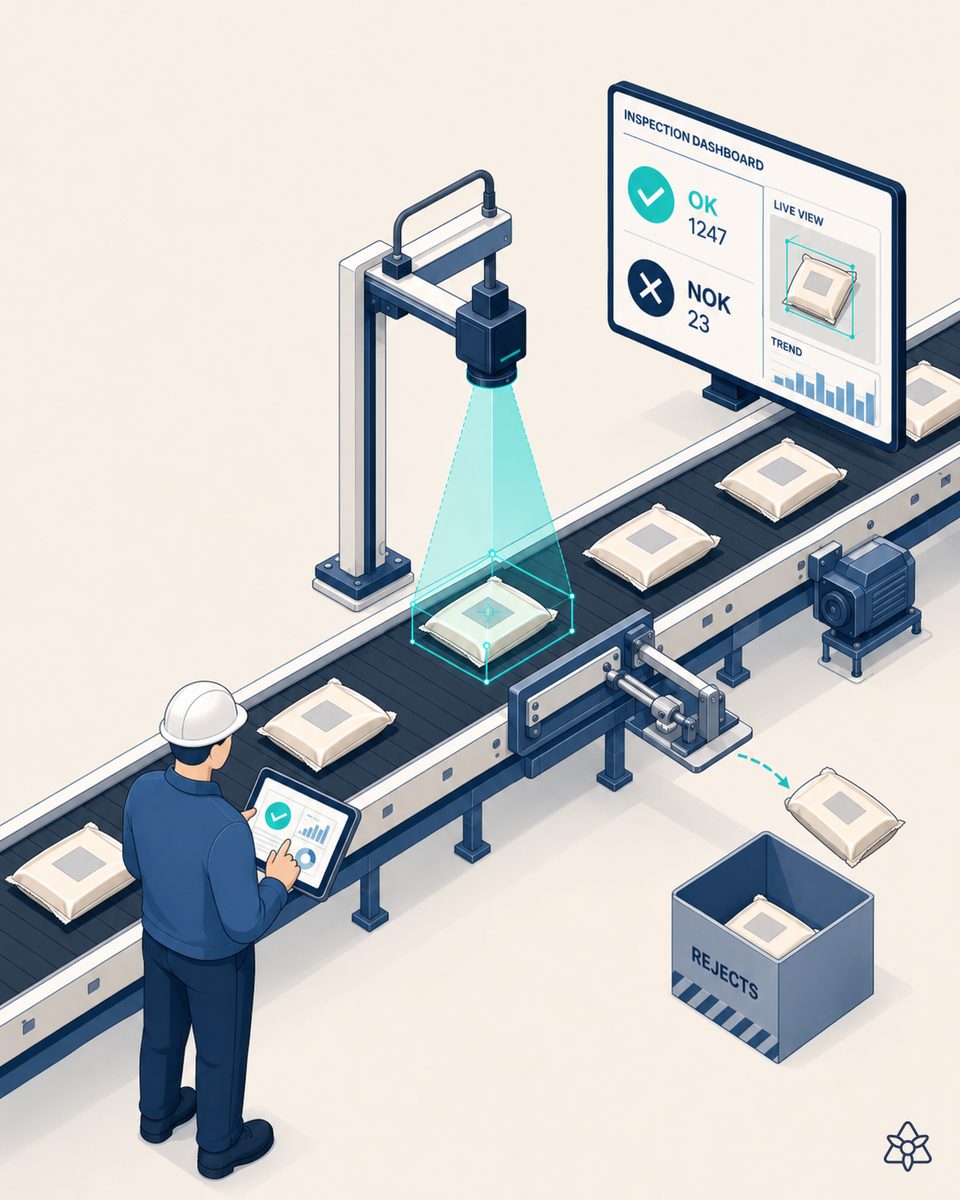
The capsule nobody sees is the capsule the retailer returns.
A single-serve compatible capsule line is a high-speed, low-tolerance system: the rim geometry, the heat sealer's temperature, the closing pressure and the coffee weight have to line up to the millimetre. And meanwhile:
- The heat sealer ages at its own pace. A thermocouple that drifts two tenths for a quarter of an hour goes unnoticed in SCADA — and leaves thousands of capsules with sealing in debt that the naked eye cannot spot.
- Quality control is statistical. One in every 5,000 is opened and measured. If the problem started 4,999 capsules ago, they are all already packed, all on the pallet, all on their way to the distributor.
- The consumer is the final quality control. The capsule does not brew well, the coffee comes out watery, the online review is one star, and the retailer asks for a lot recall. The brand damage weighs more than the product cost.
The quality manager knows this, but at 1,200 capsules/min no human eye can keep up. The classic system (thermocouple + statistical control + checklist) works 99% of the time. That 1% is the retailer's return — and each time it is hard product cost, hard reverse-logistics cost, brand cost, and a crisis committee.
iLEAN does not add a fourth system — it seals the crack between the heat sealer, the SCADA and the packing.
The problem with faulty sealing is not a lack of technology on the line: it is information living in islands (the heat sealer has its panel, the SCADA has its history, packing has its counter) that, at the critical moment — the defective capsule crossing towards packing — does not reach the actuator in time. iLEAN is the filler that closes that gap without asking you to change the heat sealer or the cartoner.
Vision sees the capsule before packing. Connect reads the heat sealer even if it is old. The agent cross-checks visual quality with process conditions and proposes the adjustment. The person signs off — never the other way round.
The three iLEAN pieces applied to coffee capsule sealing:
- iLEAN Vision (Edge) — a terminal with machine vision (CNN) over the heat sealer's exit. It sees every capsule at 1,200/min, detects incomplete sealing, aluminium deformation, a foreign particle on the rim, defective printing. It triggers the ejector (air blast or pneumatic arm) in ~45 ms. It works with no network: if the plant loses its connection, Edge keeps seeing and rejecting.
- iLEAN Connect — reads the heat sealer even if it is an old machine with an isolated local computer or an analogue panel (a photo every few minutes solves the capture). And it captures what comes from outside: the retailer's email with the first return, the salesperson's WhatsApp warning about a social-media thread, all at second zero, without anyone forwarding anything.
- iLEAN Agents — cross-checks the Edge's visual data (which type of defect) with the process conditions (temperature, pressure, pace) Connect has read from the heat sealer, and reasons the root cause. When it detects a trend, it does not send an email: it proposes the adjustment to the line leader with an argument ("the temperature has dropped two tenths in the last 12 minutes, we recommend checking thermocouple 3 before raising the pace"). The person signs off — the line never readjusts itself.
Statistical control vs. 100% inspection with iLEAN Vision
| Aspect | Thermocouple + statistical control | With iLEAN Vision + Connect + Agent |
|---|---|---|
| Inspection coverage | 1 in every 5,000 capsules | 100% of capsules at 1,200/min |
| Defect detection | When the sample is opened (minutes later) | In line, before packing, in milliseconds |
| Root cause | Later investigation, with no image of the defect | Defect photo cross-checked with process conditions |
| Recall from a retailer return | Present risk | Risk pushed to the residual |
| Operation with no network | n/a | Edge keeps rejecting on cabinet power |
| File for the BRC / IFS auditor | Reconstructed by hand, with samples | Dossier per lot with a photo of every rejected capsule |
Impact estimate for your plant — to be validated with your numbers.
The block below is an estimate to be validated with the specific figures of your plant. We set it out so the committee has an order of magnitude; we refine it during the diagnostic.
- Single-serve compatible line at 1,000-1,500 capsules/min, heat sealer with temperature control, cartoner downstream. A documented history of sealing returns from the last year.
- Edge pilot on one line with a camera at the heat sealer's exit + pneumatic ejector. First expected value within a few weeks: detection above 90%, rejection before packing.
- A reasonable reduction in defective capsules packed of ≥ 30% in the first quarter, with a clear trend towards the line's limit as the model trained on your own images improves.
- Indicative payback between 4 and 9 months, depending on the cost of avoided returns and the frequency of retailer incidents. A single avoided lot recall pays for the pilot.
And the quality director's reasonable doubt
"What if the AI discards a good capsule by mistake and fills my pallet with pointless rejects?" — hallucination is a problem of free generation, not of anchored tasks. In tasks where the AI simply classifies an image against a reference (well-sealed vs. badly sealed capsule), the best models brought the error below 1.5% [1]. And automotive quality demands a standard of 25 PPM [2] — compatible coffee for the end consumer asks for something similar. iLEAN trains on your images and improves; the person validates the learning curve. The three safety rings are there for exactly this.
[1] OpenAI paper "Why Language Models Hallucinate", 2025 — on the reliability of AI in anchored tasks.
[2] Symestic — automotive quality standard in the order of 25 PPM (parts per million).
What people ask about coffee capsule sealing defects
What visual defects does a single-serve compatible coffee capsule have?
The usual ones are: incomplete sealing (the aluminium has not folded properly over the rim), deformed capsule (the plastic or aluminium body arrived at the sealing station in poor shape), defective printing on the lid (shifted logo, off-tone colour), and a foreign particle between the rim and the aluminium (a coffee grain that breaks the tightness). They all end in the same place: a capsule that does not brew well in the consumer's machine, a retailer return or, in the worst case, a lot recall.
Can it keep up with the speed of a capsule line?
Yes. A typical single-serve compatible capsule line runs at around 1,000-1,500 capsules/min. iLEAN Vision processes the image locally on the Edge terminal, with convolutional networks optimised for fast inference, and triggers the actuator (air ejector, light signal) in ~45 ms. The defective capsule leaves the line before reaching packing, without slowing the pace.
Does it integrate with the heat sealer and cartoner already installed?
Yes. iLEAN Edge connects by dry contact with the cartoner and the heat sealer — the actuator can be an air blast, a pneumatic arm or a light signal that stops a section. iLEAN Connect reads the heat sealer's data even if it is an old machine with an isolated local computer: if it has an analogue panel, a photo every few minutes solves the capture. It does not force you to change the machine.
What happens if the plant loses its network?
The line keeps running. iLEAN Edge has a non-negotiable design rule: as long as it has power, its basic detection-and-rejection cycle continues. If the plant loses Internet, WiFi, or the connection to the ERP — Edge keeps seeing the capsule and keeps rejecting the defective one. What is critical cannot depend on connectivity. The record synchronises when the network comes back.
How long until it delivers first value on a capsule line?
An Edge pilot on a capsule line can deliver first value within a few weeks: defective capsules detected in line, rejected before packing, recorded with a photo for later root-cause analysis. Indicative payback between 4 and 9 months depending on the current cost of retailer returns and out-of-spec product — estimate to be validated with your real quality numbers.
More cases in ilean vision
- Starting injection with the wrong tooling after a reference change — and not finding out until the first quality check.iLEAN Vision reads the injection mold's insert and cavity block and confirms the reference before…
- Twist-off cap verification in canning with AI — a tilted cap at 300 jars/min is not a failure, it is a burst in the autoclave.iLEAN Vision detects a missing or badly positioned twist-off cap on a canning line at over 300 jars/min…
- Unit counting per tray in nuts with AI — the half-empty tray ships like the full one, and the customer notices.How iLEAN Vision counts units per tray and detects under-filling in a bulk nut plant — without stopping…
- Aluminum coil for beverage cans with AI — the pinhole shows on the strip, not at the filler.iLEAN Vision detects pinholes, stains and scratches on aluminum coil before beverage-can cupping — the…
- ANPR + ADR code at the chemical terminal gate — a truck that does not add up does not get in.iLEAN Vision reads plate and ADR panel at the chemical terminal gate, cross-checks the delivery note and…
- ANPR license plates at the B2B loading dock with AI — the truck docks and the order appears without anyone typing.How iLEAN Vision reads the truck plate at the B2B loading dock and links the ERP loading order with no…
Tell us your case and within 48h we will send you the estimated ROI of this AI project for your capsule line.
We work on your plant's real data, not on ours. Diagnostic with no commitment.
Request estimated ROI in 48h See iLEAN Vision