Multi-format reading on a 3PL sorter with AI — a "no read" is not a lost parcel, it is one more night operator.
A 3PL sorter receives on the same belt boxes with barcodes, marketplace QR codes and packages with typographic or handwritten labels. iLEAN Vision reads all three formats at once with a multi-head CNN in line, fuses the readings and decides the destination without slowing the belt. When no format is readable, it generates a dossier for the operator and holds the parcel. The person signs the destination.
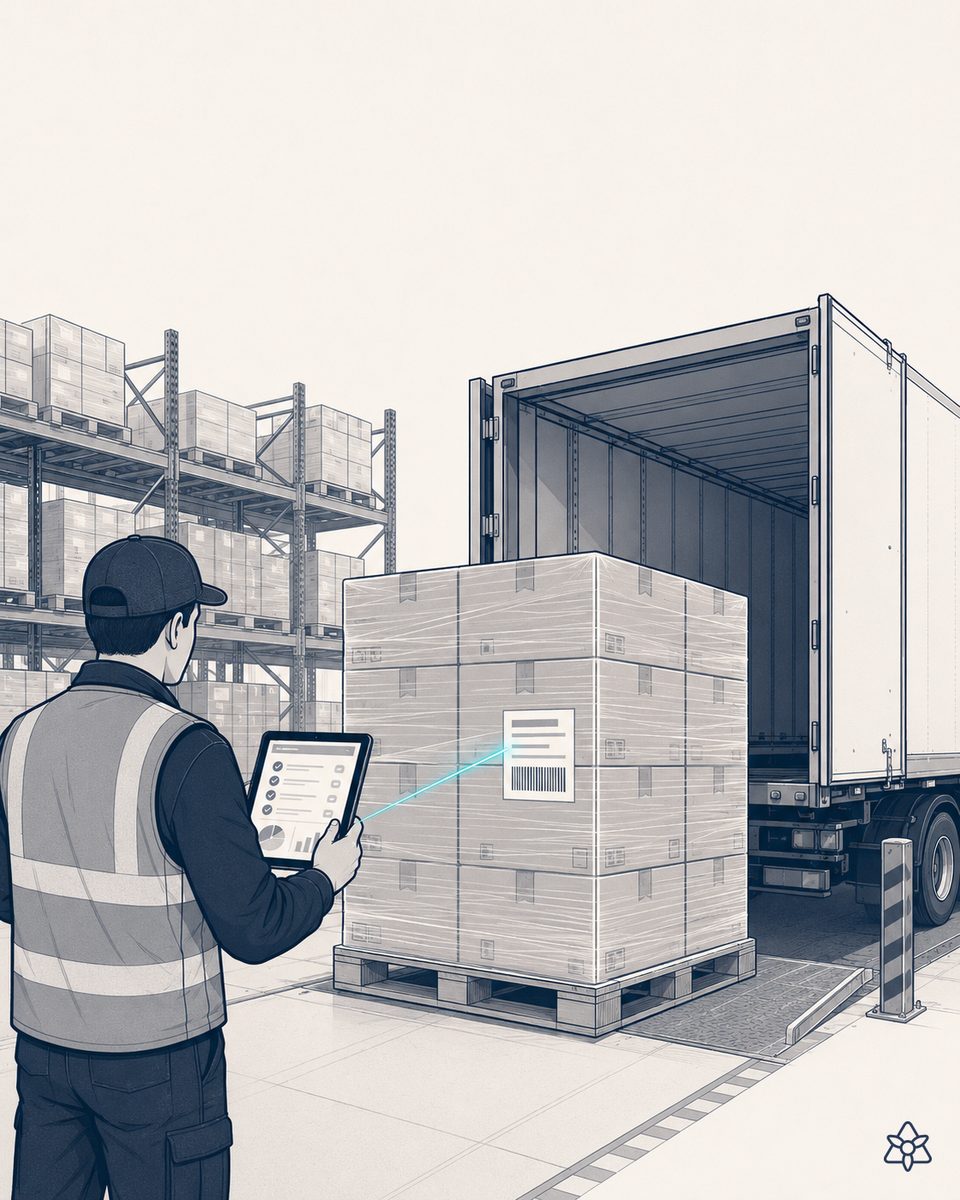
One sorter, dozens of senders, a single classic scanner.
The 3PL logistics operator is heterogeneous by definition: on the same sorter induction belt, parcels mix from sources that never spoke to each other. On every shift the belt brings you:
- Marketplace boxes with a large, clean barcode — the classic scanner is calibrated for this.
- Padded envelopes with a QR stuck over another label, folded at the corner or scratched by transport friction.
- Industrial packages with the original supplier's typographic label, sometimes with handwritten text from the operator who adjusted the destination at the last minute.
- Cross-border parcels with labels in Mandarin, Arabic or Cyrillic that the classic scanner does not understand, and an operator has to open and look up.
The classic scanner is calibrated for one format. When another arrives, it fires a "no read" and the parcel drops to the manual reject lane. And the manual reject is the bottleneck that never shows on the sorter's dashboard — because the sorter counted it as "processed and diverted". It shows on the night shift's payroll, on the SLA with the day's last customer, and in the importer's claim when a package arrives 24 hours late. The classic system works 96% of the time. That 4% is a soft cost that weighs more than the sorter.
iLEAN does not add a fourth scanner — it seals the cracks between the formats already passing on the belt.
The "no read" problem in 3PL is not about optics: it is about heterogeneity. Each format lives on an island because each of the 3PL's customers printed the label however they could, and nobody is going to standardise the world's parcels. iLEAN acts as the filler that closes that gap: it reads every format at once with a single camera and decides at the sorter's pace, without asking you to change sorter or WMS.
Edge sees the three formats at once at induction. Connect cross-checks with the WMS and the customer's latest emailed instruction. The agent decides the destination and generates a reject dossier when needed. The person signs off — the sorter never restarts on its own in the reject flow.
The three iLEAN pieces applied to multi-format reading on a 3PL sorter:
- Edge — a terminal with a multi-head CNN over the sorter's induction. Three parallel pipelines (1D, 2D, OCR), local fusion, a destination decision to the sorter's PLC by dry contact or OPC-UA in milliseconds. It generates a reject dossier when no format passes the confidence threshold. It works with no network: if the plant loses its WiFi, Edge keeps reading and deciding.
- Connect — captures the 3PL customer's latest instructions: an address change by email, an order hold by WhatsApp, an importer's new rule for a country. It brings them into the system at second zero, without anyone forwarding anything. When an exception arrives by message, the agent cross-checks it with the parcel on the belt.
- Agent — fuses Edge's three readings with the WMS, Connect's exceptions and the sender's history. It decides the destination or, if nothing adds up, holds the parcel at the assisted reject lane with the dossier open on the operator's tablet. The person signs the parcel's destination; the sorter never restarts on its own in that flow.
Classic scanner vs. multi-format iLEAN Vision.
| Aspect | Classic scanner + manual reject | With iLEAN Vision (Edge + Connect + Agent) |
|---|---|---|
| Formats supported at once | One (sometimes two) | 1D, 2D and OCR in parallel — local fusion |
| Scratched or folded codes | "No read" → reject | CNN trained on real samples — reads if there is signal |
| Multi-language / handwritten labels | Automatic reject | Multilingual OCR + anchored LLM interpretation |
| Customer's last-minute exception | Arrives by email, nobody reads it in time | Connect captures it; the agent cross-checks it with the parcel |
| Reject lane | Parcel + printed slip with the time | Dossier with photo, per-pipeline decision, confidence |
| Final destination decision | Operator interprets without context | Operator signs over a prepared dossier |
| No network | Sorter stopped / local scanner | Edge keeps reading and deciding locally |
Impact estimate for your plant — to be validated with your numbers.
The block below is an estimate to be validated with the specific figures of your plant. We set it out so the committee has an order of magnitude; we refine it during the diagnostic.
- 3PL logistics operator with a cross-belt or tilt-tray sorter, volume in the order of tens of thousands of parcels per hour, a heterogeneous customer mix (marketplace + traditional retailer + industrial B2B).
- Edge pilot on one sorter induction (high-speed IP camera + actuator / OPC-UA signal to the PLC + integration with the WMS). First expected value within a few weeks.
- Expected no-read rate reduction of ≥ 30% over the baseline, depending on the initial heterogeneity and the state of the classic scanner.
- Indicative payback between 4 and 9 months, depending on volume, the cost of a rejects operator on your shift and the end customer's SLA penalty.
- The hard lever is the manual-reject bottleneck: every recovered percentage point of no-read is one fewer operator on the lane or one more SLA met for the day's customer.
And the IT manager's reasonable doubt
"What if the AI gets it wrong and sends a parcel to the wrong destination?" — hallucination is a problem of free generation, not of anchored tasks. In tasks where the AI extracts a data point from an image and compares it with a reference (reading a code and mapping it to the WMS destination), the best models brought the error below 1.5% [1]. And even so, when the confidence threshold is not reached, iLEAN holds the parcel at the assisted lane and the operator signs the destination. The three safety rings are there for exactly this.
[1] OpenAI paper "Why Language Models Hallucinate", 2025 — on the reliability of AI in anchored tasks.
What people ask about multi-format reading on 3PL sorters with AI
Why isn't a classic scanner enough for a 3PL sorter?
A 3PL sorter sees parcels from dozens of different senders on the same belt: marketplace boxes with barcodes, padded envelopes with marketplace QR codes, industrial packages with typographic labels and handwritten text, cross-border parcels with Mandarin-script labels. A classic scanner is calibrated for one format; when another comes along, it fires a "no read" and the parcel drops to the manual reject lane. In 3PL that manual reject is the bottleneck that never shows on the sorter manufacturer's dashboard — but does show on the night shift's payroll.
How does the AI read barcode, QR and text at once without choosing?
iLEAN Vision runs a multi-head CNN on the Edge terminal over the sorter's induction belt: the same image feeds three decoding pipelines in parallel — 1D (barcode), 2D (QR/Data Matrix), OCR (printed and handwritten text) — and a local agent fuses the three readings into a single destination decision. The system does not choose a format: it reads all three and keeps the most reliable. If the barcode is scratched but the QR is clean, it goes by QR; if both fail, it reads the OCR of the recipient's name. The parcel continues on its way.
What does iLEAN do when no format is readable?
On a classic sorter, a "no read" is a reject to the manual lane with no context. The rejects operator receives a parcel and a printed slip with the time of the reject — they have to reconstruct what happened themselves. iLEAN Vision generates an automatic reject dossier for every parcel: a high-resolution photo of the label, the position on the belt, the decision of each of the three pipelines, a confidence score, the previous and next parcel. The operator opens the dossier on the tablet and decides in seconds, not minutes. The person signs the destination; the sorter never restarts on its own in that flow.
How does it integrate with the WMS without stopping the belt?
iLEAN Vision does not get into the sorter's control loop — it lives alongside it. It reads the parcel at induction, decides the destination, and returns the decision to the sorter's PLC by dry contact, OPC-UA or whichever protocol your MHE uses. The integration with the WMS is via signed file drop between rings: the data crosses to the WMS validated, without opening a door into the OT network. If the AI goes down, the sorter continues (falls back to the classic scanner); if the sorter goes down, the AI keeps recording the parcel line. It works with no network: Edge keeps reading and deciding even if the plant loses the corporate WiFi.
How much does an AI vision system reduce manual rejects in 3PL?
Manual rejects on a typical 3PL sorter range between 2% and 8% of the volume, depending on the parcels' heterogeneity and the sorter's age. An expected reduction of 30%-60% of the manual reject is a reasonable starting order of magnitude (estimate to be validated with your numbers): every percentage point less is one fewer night operator on the reject lane and one fewer parcel arriving late to the end customer. Send us your real volume and your current no-read rate, and we will send back the estimated ROI within 48h with your numbers.
More cases in ilean vision
- Pallet lot counting — the error that travels to the truck comes back as a return and a claim.iLEAN Vision counts and identifies the lots on every outbound pallet and validates them against the…
- Manual malt bag loading at the brewery — the back injury gives no warning, it arrives in week four.iLEAN Vision detects badly executed malt bag lifts at the brewery silo and assists the operator at…
- Defects on melamine board — the scratch you see after the cut is a good part thrown away.iLEAN Vision detects scratches, pores and stains on melamine board before cutting and packing in a…
- O-ring verification in hydraulic assembly with AI — a twisted seal is not rework, it is a leak at the customer.iLEAN Vision verifies the presence and correct orientation of O-rings in hydraulic cylinders before…
- An aisle crossing 1.5 m from the AGV — and the safety stop arrives just in time.iLEAN Vision detects obstacles and operators in AGV/AMR aisles and stops the fleet before impact. An…
- OCR of DOM/EXP on curved cosmetic packaging with AI — the blurry character reaches the shelf, and comes back as a claim.How iLEAN Vision reads DOM/EXP on curved plastic cosmetic packaging with low legibility — cross-checked…
Tell us your case and within 48h we will send you the estimated ROI of this AI project for your 3PL sorter.
We work on your plant's real data, not on ours. Diagnostic with no commitment.
Request estimated ROI in 48h See iLEAN Vision