Pallet lot counting — the error that travels to the truck comes back as a return and a claim.
The last metre between the palletising area and the dock is where the most expensive errors slip through: a lot-B case slipped into a lot-A pallet, one unit short, the wrong destination. iLEAN Vision counts and identifies the lots present on the pallet, cross-checks them against the shipping slip and, if it does not add up, holds the pallet at the dock. The dispatch person signs off — the truck is never loaded on its own.
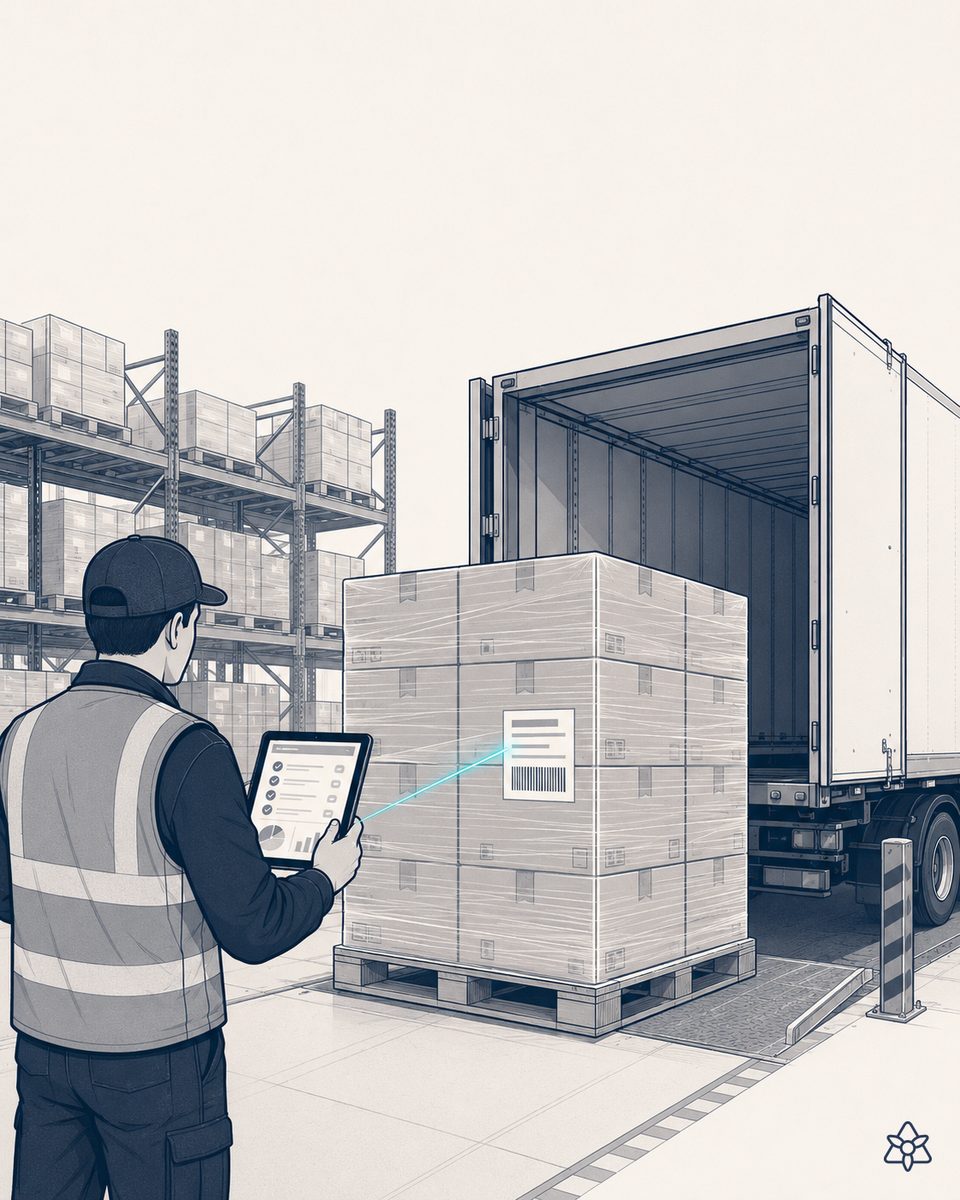
The last metre of the process is the least checked and the one that costs the most.
Between the palletising area and the truck loading dock there are three realities that should add up — and that are almost never in the same system at the critical moment:
- What is actually on the pallet. How many cases, of which lot, with which reference. What a camera would see if someone put one there.
- What the shipping slip asks for. The customer's destination, the lot-and-reference combination they ordered, the retailer's conditions (single lot, no mixing, FEFO).
- What the forklift operator does. They take the pallet from strapping to the dock, place it at dock X, and if dock X was assigned to another customer, the pallet goes into the wrong truck.
The logistics manager knows this, but at 30 pallets/hour at peak time they cannot check every one against the shipping slip list. The classic system (SSCC scanner + paper list + operator's eye) works 99% of the time. That 1% is the customer return — hard reverse-transport cost, a formal claim, and in sectors with strict traceability (food, pharma, automotive), an alert that escalates.
iLEAN does not replace the dock supervisor — it gives them a pair of eyes on the outbound portal that never blink.
The problem with lot counting is not a lack of systems: the ERP has the shipping slip, the WMS has the location, the scanner has the SSCC. But those three systems do not talk to each other at second zero at the dock portal. iLEAN is the filler that closes that gap with a set of eyes exactly where the error slips through.
Vision reads the pallet at the outbound portal. Connect cross-checks with the shipping slip and the WMS. The agent holds the pallet and alerts the dock supervisor. The person signs off — the truck does not.
The three iLEAN pieces applied to lot counting and validation against the shipping slip:
- iLEAN Vision (Edge) — a terminal with machine vision over the dock's outbound portal, with an OCR camera to read lot labels and a geometric-count camera for cases per layer. It processes the image locally, identifies the lots present and counts units. It works with no network: if the dock loses its WiFi, Edge keeps reading and recording.
- iLEAN Connect — reads the shipping slip and the dispatch order from the ERP, the location from the WMS, and captures what comes from outside: the carrier's email confirming the route, the customer's WhatsApp changing the ordered quantity, the salesperson's call asking to prioritise an order. Everything comes in at second zero.
- iLEAN Agents — cross-checks what Vision sees with what the shipping slip asks for and proposes: "pallet 3478 holds 48 cases of lot A and 12 of lot B, the shipping slip asks for 60 of lot A — we hold it". It never loads on its own. It proposes, the dock supervisor validates, signs the correction, and the truck leaves with the right load. And it files the photographic dossier per pallet in case a claim arrives months later.
Manual counting vs. visual validation with iLEAN Vision
| Aspect | Scanner + list + operator's eye | With iLEAN Vision + Connect + Agent |
|---|---|---|
| Validation coverage | The pallet's SSCC, not its content | Count and OCR of every case visible on the pallet |
| Lot-mixing detection | When the customer returns it | At the dock portal, before loading |
| Loading at the wrong dock | The operator corrects it if they notice | The agent holds it before it goes on the truck |
| Traceability for a claim | Reconstructed by hand from scanners | A photo of every pallet with its content read |
| Operation with no network | n/a | Edge keeps reading on cabinet power |
| File for the IFS/BRC/IATF auditor | Reconstructed across systems | Dossier per pallet, automatic |
Impact estimate for your plant — to be validated with your numbers.
The block below is an estimate to be validated with the specific figures of your plant. We set it out so the committee has an order of magnitude; we refine it during the diagnostic.
- Dispatch centre with 4-6 docks, frequent multi-lot pallets, a mix of customers with strict traceability (food, pharma, automotive). A documented history of returns for lot mixing in the last financial year.
- Edge pilot over one dock portal, with OCR camera + lighting + connection to the ERP. First expected value within a few weeks: pallets scanned before they go on the truck, first discrepancy alert.
- A reasonable reduction in returns for dispatch errors of ≥ 30% in the first quarter, for the simple reason that the error is caught at the dock and not at the customer.
- Indicative payback between 3 and 9 months, depending on the current cost of returns, claims and traceability-reconstruction hours. A single avoided alert in a regulated sector pays for the pilot.
And the logistics director's reasonable doubt
"What if the camera misreads a label and holds a pallet that was correct?" — hallucination is a problem of free generation, not of anchored tasks. In tasks where the AI does OCR on a printed label and compares it with a shipping slip, the best models brought the error below 1.5% [1]. And even so, what is critical is never decided alone: iLEAN holds the pallet and the person signs the closure — if the data was correct, the dock supervisor releases it in seconds. The three safety rings are there for exactly this.
[1] OpenAI paper "Why Language Models Hallucinate", 2025 — on the reliability of AI in anchored tasks.
What people ask about pallet lot counting and shipping slip validation
How does iLEAN count the lots on a pallet without a homogeneous SSCC label?
iLEAN Vision combines two readings: the OCR of every case or lot label visible on the pallet (printed codes, dates, lot number) and the geometric count of cases per layer (how many cases on the visible face × pallet layers). It cross-checks both against the ERP dispatch order and returns one fact: "this pallet holds 48 cases of lot A and 12 of lot B; the shipping slip asks for 60 of lot A". The dock person sees the alert before the forklift moves the pallet to the truck.
What happens if the pallet is wrapped in translucent film?
Clear translucent film lets the camera read the OCR of most labels, especially with well-aimed lighting — the embedded engineer studies the angle during the pilot. For pallets with opaque film, or cases with no label visible on the face, iLEAN Vision reads at the moment of strapping or palletising, before the film goes on, and records the pallet's content at that instant with a photo that travels with the pallet ID all the way to dispatch.
Does it integrate with the ERP and the warehouse management system?
Yes. iLEAN Connect reads the shipping slip and the dispatch order from the ERP or the WMS — whichever system you have — and puts them within the agent's reach. The agent cross-checks the Vision reading (what is on the pallet) with the ERP data (what should be there) and, if it does not add up, holds the pallet at the dock and alerts the logistics manager before the truck is loaded. It never moves the shipping slip on its own. It proposes, the person signs off.
And returns for lot mixing — do they really cost that much?
A return for lot mixing is not just the cost of reverse transport and restocked product — it is the complaint of a customer who had already scheduled production with your lot A and finds two lots mixed, which breaks their traceability. In sectors like food, pharma or automotive this can escalate to a formal RASFF notification, an alert or a penalty. Every return is hard logistics cost + hard brand cost + quality hours lost reconstructing by hand what happened.
How long until it delivers first value at a dispatch dock?
An Edge pilot at the dock can deliver first value within a few weeks: pallets scanned before the truck is loaded, first alert of a discrepancy between actual content and shipping slip, a photographic dossier per pallet. Indicative payback between 3 and 9 months depending on your current frequency of returns for dispatch errors — estimate to be validated with your real logistics data.
More cases in ilean vision
- Injecting aluminum over the wrong die, or over a cavity outside the thermal window — and finding out at ejection.iLEAN Vision confirms the correct die and its visual thermal state before injecting aluminum in…
- A person inside the laser cell — and the perimeter scanner arrives just in time.iLEAN Vision detects human presence inside a robotic laser welding cell and stops the equipment. An…
- Leaflet verification in pharma cartons with AI — a carton without a leaflet is not an incident, it is a GMP deviation.iLEAN Vision detects a pharma carton without its leaflet before sealing to avoid GMP incidents on the…
- Manual malt bag loading at the brewery — the back injury gives no warning, it arrives in week four.iLEAN Vision detects badly executed malt bag lifts at the brewery silo and assists the operator at…
- Defects on melamine board — the scratch you see after the cut is a good part thrown away.iLEAN Vision detects scratches, pores and stains on melamine board before cutting and packing in a…
- Multi-format reading on a 3PL sorter with AI — a "no read" is not a lost parcel, it is one more night operator.iLEAN Vision reads barcode, QR and text at once on a 3PL logistics operator's sorter — without slowing…
Tell us your case and within 48h we will send you the estimated ROI of this AI project for your dispatch dock.
We work on your plant's real data, not on ours. Diagnostic with no commitment.
Request estimated ROI in 48h See iLEAN Vision