Injecting aluminum over the wrong die, or over a cavity outside the thermal window — and finding out at ejection.
In HPDC the die change and the start-up are the two most expensive moments: an injection over a crossed die or a badly tempered cavity translates into a lost shot, structural-part scrap and, in the worst case, irreversible die damage. iLEAN Vision confirms the mounted die and its visual thermal state before injecting. The person signs off.
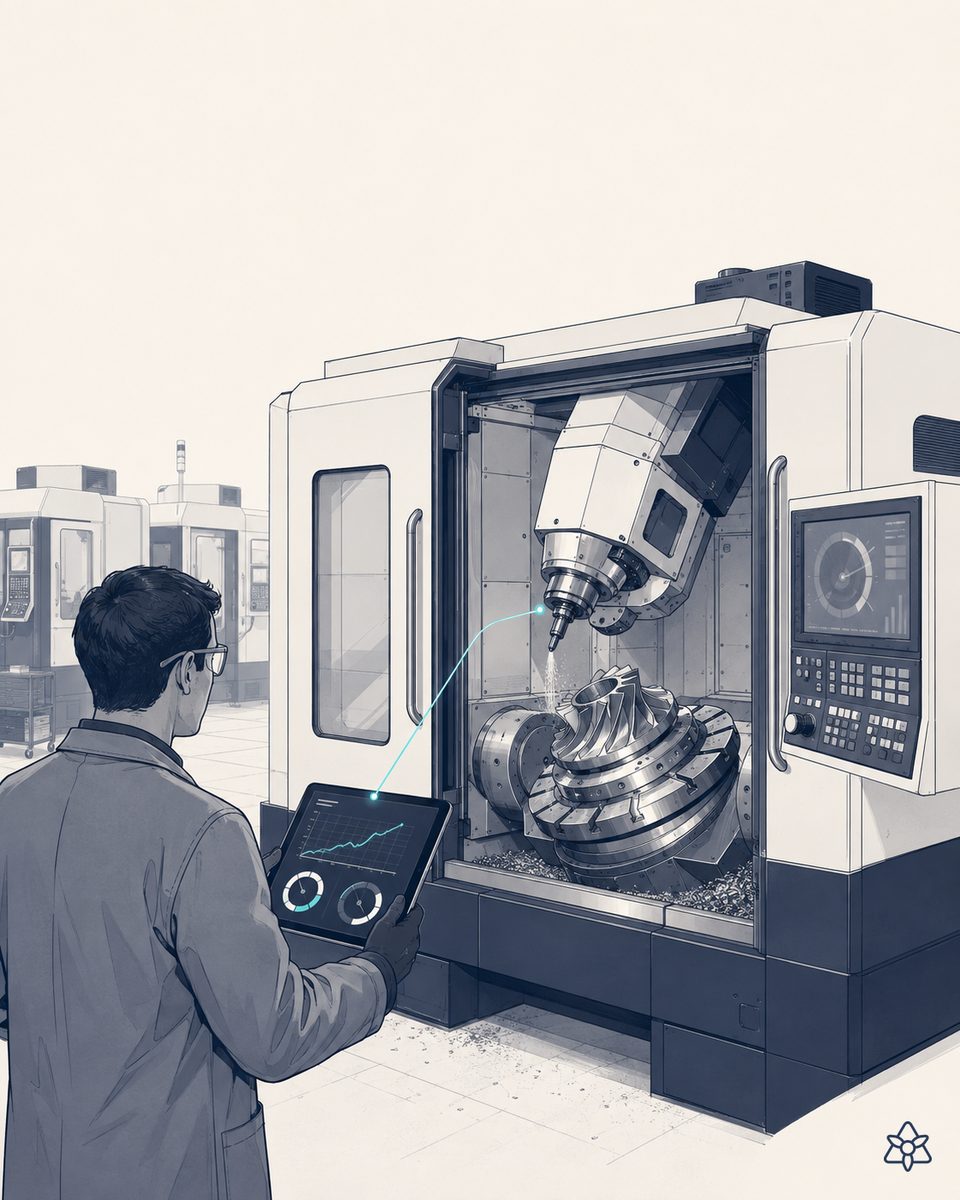
HPDC: the cost of getting it wrong before injecting is brutal.
Validating a well-executed HPDC start-up crosses four realities that are rarely on the same table at once:
- Which part is due to be cast — the MES order with its drawing revision and its assigned aluminum lot.
- Which die is actually mounted — several structural-housing dies look alike, sand cores are stored on adjacent shelves, and a night change is exactly when a similar core gets crossed.
- What thermal state the cavity is in — the die is tempered by internal circuits and sprayed with release agent. The thermocouple says one number; the spatial map is another story.
- What the data sheet demands — temperature window per zone, injection pressure, first-stage speed, the cores' position. The ERP, a vertical MES or the tooling spreadsheet.
The shift leader knows this, but cannot be reading the thermocouple, checking the core and comparing the cavity with the data sheet all at the same time. The machine injects if the clamps are fine — it does not know whether it has the right cavity at the right temperature. The first warning, if something is wrong, is the part at ejection: guaranteed scrap, or a damaged die.
iLEAN does not add another system — it seals the crack between the order, the data sheet, the thermocouple and the real cavity.
The HPDC start-up problem is not a lack of information: it is information living in islands that, at the critical moment (the first injection after the change), does not reach the person deciding in time. iLEAN acts as the filler that closes that gap, without asking you to change the MES, the ERP or the die management system you already have.
Edge sees the die and the cavity. Connect reads the order, the data sheet and the thermocouple, wherever they come from. The agent cross-checks, and if something does not add up, holds the injection. The person signs off — never the other way round.
The three iLEAN pieces applied to HPDC die verification:
- Edge — a terminal with machine vision (CNN) facing the half-open die. It reads the plate, the engravings, the cavity's geometry, the gas vents, the cores' position. With an optional thermal camera, it builds a spatial temperature map of the cavity and compares it against the expected window. If something does not add up, it triggers the actuator (dry contact with the cycle, light signal, panel notice). It works with no network.
- Connect — captures the MES order, the die's data sheet, the machine's thermocouples and the furnace's aluminum recipe. It also picks up external notices (the customer's email with a revision change, the furnace's report of a heat anomaly).
- Agent — cross-checks order + data sheet + thermocouple + vision + furnace recipe. If the geometry does not fit, it holds; if the thermocouples say OK but the visual map says cold in the critical zone, it holds too. A dossier with a photo and the thermal map for the shift leader.
HPDC start-up with a checklist vs. cross-checked start-up with iLEAN Vision
| Aspect | Manual start-up + checklist | With iLEAN Edge + Connect + Agent |
|---|---|---|
| Source of the expected reference | Shift leader checks the order and the data sheet | Order + data sheet + thermocouple + vision cross-checked |
| Die confirmation | The operator's eye and the plate | The CNN compares cavity, gas vents, geometry |
| Sand-core confirmation | "It's the same one as last time" | Model and orientation verified before closing |
| The cavity's thermal state | Point thermocouples | Spatial map cross-checked with thermocouples + data sheet |
| Operation with no network | n/a | Edge keeps operating on cabinet power |
| IATF 16949 file | Reconstructed by hand | Dossier per order, with photo and thermal map |
Impact estimate for your plant — to be validated with your numbers.
The block below is an estimate to be validated with the specific figures of your plant. We set it out so the committee has an order of magnitude; we refine it during the diagnostic.
- HPDC plant with 2-5 machines of 1,500-4,500 t for structural parts (housings, mounts, arms), multi-customer OEM/Tier-1, with external sand cores.
- Edge pilot on the machine with the most expensive die (visible camera + optional thermal + integration with the MES and die management). First expected value within a few weeks.
- Indicative payback between 4 and 9 months, depending on the frequency of crossed-die or cold-start incidents and the average cost of a lost shot at your plant.
- Expected reduction in scrap from incorrect start-ups: ≥ 30% versus the baseline. A single avoided structural-die failure pays for the pilot. Automotive quality demands the order of 25 PPM [2]; a structural housing rejected at the customer weighs far more.
And the foundry manager's reasonable doubt
"What if the AI confuses two similar cavities and lets a bad injection through?" — hallucination is a problem of free generation, not of anchored tasks. In tasks where the AI simply compares what it sees with a specific die data sheet and an expected thermal map, the best models brought the error below 1.5% [1]. And even so, what is critical is never decided alone: iLEAN holds the injection and the person signs off. The three safety rings are there for exactly this.
[1] OpenAI paper "Why Language Models Hallucinate", 2025 — on the reliability of AI in anchored tasks.
[2] Automotive quality standard in the order of 25 PPM — Symestic.
What people ask about HPDC die verification
How does iLEAN Vision confirm that the mounted HPDC die is the right one before injection?
Edge is a terminal with machine vision (CNN) facing the HPDC machine with the die half-open. It reads the identification plate, the engravings, the cavity's geometry, the gas vents and the cores' position, cross-checks them with the production order and the die's data sheet, and confirms that the expected reference of the structural part to be cast matches (gearbox housing, engine mount, dome, etc.). If it does not add up, it holds the injection and alerts the shift leader. The person signs off.
What does visual thermal state mean and why does it matter before injecting aluminum?
In HPDC, the die is tempered by internal circuits before every start-up and sprayed with release agent between shots. If the die is too cold in a critical zone, incomplete filling and porosity result; if it is too hot, the aluminum solders to the die and drags. iLEAN Vision reads, with a thermal camera (or visible with calibrated lighting), the cavity's visual temperature pattern and compares it against the expected window for that reference. It does not replace the thermocouples — it complements them with a spatial map that no point sensor can give.
Does it work with sand-core cells and lost cores?
Yes. In HPDC with sand cores the risk is mounting another reference's core with a similar geometry, or mounting the right reference's core with the orientation turned. Vision confirms the core's model and orientation before the die closes. If the cores' layout is not the expected one, it holds the cycle — because injecting aluminum over a crossed core is guaranteed scrap and, at times, damage to the die.
Does it integrate with the MES, the die management system and the machine's thermocouples?
Yes, through iLEAN Connect. It captures the MES order, the die's data sheet (the ERP, a vertical MES or the tooling manager's file), the machine's thermocouples and the furnace's aluminum recipe. If the data do not add up with each other, the agent holds the injection and leaves a dossier with a photo of the die and the thermal map for the shift leader. It does not force you to change anything in the system you already have.
How much does a pilot cost in an HPDC foundry plant?
The order of magnitude of an Edge pilot in an HPDC cell is close to that of any Edge pilot in a plant: an initial investment covering the terminal, a visible camera + thermal option, integration with the MES/die management and training, plus an annual licence. The reasonable payback to present to the committee is a matter of a few months — the hard lever is a single lost shot or one avoided die failure. Send us your plant's data and we will send back the estimated ROI within 48h, with your numbers.
More cases in ilean vision
- Galvanized sheet for white goods with AI — the defect shows on the coil, not on the washing machine.iLEAN Vision reads the galvanized coil before cutting and holds the part when scratches, pores or stains…
- High-throughput GS1-128 in meat with AI — over 200 cases per minute without the belt stopping to read.iLEAN Vision reads GS1-128 labels at over 200 cases per minute in the dispatch area of a meat cutting…
- Hot-rolled bar for oil & gas pipe with AI — the tear shows on the bar, not in the well.iLEAN Vision detects cracks, laps and tears in hot-rolled bar destined for seamless oil and gas pipe —…
- A person inside the laser cell — and the perimeter scanner arrives just in time.iLEAN Vision detects human presence inside a robotic laser welding cell and stops the equipment. An…
- Leaflet verification in pharma cartons with AI — a carton without a leaflet is not an incident, it is a GMP deviation.iLEAN Vision detects a pharma carton without its leaflet before sealing to avoid GMP incidents on the…
- Pallet lot counting — the error that travels to the truck comes back as a return and a claim.iLEAN Vision counts and identifies the lots on every outbound pallet and validates them against the…
Tell us your case and within 48h we will send you the estimated ROI of this AI project for your HPDC.
We work on your plant's real data, not on ours. Diagnostic with no commitment.
Request estimated ROI in 48h See iLEAN Vision