High-throughput GS1-128 in meat with AI — over 200 cases per minute without the belt stopping to read.
The dispatch area of a meat cutting plant passes over 200 cases/min with a GS1-128 label (lot, variable weight, date, SSCC) — and cheap laser readers fail on wet, wrinkled or badly placed labels. iLEAN Vision reads the GS1-128 with a matrix camera + neural network, closes the dispatch dossier and leaves the diversion of the doubtful case in the operator's hands. The person signs off.
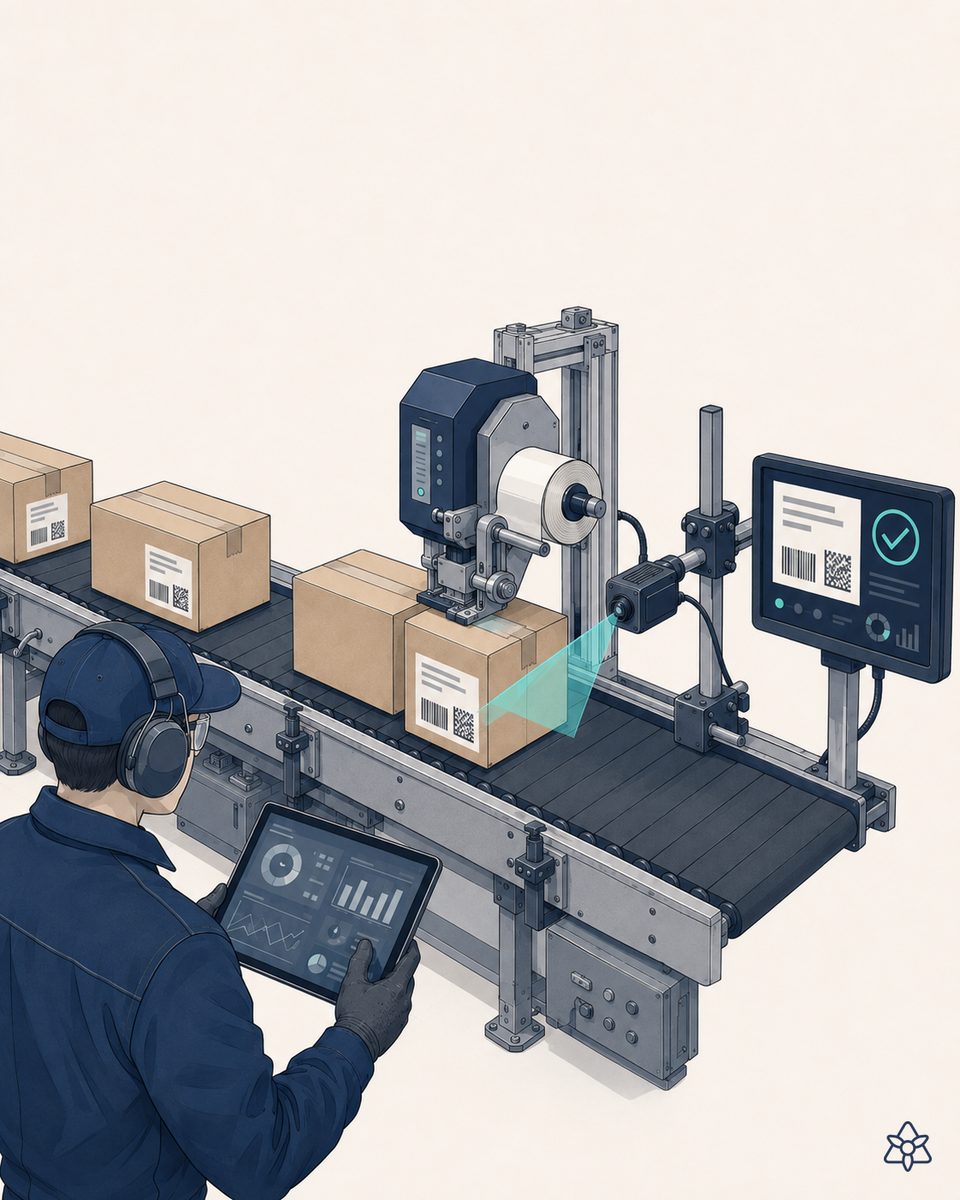
The belt cannot stop to read — and misreading is a returned pallet or an incomplete recall dossier.
The dispatch area of a meat cutting plant moves cases at sustained speed — in the order of over 200 cases/min at peak hours. Every case carries a GS1-128 label with variable weight, lot, use-by date and SSCC. The reading has to be clean: if it fails, the belt stops or the case is left unassigned to a pallet, and downstream the customer returns the SSCC.
- The label arrives wet from the cold room, wrinkled or slightly skewed. The cheap laser reader cannot resolve it.
- The variable weight changes per case. The reader has to read the AI 3103/3203 field case by case, assuming nothing.
- A wrong SSCC is a rejected pallet. The customer returns it and, worse, the lot-recall dossier before the food-safety authority (AESAN/RASFF) is left incomplete.
The classic system works 99% of the time. The 1% is the case that stops the belt or the pallet that comes back from the customer.
iLEAN Vision seals the crack between labelling, dispatch and the WMS — it adds no system, it fills the gaps.
High-throughput GS1-128 reading in meat does not fail for lack of laser technology: it fails because of the plant's real conditions (humidity, wrinkles, position) and because the lot, pallet and destination data live in different systems. iLEAN acts as the filler that closes that gap without asking you to change the WMS or the labeller.
Edge sees the label at belt speed. Connect reads the shipping slip, the pallet's SSCC and the customer's destination. The agent cross-checks reading, variable weight and SSCC — and diverts the doubtful case. The person signs the correction.
The three iLEAN pieces applied to GS1-128 reading in meat dispatch:
- Edge — a terminal with machine vision (CNN) over the dispatch belt. A high-resolution matrix camera, humidity-resistant directed lighting and a neural network trained on GS1-128 in real meat conditions (folds, droplets, tilted labels). If the first reading is not clean, a second camera downstream or the agent closes the field. It works with no network: as long as the cabinet has power, reading and recording continue.
- Connect — captures the shipping slip, the SSCC and the destination whether they come from the WMS, the ERP or the customer's email with the latest order. And it also captures what arrives from outside (a lot-recall instruction, an importer's requirement) at second zero.
- Agent — cross-checks the GS1-128 reading with the shipping slip, validates the coherence of weight and SSCC, and diverts the doubtful case to an assistance lane. When a recall applies, it prepares the lot dossier with photos of the affected labels and SSCCs. The person validates and signs — the main belt does not stop.
Cheap laser reader vs. GS1-128 reading with iLEAN Vision
| Aspect | Laser reader + handheld scanner | With iLEAN Vision + Connect + Agent |
|---|---|---|
| Clean-read rate | Drops with humidity/wrinkles/position | Matrix camera + CNN trained in real conditions |
| Sustainable throughput | Belt stops at every failure | 200+ cases/min without stopping the main line |
| Doubtful case | Manual picking, scanner handed to the operator | Secondary lane with image + AI proposal |
| AESAN/RASFF recall dossier | Manual lot reconstruction | Lot dossier with label photo + SSCC |
| Operation with no network | n/a | Edge keeps operating on cabinet power |
| Pallet → customer traceability | Shipping slip and the operator's memory | SSCC closed by the agent and signed by the person |
Impact estimate for your plant — to be validated with your numbers.
The block below is an estimate to be validated with the specific figures of your plant. We set it out so the committee has an order of magnitude; we refine it during the diagnostic.
- Meat plant with a cutting room, variable-weight labelling and dispatch with a palletising belt.
- Edge pilot over the dispatch belt (matrix camera + lighting + assistance lane + integration with WMS/ERP). First expected value within a few weeks.
- Reduction in cases stopped by failed readings + pallets rejected for wrong SSCCs: ≥ 30% as a defensible floor.
- Indicative payback between 4 and 9 months, depending on the documented frequency of belt stops, returned pallets and recall dossiers managed per year.
- The hard lever is threefold: a belt that does not stop, a pallet that does not come back, a complete recall dossier.
And the quality manager's reasonable doubt
"What if the AI misreads a variable weight and sends the shipping slip out wrong?" — hallucination is a problem of free generation, not of anchored tasks. GS1-128 reading is precisely an anchored task: reading a code, recontextualising it into a shipping-slip field. In this kind of task the best models brought the error below 1.5% [1]. And even so, what is critical is never decided alone: when the reading is not clean, iLEAN diverts the case to the assistance lane and the person signs off. The three safety rings are there for exactly this.
[1] OpenAI paper "Why Language Models Hallucinate", 2025 — on the reliability of AI in anchored tasks such as OCR/code reading.
What people ask about high-throughput GS1-128 reading in meat
What does a GS1-128 label encode on a meat cutting case?
The GS1-128 label of a cutting case encodes at least: the product's GTIN (AI 01), the variable weight in kg (AI 3103 or 3203 with three decimals), the lot (AI 10), the use-by date (AI 17) and the pallet's SSCC (AI 00) when it applies. In meat, the variable weight is what breaks cheap laser readers: the field changes case by case, and every reading error is a shipping slip that does not add up or a pallet that gets returned.
Why do cheap laser readers fail at high throughput in meat plants?
Three physical reasons: the wet or wrinkled label from the cold room reflects the laser beam poorly; the dispatch belt speed (over 200 cases/min) leaves the reader with less time than it needs for verification; and the label's position on the case is not always the expected one when the operator dispatched in a hurry. The consequence is the same: failed readings, a stopped belt, manual picking with a scanner, an incomplete dispatch dossier. iLEAN Vision solves it with a matrix camera + a neural network trained for GS1-128 in real meat-plant conditions, not laboratory ones.
How does iLEAN Vision read over 200 cases per minute without stopping the belt?
iLEAN Edge combines a high-resolution matrix camera, directed lighting resistant to the cold room's humidity and a neural network trained on real GS1-128 labels — with folds, droplets and imperfect positions. If the camera does not resolve the code on the first pass, a second camera downstream or an agent that infers the field from the image and cross-checks it with the shipping slip closes the reading without the belt having to stop. It works with no network: if the plant loses its WiFi, Edge keeps reading and queues the records for Central when the connection returns.
What happens to cases that do not get a clean reading?
Those cases are diverted to a secondary lane with operator assistance: Edge shows the label's image on screen and proposes the most likely reading; the operator confirms with one click or corrects the field in question. The agent closes the pallet's SSCC with the validated reading and notifies dispatch. The main line does not stop, and the decision is signed — this matters especially when the label is the basis of the lot-recall dossier before the food-safety authority (AESAN/RASFF).
What payback is reasonable to expect in a meat cutting plant?
In a meat cutting plant, the belt stops from failed readings + the cost of the pallet returned for a wrong SSCC + the recall risk from an incomplete dossier weigh far more than the pilot's investment. The order of magnitude covers matrix cameras, lighting, terminals and the integration with the WMS and the ERP. The reasonable payback to present to the committee sits between several months and a year, and the hard lever is eliminating the queue of stopped cases + reducing pallets rejected by the customer. Send us your plant's data and we will send back the estimated ROI within 48h.
More cases in ilean vision
- Starting the press with the wrong die — and finding out with the first broken stroke.iLEAN Vision recognises the die installed in an automotive stamping press and blocks start-up with the…
- Float glass for automotive with AI — the inclusion shows on the table, not in the furnace.iLEAN Vision detects inclusions, bubbles and scratches in float glass before tempering for automotive…
- Galvanized sheet for white goods with AI — the defect shows on the coil, not on the washing machine.iLEAN Vision reads the galvanized coil before cutting and holds the part when scratches, pores or stains…
- Hot-rolled bar for oil & gas pipe with AI — the tear shows on the bar, not in the well.iLEAN Vision detects cracks, laps and tears in hot-rolled bar destined for seamless oil and gas pipe —…
- Injecting aluminum over the wrong die, or over a cavity outside the thermal window — and finding out at ejection.iLEAN Vision confirms the correct die and its visual thermal state before injecting aluminum in…
- A person inside the laser cell — and the perimeter scanner arrives just in time.iLEAN Vision detects human presence inside a robotic laser welding cell and stops the equipment. An…
Tell us your case and within 48h we will send you the estimated ROI of this AI project for your meat plant.
We work on your plant's real data, not on ours. Diagnostic with no commitment.
Request estimated ROI in 48h See iLEAN Vision