A person inside the laser cell — and the perimeter scanner arrives just in time.
In a robotic laser welding cell, the perimeter scanners and interlocks are the first layer — SIL/PL-certified and essential. But the scariest incidents happen when someone slips in through a blind zone or enters before the cell has finished its stop. iLEAN Vision adds an overhead layer with a CNN that recognises the human silhouette in the protected zone and sends the stop order before impact. In line with ISO 10218 and ISO/TS 15066.
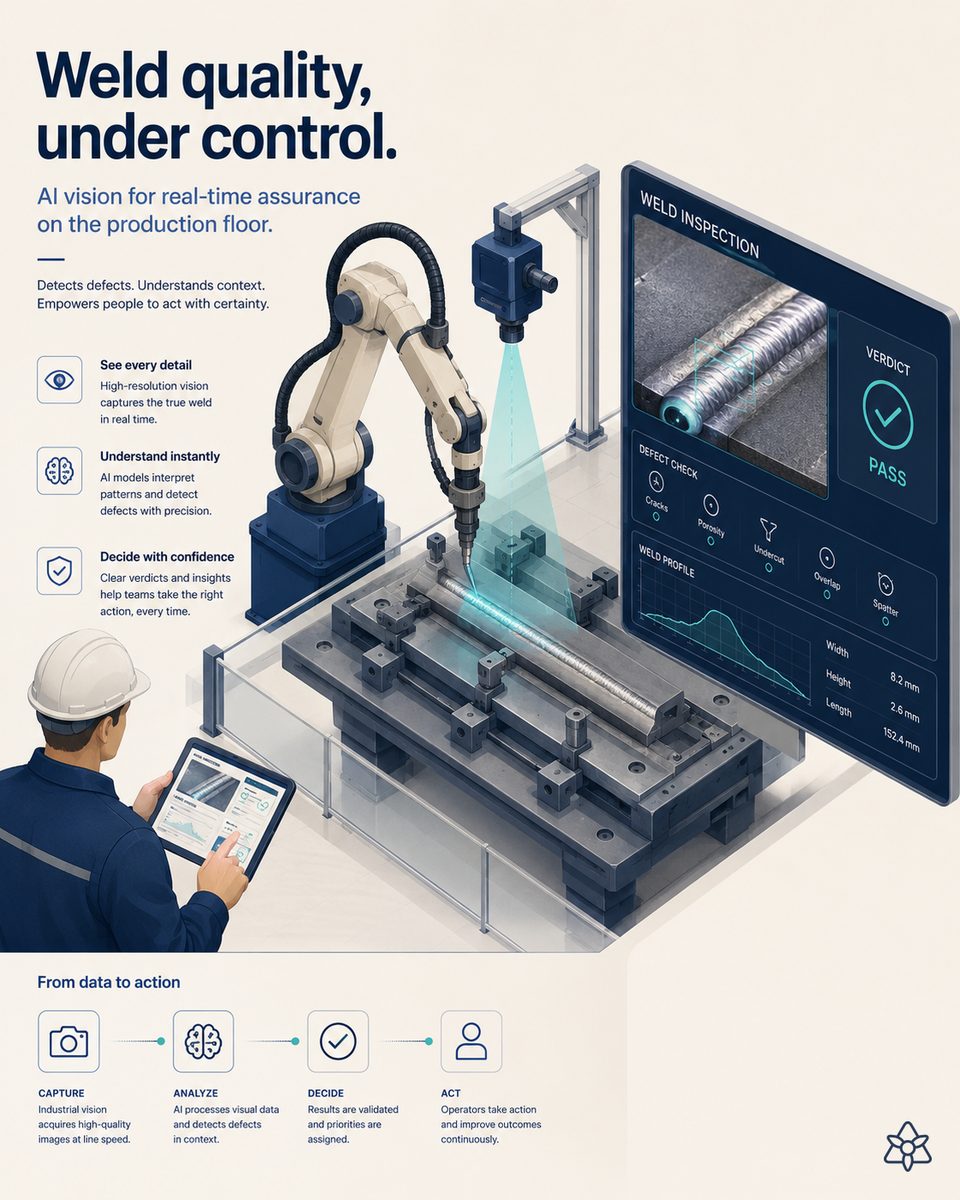
The laser cell sees the perimeter. What happens inside cannot be seen from the perimeter.
The safety of a robotic laser welding cell crosses three realities that are rarely governed together:
- What the cell itself sees — safety laser scanners, mats, interlocks. First layer, SIL/PL-certified. Essential, but tied to the perimeter and with blind zones inside.
- What happens from above — the information that would help: someone slipping in through a badly closed maintenance hatch, someone entering through the part-loading area before the cell has finished its stop, a maintenance technician leaning over the beam zone.
- How much real authority the plant has over the cell's logic — the cell arrives closed from the integrator, and adding your own criterion without touching the certified logic is non-trivial.
The result: most near-misses in laser cells happen at zones with hatches or in the transitions between modes (automatic ↔ teaching ↔ maintenance), and are documented after the fact in the shift leader's report. The cell's safety system works 99% of the time. That 1% is what you want to armour with a second, anticipatory layer owned by the plant.
iLEAN does not touch the cell's certified safety — it adds an anticipatory layer on top, in line with ISO 10218.
The problem with the laser cell is not that the safety system is bad: it is that its criterion is fixed by the integrator and lives on an island relative to the plant. iLEAN acts as the filler that closes that gap, without touching what is certified.
Edge sees the protected zone from above. Connect sends the order to the safety PLC. The agent cross-checks with the cell's mode and the maintenance calendar. The safety manager signs the rules.
The three iLEAN pieces applied to intrusion detection in a laser cell:
- Edge — a terminal with machine vision (CNN) on an overhead camera above the cell, in visible, NIR or thermal depending on the environment. It recognises the human silhouette in the protected zone and sends the stop order to the safety PLC by dry contact or safe bus. It works with no network. If the plant loses its WiFi, Edge keeps protecting the cell.
- Connect — captures the robot's state, the program it is running and the mode (automatic/teaching/maintenance). In teaching mode the rule changes automatically — a person in the zone is expected. Connect also picks up external notices (the shift leader's near-miss report, the integrator's instruction).
- Agent — cross-checks Edge events with the cell's mode and the maintenance calendar. If it detects a pattern (a specific hatch producing repeated intrusions, a shift change with several events), it proposes a rule change to the safety manager and leaves the dossier. The person validates the change.
Perimeter safety alone vs. perimeter + iLEAN Vision layer
| Aspect | Laser scanner + interlocks only | With iLEAN Vision as a second layer |
|---|---|---|
| Perspective | Perimeter-bound, tied to the integrator | Overhead, sees the whole protected zone |
| Blind zones inside the cell | Covered as per the original design | Overhead coverage of zones with hatches or loading |
| False positives from laser reflections | Frequent with classic auxiliary cameras | The CNN classifies the silhouette, ignores glare |
| Rule change by mode (auto/teaching) | Manual and outside the system | Automatic change based on the robot's mode |
| Governance by the plant | Limited to the integrator's parameters | Rules configurable by zone and mode |
| Near-miss dossier | Reconstructed by hand | Automatic, with video and the robot's mode at the event |
Impact estimate for your plant — to be validated with your numbers.
The block below is an estimate to be validated with the specific figures of your plant. We set it out so the committee has an order of magnitude; we refine it during the diagnostic.
- Plant with 2-6 laser welding cells (body panels, exhausts, chassis or other assemblies), known integrator, safety PLC already installed.
- Edge pilot with 1-2 overhead cameras on the critical cell + integration with the PLC. First expected value within a few weeks.
- Indicative payback between 4 and 9 months, depending on the frequency of documented near-misses and the average cost of the integrator's forced stops to review an incident.
- Expected reduction in near-misses at zones with hatches or mode transitions: ≥ 30% versus the measured baseline. A single avoided incident with sick leave pays for the pilot with plenty of margin.
And the prevention manager's reasonable doubt
"What if the CNN gives a false positive and stops the cell for no reason?" — the costs of a false positive (1-2 minutes of stopped cell) are orders below those of a false negative (an incident with sick leave), so the rule is calibrated towards prudence. Moreover, hallucination is a problem of free generation, not of anchored tasks: classifying what is seen in an image against a closed catalogue of classes (person/robot/part/trolley) is exactly the kind of task where the best models brought the error below 1.5% [1]. And the cell's primary SIL/PL safety layer remains intact as the net underneath.
[1] OpenAI paper "Why Language Models Hallucinate", 2025 — on the reliability of AI in anchored tasks.
What people ask about intrusion detection in laser cells
Is iLEAN Vision compatible with ISO 10218 and ISO/TS 15066?
Yes, as an anticipatory layer on top of the cell's safety system. ISO 10218 (industrial robots) and ISO/TS 15066 (collaborative) require the cell itself to have its SIL/PL-certified functional system — perimeter laser scanners, mats, interlocks. iLEAN replaces none of that: it adds an overhead vision layer that recognises the human silhouette in the protected zone before it reaches the barrier and sends the stop order through a traceable channel, in line with the three-rings principle.
How does iLEAN Vision tell an operator from a large part the robot has just lifted?
The convolutional neural network (CNN) is trained to classify a human silhouette against robot, part, loading trolley and fixed furniture. It recognises the person even in PPE (helmet, laser-fume mask, flame-retardant clothing) and discards the false positives caused by laser-beam reflections on the part, which are the nightmare of systems based only on a visible camera with no classification. The stop rule is calibrated towards prudence: the cost of a false positive (1-2 minutes of stopped cell) is far lower than that of a false negative.
How does it connect to the cell's safety PLC?
Through iLEAN Connect. The output can go by dry contact to the safety PLC (the most common setup in cells with the usual safety-PLC vendors already installed) or by safe bus if the cell supports it. Connect also captures the robot's state, the program it is running and the mode (automatic, maintenance, teaching), and sends the stop order with the degree appropriate to the mode. In teaching mode the rule changes automatically: a person in the zone is expected, not an intrusion.
Does it work in laser welding cells with fumes and reflections?
The fumes of the laser welding process and the beam's reflections are exactly what breaks classic vision systems based on background subtraction. iLEAN Vision uses a CNN trained on data from the process itself: fumes, spatter, glare, flame-retardant PPE. Classification is done on the silhouette, not the pixel, so dense fumes do not degrade detection below the threshold. And the camera, depending on the cell, can run in visible, NIR or thermal.
How much does a pilot cost in a laser welding cell?
The order of magnitude of an Edge pilot for intrusion detection in a laser welding cell is close to that of any Edge pilot in a plant: an initial investment covering 1-2 overhead cameras suited to the laser environment, the terminal, integration with the safety PLC and training the model with the cell's own data, plus an annual licence. The reasonable payback to present to the committee is a matter of a few months — the hard lever is a single avoided incident with sick leave. Send us your cell's data and we will send back the estimated ROI within 48h.
More cases in ilean vision
- High-throughput GS1-128 in meat with AI — over 200 cases per minute without the belt stopping to read.iLEAN Vision reads GS1-128 labels at over 200 cases per minute in the dispatch area of a meat cutting…
- Hot-rolled bar for oil & gas pipe with AI — the tear shows on the bar, not in the well.iLEAN Vision detects cracks, laps and tears in hot-rolled bar destined for seamless oil and gas pipe —…
- Injecting aluminum over the wrong die, or over a cavity outside the thermal window — and finding out at ejection.iLEAN Vision confirms the correct die and its visual thermal state before injecting aluminum in…
- Leaflet verification in pharma cartons with AI — a carton without a leaflet is not an incident, it is a GMP deviation.iLEAN Vision detects a pharma carton without its leaflet before sealing to avoid GMP incidents on the…
- Pallet lot counting — the error that travels to the truck comes back as a return and a claim.iLEAN Vision counts and identifies the lots on every outbound pallet and validates them against the…
- Manual malt bag loading at the brewery — the back injury gives no warning, it arrives in week four.iLEAN Vision detects badly executed malt bag lifts at the brewery silo and assists the operator at…
Tell us your case and within 48h we will send you the estimated ROI of this AI project for your laser cells.
We work on your plant's real data, not on ours. Diagnostic with no commitment.
Request estimated ROI in 48h See iLEAN Vision