Galvanized sheet for white goods with AI — the defect shows on the coil, not on the washing machine.
The galvanized coil feeding an appliance line carries scratches, pores, stains and roller marks that only show once the part is formed and painted. iLEAN Vision reads the strip before the cut, holds the coil when something does not add up and leaves the critical rejection in the quality manager's hands. The person signs off.
The defect that costs dearly is born on the coil and is seen five processes later.
The galvanized sheet entering a white-goods plant passes through uncoiling, cutting, drawing, painting and assembly before leaving as a fridge door, a washing-machine drum or an oven panel. When a longitudinal scratch, a zinc pore or a white rust stain travels with it, it becomes visible and claimable precisely at the end — on the already-painted sheet the customer touches in the store.
- The defect is subtle on the coil, obvious on the part. The warehouse's general lighting cannot resolve half-millimetre scratches or scattered pinholes on a reflective surface.
- Human inspection arrives late. The inspector watches two square metres per second pass under their eyes for eight hours; it is not attention, it is physics.
- The cost multiplies as the process advances. A defect discarded on the coil costs the affected section; the same defect discarded after painting costs the complete part, the oven cycle, the labour and, if it reaches the field, the withdrawal.
The sector has demanded levels in the order of 25 PPM in automotive for decades [1], and the appliance buyer is travelling in the same direction. The classic system works almost always. The part that reaches the field is the one the customer remembers.
iLEAN Vision seals the crack between the coil and the line — it adds no extra system, it seals the one you have.
Surface control of galvanized sheet is not missing because nobody knows how to do it: it is missing because until now it was expensive to install on every old cutter, and because the data was never cross-checked with the rest. iLEAN acts as the filler that closes that gap without asking you to change the cutter or the ERP.
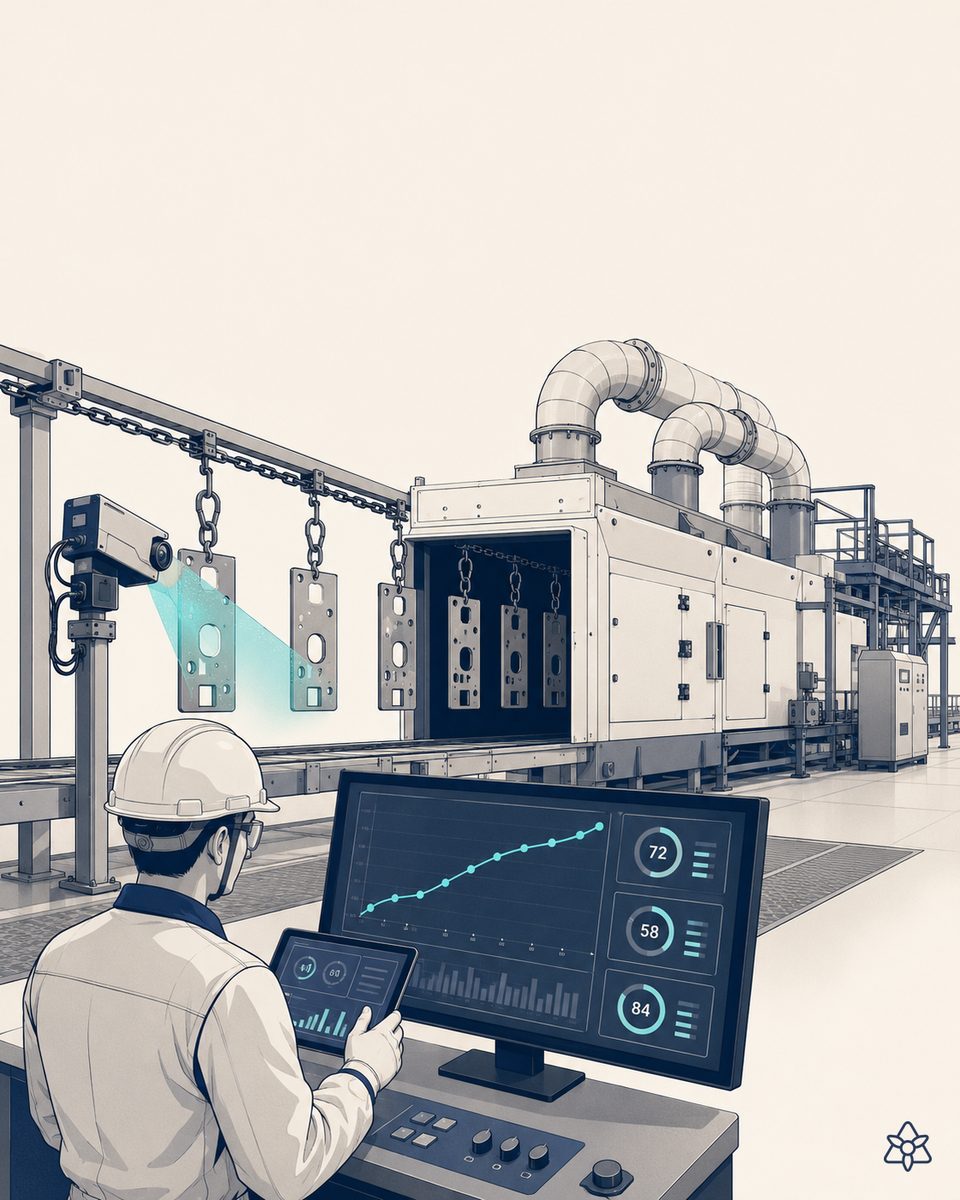
Edge sees the coil before the cut. Connect reads the production order and the supplier's certificate from the ERP, the MES or a spreadsheet. The agent cross-checks defect, certificate and order — if something does not add up, it holds the coil. The person signs off.
The three iLEAN pieces applied to galvanized sheet inspection for white goods:
- Edge — a terminal with machine vision (CNN) over the uncoiler or the shear. Directed bright/dark-field lighting, a line-scan or matrix camera depending on the strip's speed, a neural network trained for scratches, pores, white rust and roller marks. It triggers the actuator (ink marker, light signal, ejector for the already-cut part) in milliseconds. It works with no network: as long as the cabinet has power, the cycle continues.
- Connect — captures the production order, the supplier's heat certificate and the drawing parameters whether they come from the ERP, the vertical MES, the planning spreadsheet or the supplier's email with the latest batch. The information arrives at second zero, with no forwarding.
- Agent — cross-checks the defect Edge detected, the coil's certificate and the part's destination (visible outer door vs. non-aesthetic internal panel). If the defect is critical for that destination, it holds the coil and alerts the quality manager through whichever channel they use. The person validates and signs; the shear never restarts on its own.
Human visual inspection vs. cross-checked inspection with iLEAN Vision
| Aspect | Human inspection + sampling | With iLEAN Vision + Connect + Agent |
|---|---|---|
| Strip coverage | Periodic sampling, the inspector's eye | 100% of the useful width, in line, at cutter speed |
| Defect detected | After drawing or painting | On the coil, before the cut, or as a marked part |
| Cross-check with the heat certificate | Manual, a PDF file | Automatic: the agent compares with the supplier's batch |
| The part's aesthetic destination | The operator's assumption | Rules per SKU: visible door vs. hidden panel |
| Operation with no network | n/a | Edge keeps operating on cabinet power |
| File for the IATF/QS audit | Reconstructed by hand | Dossier per coil with a photo of every defect |
Impact estimate for your plant — to be validated with your numbers.
The block below is an estimate to be validated with the specific figures of your plant. We set it out so the committee has an order of magnitude; we refine it during the diagnostic.
- Appliance plant with a multi-format galvanized sheet cutter and two drawing/painting lines downstream.
- Edge pilot at the cutter (lighting + camera + actuator + integration with the production order). First expected value within a few weeks.
- Reduction in scrap from surface defects detected after painting: ≥ 30% on visible-face SKUs, as a defensible floor.
- Indicative payback between 4 and 9 months, depending on the documented frequency of warranty withdrawals for surface defects and your channel's average reverse-logistics cost.
- The hard lever is the cost of the part at the end of the process: the later the defect is seen, the more it costs.
And the quality manager's reasonable doubt
"What if the AI gets it wrong and rejects a good coil?" — hallucination is a problem of free generation, not of anchored tasks. In tasks where the AI simply classifies an image against a learned pattern (defect yes/no), the best models brought the error below 1.5% [2]. And even so, what is critical is never decided alone: iLEAN holds the coil and the person signs off. The three safety rings are there for exactly this.
[1] Automotive quality standard in the order of 25 PPM (Symestic).
[2] OpenAI paper "Why Language Models Hallucinate", 2025 — on the reliability of AI in anchored tasks.
What people ask about galvanized sheet inspection for white goods
What surface defects appear on galvanized sheet for white goods?
On the galvanized coil feeding a white-goods line, the typical ones are: longitudinal scratches from the mill or the rewinding, pores and pinholes from the zinc bath, white rust stains from warehouse humidity, irregular spangle and roller marks. Most are subtle in flat sheet and become obvious after the appliance's drawing and painting — when removing them already costs ten times more.
Why doesn't human inspection catch these defects?
A galvanized strip can run through the line at over a metre per second. The inspector's eye sees the whole, but cannot resolve a half-millimetre scratch or a scattered pinhole at that speed, and the zinc's reflection masks many subtle defects under normal lighting. It is not an attention problem, it is a physics problem: a person cannot look at two square metres of sheet per second for eight hours. iLEAN Vision can — and the person keeps the decision, not the staring.
How does iLEAN Vision read a moving galvanized coil?
iLEAN Edge is a terminal with machine vision (CNN) installed over the uncoiling line or over the cutting shear. It combines directed lighting (bright/dark field) with line-scan or matrix cameras and a neural network trained for the typical galvanizing defects: scratches, pores, white rust, roller marks. When it detects a critical defect, it triggers an actuator (light signal, marker, ejector for the already-cut part). The operator has the defect's image on screen in milliseconds to decide whether the whole coil is held or only the affected section.
Does it work if the plant loses its network?
Yes. iLEAN Edge's design is non-negotiable on this point: as long as the terminal has power, its basic detection-and-intervention cycle keeps working even if the plant loses WiFi, Internet and the connection to the ERP. In a factory, what is critical cannot depend on there being a network — and surface control of the galvanized coil is exactly that, critical. When the connection comes back, Edge synchronises the history with Central.
What payback is reasonable to expect in a white-goods plant?
The order of magnitude of an Edge pilot on a galvanized sheet uncoiling/cutting line is comparable to any Edge pilot in heavy industry: an initial investment covering terminals + cameras + lighting + integration with the cutter, plus an annual licence. The reasonable payback to present to the committee sits between several months and a year, and the hard lever is the cost of a single appliance withdrawn from the field (reverse logistics, channel withdrawal, brand damage) versus detecting the defect on the coil. Send us your plant's data and we will send back the estimated ROI within 48h.
More cases in ilean vision
- Data Matrix reading in SMT with AI — a misread component is not a defect, it is half a board in the scrap bin.iLEAN Vision reads Data Matrix codes on SMT components at pick-and-place speed — without slowing the…
- Starting the press with the wrong die — and finding out with the first broken stroke.iLEAN Vision recognises the die installed in an automotive stamping press and blocks start-up with the…
- Float glass for automotive with AI — the inclusion shows on the table, not in the furnace.iLEAN Vision detects inclusions, bubbles and scratches in float glass before tempering for automotive…
- High-throughput GS1-128 in meat with AI — over 200 cases per minute without the belt stopping to read.iLEAN Vision reads GS1-128 labels at over 200 cases per minute in the dispatch area of a meat cutting…
- Hot-rolled bar for oil & gas pipe with AI — the tear shows on the bar, not in the well.iLEAN Vision detects cracks, laps and tears in hot-rolled bar destined for seamless oil and gas pipe —…
- Injecting aluminum over the wrong die, or over a cavity outside the thermal window — and finding out at ejection.iLEAN Vision confirms the correct die and its visual thermal state before injecting aluminum in…
Tell us your case and within 48h we will send you the estimated ROI of this AI project for your white-goods plant.
We work on your plant's real data, not on ours. Diagnostic with no commitment.
Request estimated ROI in 48h See iLEAN Vision