Fresh meat pallet cold chain segregation — one break on one truck should not cost thirty pallets on hold.
The cold chain of a fresh meat pallet crossing several trucks and cross-dock bays is measured today per truck, not per pallet — and when there is a break, the whole batch is held as a precaution. iLEAN Tracer records the temperature-time curve per pallet, pairs it with the bays it crossed, and segregates only what actually suffered the break. The person signs off.
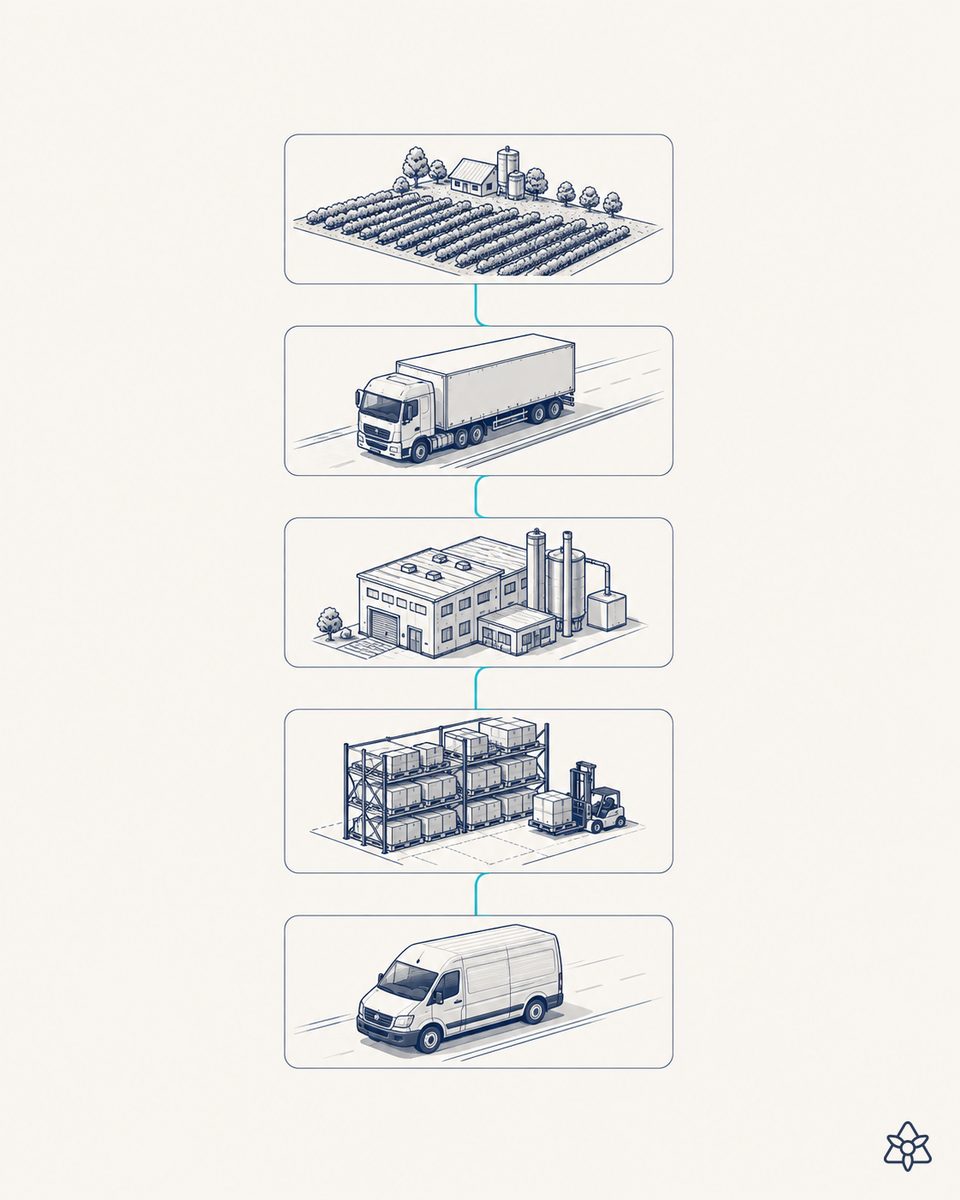
Temperature is measured on the truck — the risk sits on the pallet.
A traceable cold chain for a fresh meat pallet moving through a cross-dock is the crossing of four pieces of data that live in four different places:
- The origin truck temperature — recorded by the carrier's data logger, aggregated onto the delivery note.
- The minutes on the bay — how long each pallet spends in cross-dock, between coming off the origin truck and going onto the destination truck. Almost never recorded at pallet level.
- The destination truck temperature — another logger, another carrier, another delivery note.
- The SSCC and the batch — which meat and from which supplier each pallet carries, with its use-by date and the applicable EU Regulation 853/2004 requirements.
The platform manager knows this, but cannot measure temperature per pallet by hand. When the destination truck curve arrives with a spike, there is no way to tell whether it affected the 30 pallets or only the 3 on the exposed bay. The classic system holds the whole batch 99% of the time. That remaining 1% is the recall that reaches the customer — and meanwhile the 27 good pallets sit still as a precaution, losing shelf life and margin.
iLEAN Tracer does not replace your data loggers — it seals the cracks between origin truck, bay, destination truck and SSCC.
The problem in chilled cross-dock is not a lack of information: it is information living on four islands that only gets reconciled late, once the hold-or-release decision is already due. iLEAN Tracer acts as the filler that closes those gaps, without asking you to change your TMS, your WMS, or your carriers' data loggers.
Edge sees every pallet on the bay. Connect captures the logger curves and the per-pallet loggers. Tracer pairs them with the SSCC. The agent reconstructs the curve per pallet and segregates only the affected one. The person signs off — never the other way around.
The iLEAN pieces applied to the fresh meat cold chain in cross-dock:
- Tracer (functional layer over Edge + Agents) — keeps the SSCC-pallet-batch-temperature-curve association alive along the whole cross-dock chain, without losing traceability when the pallet changes truck. Every pallet carries its number, its curve and its evidence.
- Edge — a terminal with computer vision (CNN) over the cross-dock bays. It records the exact moment each pallet comes off and goes onto a truck, with timestamp and position. It works with no network. If the platform loses connectivity, Edge keeps recording into its local buffer — because what is critical cannot depend on connectivity.
- Connect — captures the truck logger curves (modern ones via API, older ones from a photo of the carrier's printout), the per-pallet loggers where they exist, and the incident notices arriving by email or messaging app from the supplier or the customer. All of it at second zero.
- Agent — reconstructs the temperature-time curve per pallet by crossing the origin truck curve, the Edge bay minutes and the destination truck curve. It applies the tolerances of EU Regulation 853/2004 and of the retailer specifications. If one specific pallet leaves tolerance, it does not hold the whole batch: it raises the alert, segregates that pallet, and lets the rest go. The quality manager validates and signs off.
Precautionary hold per truck vs. segregation per pallet with iLEAN Tracer
| Aspect | Data logger + delivery note + human decision | With iLEAN Tracer + Edge + Agent |
|---|---|---|
| Measurement granularity | Per truck, aggregated onto the delivery note | Per pallet, with timestamp and bay crossed |
| Cross-dock | Gap not recorded per pallet | Edge records entry/exit per pallet |
| Decision on a break | Hold the whole truck as a precaution | Segregate only the affected pallet, release the rest |
| Temperature-time curve | Reconstructed by hand when there is an incident | Reconstructed automatically per pallet, full dossier |
| Shelf life of the good product | Lost to the precautionary hold | Preserved, ships to destination without stopping |
| IFS Logistic / BRC S&D audit | File reconstructed over weeks | Automatic per-SSCC file with Edge photos |
Impact estimate for your plant — to be validated with your numbers.
The block below is an estimate to be validated with the actual data of your platform. We put it forward so the committee has an order of magnitude; we refine it during the diagnostic.
- Chilled platform with several cross-dock bays, a mix of refrigerated meat and cuts, heterogeneous carriers with data loggers of several generations.
- Tracer pilot over one cross-dock area (Edge cameras over the bays + integration with truck sensors and pallet loggers + TMS/WMS connector). First value expected within a few weeks.
- Expected reduction in pallets held as a precaution because of an unsegregated break: ≥ 30% over your platform's baseline incident rate.
- Indicative payback between 4 and 9 months, depending on the documented frequency of precautionary holds and the average cost of lost shelf life/margin per good pallet held.
- The hard lever is the shelf life recovered on the good product: every pallet released to its destination preserves margin and customer trust, and does not put the retailer listing at risk. One season of avoided holds pays for the pilot.
And the quality manager's fair objection
«What if the AI gets it wrong and releases a pallet with a broken cold chain?» — hallucination is a problem of free generation, not of anchored tasks. In tasks where the AI merely recontextualises a data point from one system into another (pairing temperature curves with Edge timestamps), the best models brought the error rate below 1.5% [1]. And even so, what is critical is never decided alone: iLEAN Tracer holds the suspect pallet and the person signs off. The three safety rings exist precisely for this.
[1] OpenAI paper "Why Language Models Hallucinate", 2025 — on the reliability of AI in anchored tasks.
What people ask about fresh meat pallet cold chain segregation
What does EU Regulation 853/2004 require for the fresh meat cold chain?
EU Regulation 853/2004 and the HACCP principles require fresh meat to be kept below 7 °C (carcasses) or 4 °C (cuts and derived products) throughout transport and storage, and any break to be documented and traceable. The hard part is not the truck data logger — it is that in cross-dock a pallet moves from one truck to another across open bays, with minutes of exposure that few systems record at pallet level. The regulation asks for batch traceability, and that means per pallet, not per truck.
Why does cold chain segregation fail in cross-dock?
Because temperature is measured on the truck, not on the pallet, and cross-dock scanning happens at delivery-note level. If a pallet spends 15 minutes on the bay between two trucks, that gap appears in no system. When one of the pallets reaches its destination and the quality manager detects a compromised temperature, nobody knows which of the 30 pallets on the truck suffered the break, or which supplier it came from. The outcome is a precautionary hold on the whole batch — a hard cost that is avoidable if segregation had happened at pallet level.
Can iLEAN Tracer record temperature per pallet in real time?
Yes. Tracer integrates the truck sensors and the per-pallet loggers (where they exist), and pairs them with the pallet's SSCC and batch on every reading. In cross-dock, an Edge camera over the bay records the exact moment each pallet comes off one truck and goes onto the next, and the agent reconstructs the temperature-time curve per pallet, not per truck. If the curve of one specific pallet leaves tolerance, that pallet is segregated — the rest carry on without the precautionary hold.
How is per-pallet traceability documented for an IFS/BRC audit?
Tracer generates a dossier per SSCC with the pallet's temperature-time curve from origin to destination, the list of bays it crossed, the minutes of exposure at each cross-dock, and the Edge photo of the pallet at loading and at unloading. The file is built automatically, with timestamps cross-checked against the TMS, and is available to the IFS Logistic or BRC Storage & Distribution auditor with no manual reconstruction. The quality manager signs off the batch, not the dossier — the system prepares that.
How much does it cost to deploy Tracer on a fresh meat cross-dock platform?
The order of magnitude of a Tracer pilot on a chilled cross-dock platform sits in the range of any logistics Edge pilot: an initial investment covering Edge cameras over the bays + integration with truck sensors and pallet loggers + a connector to TMS/WMS, plus an annual licence. A reasonable payback sits in the range of several months — the hard lever is the precautionary batch holds avoided, which in fresh meat multiply fast. Send us your platform data and we will send you the estimated ROI within 48h.
More cases in ilean tracer
- FSMA in the United States, MERCOSUR in Brazil, EUDR in the EU — three regulations, one single packaging line.iLEAN Tracer switches the regulatory dossier by destination (FSMA US, MERCOSUR, EUDR EU) per exported…
- A PDO bottle that cannot prove its parcel is no longer PDO — it is table wine with a shiny label.iLEAN Tracer assigns the PDO/PGI parcel and municipality to every bottle of wine or tin of olive oil,…
- You export to twelve countries and each one bans different pests — one wrong certificate and the consignment comes back from the port.iLEAN Tracer keeps the phytosanitary certificate per destination country for every exported SKU, with…
- Iberian pig — the PDO demands a record per animal, and that record lives in five different notebooks.iLEAN Tracer links the Iberian pig's RFID ear tag to the PDO, montanera days and the slaughterhouse —…
- ISO tank ADR class 3: the custody chain does not break between the loading bay and the consignee.iLEAN Tracer signs the custody chain of an ADR class 3 chemical ISO tank from loading bay to destination…
- ADR LPG butane tanker: every stop, a signed discharge — product, tank temperature and customer serial.iLEAN Tracer links ADR, tank temperature and customer serial on an LPG butane home-delivery tanker, with…
Tell us about your case and within 48h we will send you the estimated ROI of this AI project for your cross-dock platform.
We work on your plant's real data, not on ours. Diagnostic with no commitment.
Request estimated ROI in 48h See iLEAN Tracer