ADR LPG butane tanker: every stop, a signed discharge — product, tank temperature and customer serial.
A butane tanker makes twelve stops a day on home delivery, and every stop is a different ADR delivery. iLEAN Tracer links product (UN 1011 / UN 1965), tank temperature and customer serial at every discharge, captures pressure through whichever channel is available, and signs the custody chain leg by leg — even with no network. The person validates; it does not replace them.
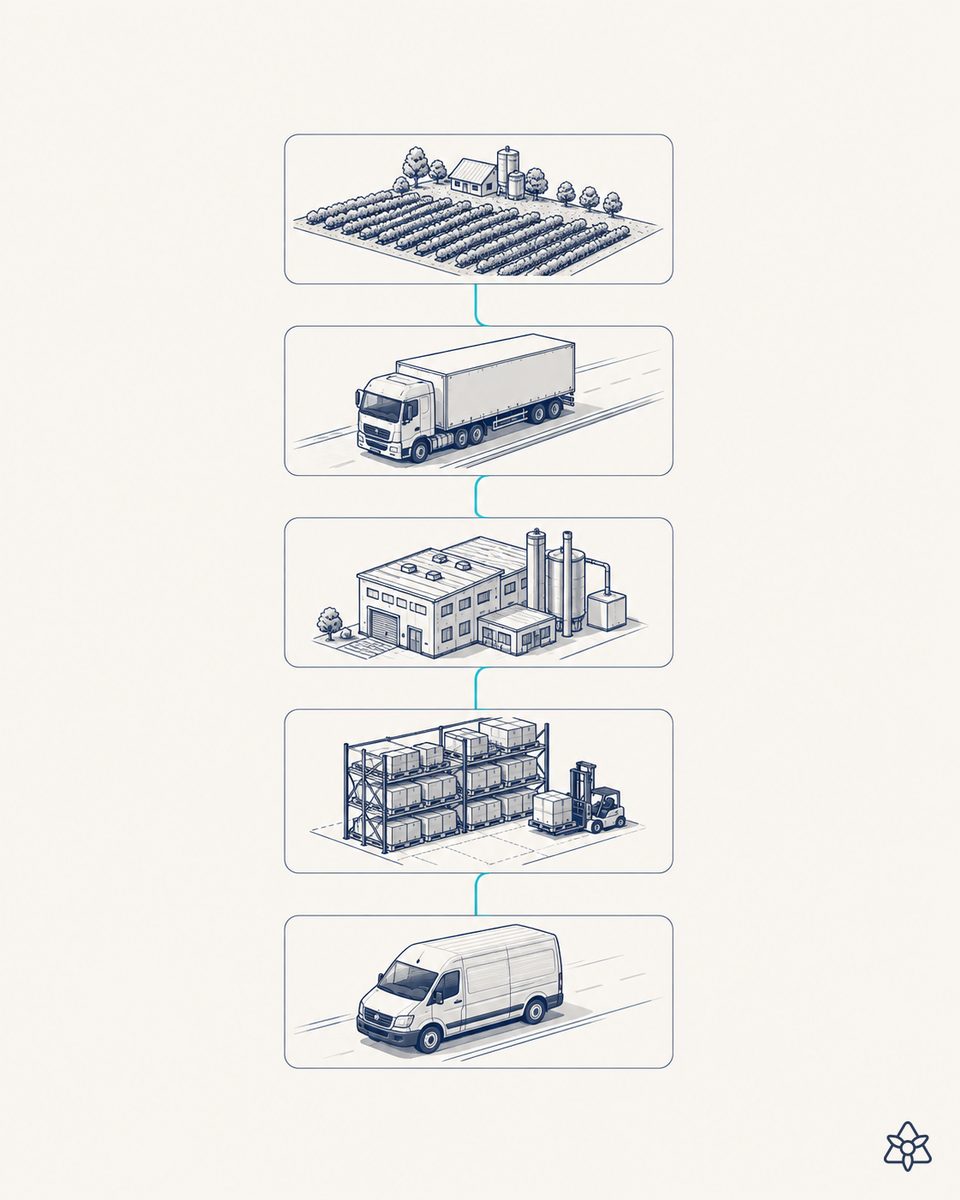
Twelve stops, twelve ADR deliveries, twelve serials — and one paper sheet from the driver.
An LPG butane tanker leaves the distributor's depot with its ADR declaration, its written instructions, a delivery route with 8-15 residential or small B2B customers, and a tank whose pressure changes with the sun, with the journey and with every discharge. Each stop generates a different piece of paper in a different system:
- The driver: a printed delivery note per stop, the meter reading, the customer's signature, sometimes a photo of the tank.
- The distributor's ERP: waits for the route to close at the end of the day — between the stop and the close, anything can happen.
- The truck's tank: has its pressure and temperature display, but it is rarely cross-checked against the discharge to a specific customer.
- The customer tank serial: this is where most things get mixed up — customers with similar serials, one-off replacements, tanks that no longer belong to the distributor.
The delivery manager knows this, but the driver is alone in the cab and the back office receives the reports at the end of the day. The classic system works 99% of the time. That 1% is the discharge into the wrong serial, the tank pressure that goes out of range with nobody recording it, the customer who files a claim with no way to defend it. In LPG, that 1% is heavy: ADR, safety and reputation all at once.
iLEAN Tracer does not add another system — it seals the cracks between truck, ERP and customer.
The problem in LPG home delivery is not a lack of information: it is information living on three islands (truck, ERP, customer) which, at the critical moment (the discharge at the next stop, the incident that surfaces at 22:00), does not reach the decision-maker in time. iLEAN Tracer acts as the filler for those gaps, without asking the distributor to change the ERP or renew the fleet.
Edge reads the ADR plate, the customer tank serial and the tank display. Connect captures the meter reading and the driver's messaging. The agent cross-checks product + temperature + serial at every stop. The person validates.
The iLEAN pieces applied to the ADR LPG butane tanker on home delivery:
- Edge — a terminal with computer vision (CNN) on the truck itself. It reads the truck's ADR plate, the customer tank serial at every stop and the tank pressure/temperature display. It works with no network: if the route is rural and coverage drops, the capture-and-sign cycle continues, and syncs when the signal returns.
- Connect — captures everything arriving through loose channels: the customer meter reading, photos of the tank and the valve, the driver's message reporting an incident, truck telemetry if the fleet emits it. Every data point enters tied to the stop and to the ADR batch at second zero.
- Agent — at every stop, it cross-checks the ADR product + the customer serial the ERP expects + the tank pressure + the kg discharged. If the serial is not the one the ERP expected, if pressure moves outside the operating range, or if the customer meter does not match what was loaded, it holds the signature on the discharge and alerts the driver with the concrete next action. The person validates on site or remotely; the discharge does not close by itself. The three safety rings exist precisely for this.
Delivery with a paper sheet vs. delivery with iLEAN Tracer
| Aspect | Printed delivery note + driver's report | With iLEAN Tracer |
|---|---|---|
| ADR product identity | On the truck's paperwork, not on each discharge | Tied to each stop and to the customer serial |
| Tank temperature/pressure | Visible on the display, never recorded | Captured by Edge and cross-checked with events |
| Customer tank serial | Checked by eye by the driver | Edge OCR + cross-checked against the ERP |
| Reconciling kg loaded vs. discharged | At the end of the day, at route close | Per stop, at second zero |
| Operation with no network | Manual, risk of losing the data | Edge keeps signing locally, syncs on return |
| File for an ADR auditor / customer claim | Rebuilt by hand, weeks | Dossier per stop, automatic, with photo, serial and human signature |
Impact estimate for your operation — to be validated with your numbers.
The block below is an estimate to be validated with the concrete data of your operation. We put it forward so the committee has an order of magnitude; we refine it during the diagnostic.
- LPG distributor with 10-20 tankers, mixed rural/urban home delivery plus small B2B, logistics ERP and a fleet with partial telemetry.
- Tracer pilot on one or two trucks (Edge for the ADR plate + customer serial + tank display, Connect for the meter reading + the driver's messages, an agent that cross-checks ADR + temperature + serial). First value expected within a few weeks: the first stops already arrive with a signed custody chain.
- Indicative payback between 4 and 9 months, depending on how often incidents occur (discharges into the wrong serial, kg mismatches, customer claims with no defence).
- Reduction of the time spent defending a claim or an ADR inspection of ≥30%, with a defensible floor far below the cost of a single incident or a single ADR penalty.
- The hard lever is a defensible operation: in front of the inspector, the insurer and the customer filing a claim, arriving with the photo, the serial, the reading and the human signature for each stop closes discussions that today drag on for weeks.
And the reasonable doubt of the safety manager
«What if the AI confuses a customer serial or misreads a pressure and we sign something that isn't true?» — hallucination is a problem of free generation, not of anchored tasks. In tasks where the AI merely re-contextualises a data point from one system to another (reading a plate, a serial, a display), the best models brought the error below 1.5% [1]. And even so, what is critical is never decided alone: iLEAN holds the discharge and the person signs. The three safety rings exist precisely for this.
[1] OpenAI paper "Why Language Models Hallucinate", 2025 — on the reliability of AI in anchored tasks.
What people ask about the ADR LPG butane tanker on delivery
What does ADR require from an LPG butane tanker on home delivery?
For LPG butane (UN 1011) and commercial mixtures (UN 1965), ADR requires: transport documentation stating the product identity, written instructions, specific driver training, sealing of the compartment, control of the tank temperature within the operating range (service pressure), and identification of every end customer as recipient, with the serial number of the customer tank. On home delivery, what matters is not mixing up customer serials, not going outside service pressure, and leaving a signed record of who loaded, how much was discharged at each stop and at what time.
How does Tracer cross-check ADR, tank temperature and customer serial at every stop?
Tracer links three data points that today live in different systems: the product ADR (UN number, MSDS, written instructions that travel with the truck), the temperature/pressure of the tanker tank (the truck's own sensor, or the display reading captured by iLEAN Edge), and the customer tank serial (the plate Edge reads on arrival at the stop). At every discharge, the agent cross-checks product + serial + kg discharged + the customer meter reading — and if the tank pressure goes outside range, or the serial is not the one the ERP expected, it holds the discharge and alerts the driver. The person validates.
What happens if the truck loses network coverage in a rural area?
On rural home delivery, coverage is what it is. iLEAN Edge is designed to work without a network: as long as it has power, it keeps reading the product ADR, the customer tank serial and the tank pressure, and signing each stop locally. When coverage returns, the custody chain syncs to the central system. On an LPG tanker, what is critical cannot depend on the Wi-Fi of a village of 200 people.
Why does tank temperature and pressure matter so much on an LPG tanker?
Because butane and LPG mixtures are liquefied gases under pressure: a tank temperature outside the operating range is not an administrative issue — it is safety. Service pressure defines the margin against the relief valve and against the limit of the vessel itself. Having the real tank curve for every leg of the route, and being able to cross it with events (a long stop in direct sun, a pressure jump during a discharge), protects the driver, the customer and the carrier. It is one of those things the ADR inspector does not ask for until something happens — and then they ask for everything.
What is a signed custody chain for in LPG home delivery?
It is there to settle in minutes what today takes weeks. A customer claiming they were not given what the delivery note says, an ADR authority asking for the history of a specific route after an accident, a distributor that needs to reconcile kg loaded at the depot vs. kg discharged at customers vs. returned to the depot, an auditor checking that every customer tank received the correct ADR product. Who signed what, when, with what evidence — granular per stop, that cannot be reconstructed from the driver's paper sheet.
More cases in ilean tracer
- Fresh meat pallet cold chain segregation — one break on one truck should not cost thirty pallets on hold.How iLEAN Tracer segregates the cold chain of a fresh meat pallet as it crosses trucks and cross-dock…
- Iberian pig — the PDO demands a record per animal, and that record lives in five different notebooks.iLEAN Tracer links the Iberian pig's RFID ear tag to the PDO, montanera days and the slaughterhouse —…
- ISO tank ADR class 3: the custody chain does not break between the loading bay and the consignee.iLEAN Tracer signs the custody chain of an ADR class 3 chemical ISO tank from loading bay to destination…
- EUDR dossier for a mango reefer container — a container held at customs is not paperwork, it is shelf life thrown away at the port.How iLEAN Tracer closes the EUDR dossier of a mango reefer container with plot coordinates and country…
- GS1 SSCC label on a multi-SKU mixed pallet — one error is not an incident, it is a pallet rejected at the dock.How iLEAN Tracer builds the GS1 SSCC label of a multi-SKU mixed pallet for retail in real time, with no…
- mRNA vaccine batch in a -70 °C chain — an unrecorded break is not an incident, it is an invalidated batch.iLEAN Tracer signs every -70 °C ultra-cold chain break of an mRNA vaccine batch with timestamp, owner…
Tell us about your case and within 48h we'll send you the estimated ROI of this AI project for your LPG butane delivery operation.
We work on the real data of your operation, not on ours. Diagnostic with no commitment.
Request estimated ROI in 48h See Tracer