GS1 SSCC label on a multi-SKU mixed pallet — one error is not an incident, it is a pallet rejected at the dock.
A multi-SKU mixed pallet bound for a retail chain requires the GS1 SSCC label to be built from the real physical content, not from the theoretical order. iLEAN Tracer builds the content list case by case during picking, reconciles the SSCC against the WMS and the retailer ASN, and holds the closure if something does not add up. The person signs.
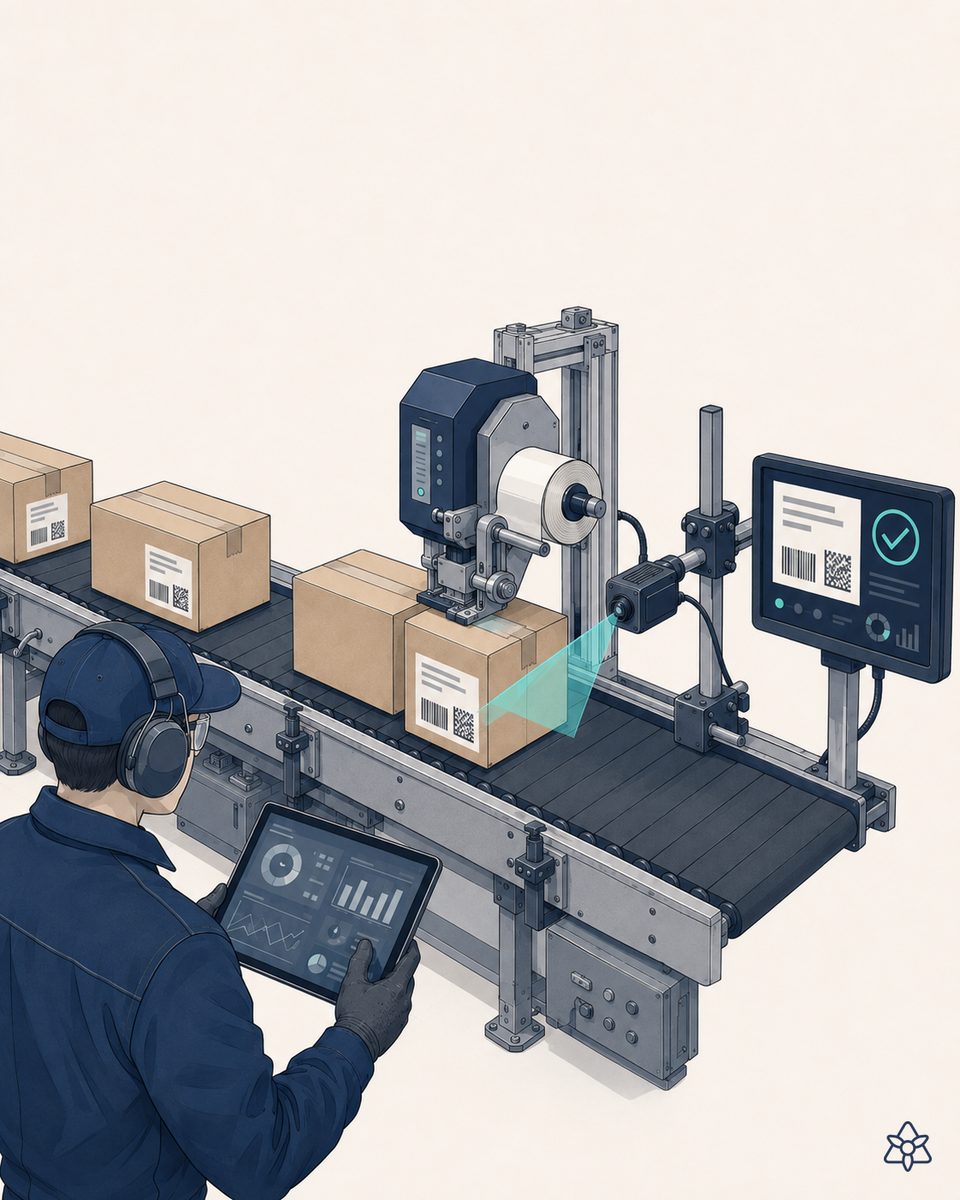
A mixed pallet is built twice — once in the WMS and once on the floor. They are almost never the same.
A correct GS1 SSCC label on a mixed pallet is the crossing of four data points that live in four different places:
- What the store ordered — the retailer order in the WMS, with the expected GTINs, quantities and batches.
- What was actually picked — the real picking on the floor, where the picker swaps, changes, breaks or adjusts cases depending on what is on the rack.
- The available SSCC range — the SSCCs the company has not consumed yet, managed in a spreadsheet or in an ERP module.
- The retailer ASN format — EDIFACT DESADV for European grocery chains, X12 856 in the US, proprietary XML for other retailers and marketplaces, each with its own mapping.
The operator knows all this, but cannot keep the four in sync by hand. They try with a scanner and a spreadsheet, and most of the time it works. The classic system works 99% of the time. That 1% is the pallet rejected at the dock — the truck comes back, the retailer files a claim, the SSCC stays «dirty» in the national database, and the cost of the incident is far higher than the cost of the transport.
iLEAN Tracer does not replace your WMS — it seals the cracks between WMS, picking, SSCC range and retailer ASN.
The mixed pallet problem is not a lack of information: it is information living on four islands that gets reconciled too late, already at the dock, when the truck is about to leave. iLEAN Tracer acts as the filler that closes those gaps, without asking you to change your WMS, your TMS, or the flow of your platform.
Edge sees every case as it goes onto the pallet. Connect captures the retailer order and the ASN formats. Tracer assigns the SSCC against the GS1 range and builds the list. The agent reconciles and holds the closure if it does not add up. The person signs — never the other way round.
The iLEAN pieces applied to the multi-SKU mixed pallet for retail:
- Tracer (functional layer over Edge + Agents) — reserves the SSCC from the corporate GS1 range when the pallet is opened, builds the content list case by case, and at closure reconciles GTIN, batch, quantity and expiry date against the store order. Every pallet carries its number, and every number carries its evidence.
- Edge — terminal with machine vision (CNN) over the pallet build area. Reads the GTIN of every case as it goes up, validates batch and expiry when they come in the GS1-128, and triggers a light or a rejector if the content does not match what was expected. It works with no network. If the platform loses its connection to the WMS, Edge keeps reading and reconciling with its local buffer.
- Connect — captures the order of every retailer whether it arrives via modern EDI, via an email from the buyer, or via a customer web portal. And it also captures what arrives from outside (a damage alert on the rack that changes the picking, a transport message about a dock change) at second zero.
- Agent — cross-checks the real pallet content, the retailer order, the available SSCC range and the rules of each ASN format. If there is a deviation, it does not wait for the dock: it holds the pallet closure and alerts the shift supervisor through whatever channel they use. The person validates and signs; the SSCC is not printed without reconciliation.
SSCC label rewritten at the dock vs. SSCC built on the line with iLEAN Tracer
| Aspect | WMS + scanner + spreadsheet | With iLEAN Tracer + Edge + Agent |
|---|---|---|
| SSCC assignment | Reserved when the pallet is closed, sometimes duplicated | Reserved when the pallet is opened, against the GS1 range, no duplicates |
| Reconciliation with real picking | Manual rewrite when a difference is spotted | Case by case while the pallet is being built |
| Swap due to damage or change | The picker adjusts, the system never finds out | Edge sees the swap, the agent updates the list |
| ASN to the retailer | Generated from the theoretical data, frequent errors | Generated from the real data, validated against retailer rules |
| Rejection at the dock | Truck comes back, cost of return transport | Closure held before the truck is sealed |
| Batch→store traceability | Rebuilt by hand if there is an incident | Evidence pack per SSCC, automatic, with a photo of the pallet |
Impact estimate for your plant — to be validated with your numbers.
The block below is an estimate to be validated with the actual data of your platform. We put it forward so the committee has an order of magnitude; we refine it during the diagnostic.
- Logistics platform with 3-5 retailers, several thousand pallets/day, mostly multi-SKU mixed, heterogeneous ASN (DESADV + proprietary ASN).
- Tracer pilot over one picking area (Edge cameras over the pallet build area + scanners + closure actuator + integration with the WMS and the ASN connectors). First value expected within a few weeks.
- Expected reduction in pallets rejected at the dock because of an SSCC with wrong content: ≥ 30% over your platform baseline incident rate.
- Indicative payback between 4 and 9 months, depending on the frequency of documented rejections and the average cost of a return from the retailer dock.
- The hard lever is the compound cost of a rejected pallet: return transport, rework, retailer penalty, a «dirty» SSCC in the national system, and reputation with the customer. Every rejection avoided goes straight to margin.
And the reasonable doubt of the operations director
«What if the AI gets it wrong and lets a pallet out with the wrong list?» — hallucination is a problem of free generation, not of anchored tasks. In tasks where the AI is limited to recontextualising a data point from one system into another (reading the GTIN and comparing it against the expected order), the best models brought the error below 1.5% [1]. And even so, what is critical is never decided alone: iLEAN Tracer holds the pallet closure and the person signs. The three safety rings are there for exactly this.
[1] OpenAI paper «Why Language Models Hallucinate», 2025 — on the reliability of AI in anchored tasks.
What people ask about the GS1 SSCC label on multi-SKU mixed pallets
What does the GS1 SSCC standard require on a multi-SKU mixed pallet for retail?
GS1 requires every pallet shipped to a retail chain to carry a logistics label with a unique 18-digit SSCC and a list of its content — GTIN, batch, quantity and expiry date for each SKU aggregated on the pallet. For a homogeneous pallet this is trivial. For a multi-SKU mixed pallet (several products from the same supplier on one pallet bound for a specific store), building that label means reconciling the picking order, the actual picking, the cases that were read, and the retailer rules (some require an EDIFACT/XML ASN linked to the SSCC). The most expensive error: a duplicated SSCC, or a content list that does not match the physical pallet.
Why does the SSCC label fail on mixed pallets?
Because the label is printed late, once the pallet is already built, and it is rewritten with data coming from three systems that do not talk to each other in real time: the WMS (what the store ordered), the TMS (which truck), and the picking line (what was actually taken). If a picker swaps one case for another because of damage, or a case falls and the batch changes, that change rarely reaches the label. The result is SSCCs carrying theoretical content, not real content — and in retail that means the pallet is rejected at the dock, with the cost of return transport.
Can iLEAN Tracer build the SSCC in real time during picking?
Yes. Tracer builds the pallet content list case by case while the pallet is physically built, reading every GTIN with vision or with the picker scanner, and reserving the SSCC against the company GS1 range. When the pallet is closed, the label prints with the SSCC already reconciled against the real content and against the retailer order. If the physical content does not match what the store ordered, the system holds the pallet closure and alerts the shift supervisor. The person decides and signs.
How does it integrate with the retailer EDIFACT/XML ASN?
iLEAN Connect captures the format of every customer — EDIFACT DESADV from European grocery chains, proprietary ASN from other retailers, EDI X12 856 in the US, XML from large marketplaces — and builds the message from the real content list of the closed pallet, with the SSCC already validated. The wrong-field error (a GTIN in the batch slot, a quantity in pieces instead of cases) disappears because the AI recontextualises an anchored data point, it does not invent one. The shipping supervisor validates the message before it is sent.
How much does it cost to deploy Tracer on a multi-SKU picking platform?
The order of magnitude of a Tracer pilot over a mixed-pallet picking area sits in the range of any logistics Edge pilot: an initial investment covering vision terminals over the pallet build area + scanners + actuator (closure light) + integration with WMS/TMS and the EDI connectors of your retailers, plus an annual licence. A reasonable payback sits in the range of several months — the hard lever is the rejected pallets avoided at the dock, which in retail run into thousands per plant per year. Send us your platform data and we will send back the estimated ROI within 48h.
More cases in ilean tracer
- ISO tank ADR class 3: the custody chain does not break between the loading bay and the consignee.iLEAN Tracer signs the custody chain of an ADR class 3 chemical ISO tank from loading bay to destination…
- ADR LPG butane tanker: every stop, a signed discharge — product, tank temperature and customer serial.iLEAN Tracer links ADR, tank temperature and customer serial on an LPG butane home-delivery tanker, with…
- EUDR dossier for a mango reefer container — a container held at customs is not paperwork, it is shelf life thrown away at the port.How iLEAN Tracer closes the EUDR dossier of a mango reefer container with plot coordinates and country…
- mRNA vaccine batch in a -70 °C chain — an unrecorded break is not an incident, it is an invalidated batch.iLEAN Tracer signs every -70 °C ultra-cold chain break of an mRNA vaccine batch with timestamp, owner…
- EU, UK and Swiss nutrition labelling per SKU — a pallet that crosses the border with the wrong label is a rejection, not an incident.iLEAN Tracer segments EU, UK and Swiss nutrition labelling by destination for every SKU, without…
- Your plant serves five OEMs and each one brings its own CSR — one mixed dossier and you lose the approval.iLEAN Tracer applies each OEM's own CSR (Stellantis, VW, Renault, Ford) in a multi-customer tier-1…
Tell us about your case and within 48h we will send you the estimated ROI of this AI project for your picking platform.
We work on the real data of your plant, not on ours. Diagnostic with no commitment.
Request estimated ROI in 48h See iLEAN Tracer