Your plant serves five OEMs and each one brings its own CSR — one mixed dossier and you lose the approval.
A tier-1 automotive plant applies different CSR at the same time: Stellantis CSL1000, VW Formel-Q, Renault ASES, Ford Q1, BMW VDA-6.3. iLEAN Tracer separates the flow per customer from the very first COC and assembles the correct PPAP/PSW for each OEM, so that a SKU changeover never mixes two requirement books. A person signs every dossier.
Five OEMs under the same roof, five different requirement books.
A tier-1 plant never serves a single customer. It stamps for Stellantis in the morning, assembles for VW in the afternoon and squeezes a short run for Renault in between — and each one brings its own book of Customer Specific Requirements on top of IATF 16949:
- Different control frequencies — Stellantis asks for 1/100, VW demands a continuous SPC control chart, Ford wants a master sample retained per shift. The same press changes regime every time the SKU changes.
- A PPAP/PSW format per customer — Belegliste for VW, GYS for Ford, SQT for Stellantis. The same data crosses four spreadsheets before it is uploaded to the OEM portal.
- Technical notes that change mid-campaign — the OEM publishes a revision and the email stays trapped in the quality engineer's inbox. Meanwhile the line keeps producing to the previous version.
- Zero tolerance for mixing — the automotive quality standard is in the order of 25 PPM[1]. A part that crossed requirement books between two OEMs is not an incident: it is a rejected PPAP and, sometimes, a Q escalation.
The quality engineer knows it — but cannot be in five portals at once. And when you lose track of which batch answers to which CSR, what breaks is not the part: it is the approval with that customer.
iLEAN Tracer does not add a sixth portal — it seals the cracks between the five books you already manage.
The problem of the multi-customer tier-1 is not a lack of information: it is information living on islands (one portal per OEM, one spreadsheet per engineer, one control sheet per line) that, at the critical moment (a SKU changeover, a technical note on a Friday afternoon), does not reach the decision-maker in time. iLEAN Tracer acts as the filler that closes those gaps, without asking you to change your ERP or your QMS.
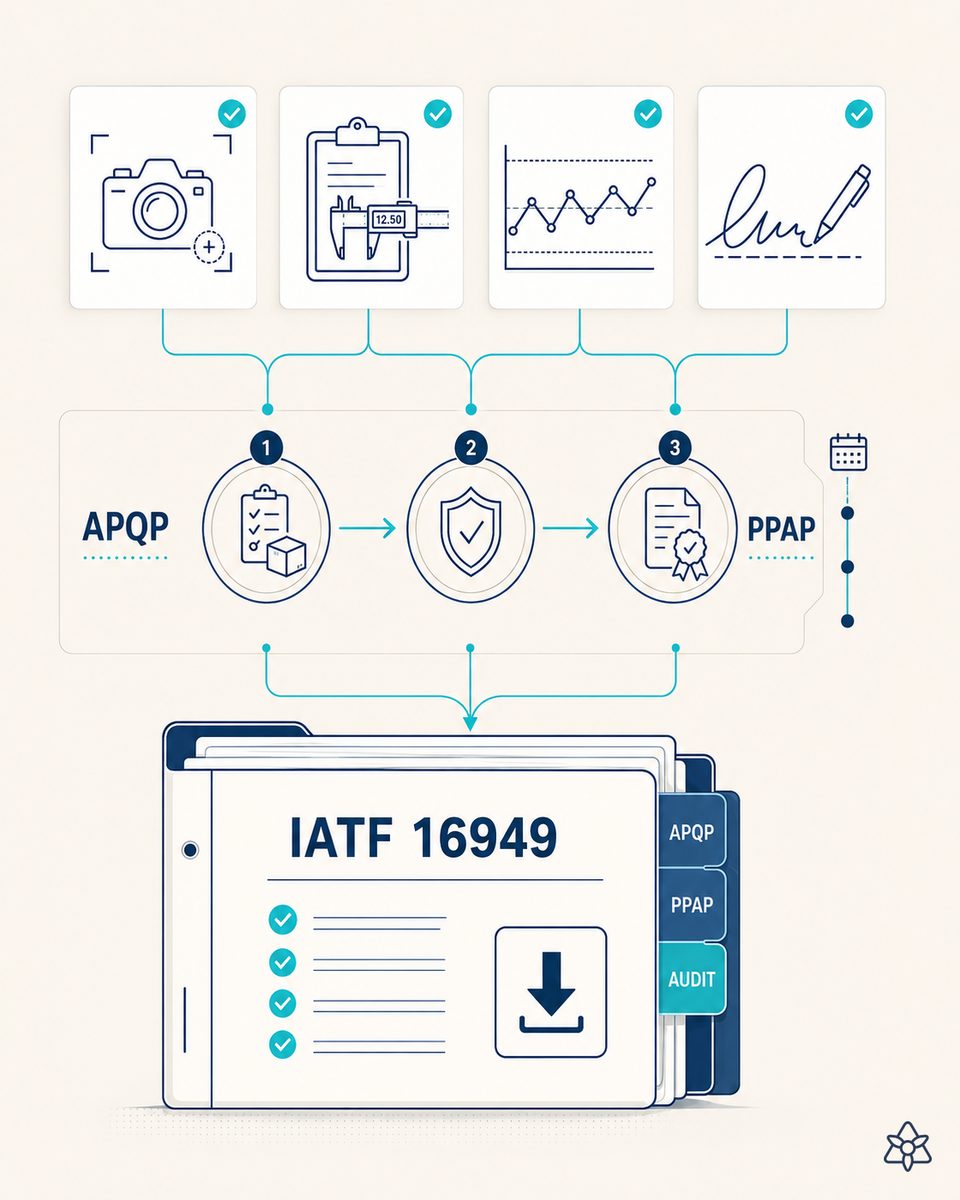
Tracer tags every batch with the OEM it is going to. Connect captures the CSR in force from that customer's portal. The agent assembles the PPAP/PSW in the required format. A person signs — the dossier never leaves on its own.
iLEAN Tracer is the piece that combines Connect (capture per channel) and Agents (regulatory cross-check + dossier per customer) applied to tier-1 automotive:
- Connect — captures the CSR in force from the OEM portal (Covisint, SQT, MMOG), the technical note that arrived by email, the frequency change the Stellantis engineer posted this morning. It also captures what the plant produces: the batch recipe in the ERP, OEE from the MES, photos of the old press panel that still is not integrated. All at second zero, with nobody forwarding anything.
- Agents — cross-check the batch recipe, the destination OEM, the CSR version in force for that OEM and the process data. If the next part goes to an OEM with a different control frequency, they apply it to that unit alone. If a technical note leaves a batch in progress out of spec, they hold the shipment and alert the quality engineer through whichever channel they use.
- PPAP/PSW assembly per customer — the agents build the dossier per batch and per OEM in the format that OEM requires (Belegliste, GYS, SQT), with process capabilities, control charts, master samples and authorised deviations. Ready for the customer portal. The engineer reviews and signs.
The three security rings guarantee that the OT network (the presses, the robots) stays isolated: Tracer lives in ring 3, validates in ring 2 and only deposits cryptographically signed data in ring 1 — where a person decides whether to import it.
Manual multi-OEM CSR management vs. per-customer segmentation with iLEAN Tracer
| Aspect | Manual management (spreadsheets + portals) | With iLEAN Tracer |
|---|---|---|
| CSR in force per OEM | The engineer downloads it from the portal and saves it in a folder | Automatic capture at second zero, linked to the batch |
| SKU changeover between two OEMs | Control sheet and manual signature by the shift leader | Tracer applies the new OEM's CSR to the next unit |
| Control frequency | A single one for the whole line, the most demanding | Per OEM, per batch — the minimum needed, without over-controlling |
| Technical change note | Email that arrives when the batch is already running | Immediate capture + hold on the affected batch |
| PPAP/PSW assembly | Four spreadsheets cross-checked at 10 p.m. by the engineer | Dossier per OEM in its format, automatic, ready to sign |
| IATF + CSR audit | Rebuilding the history weeks in advance | Traceability per batch, per OEM, per CSR version |
Impact estimate for your plant — to be validated with your numbers.
The block below is an estimate to be validated with the specific data of your plant. We put it forward so the committee has an order of magnitude; we refine it during the diagnostic.
- Tier-1 plant with 3-5 active OEMs, several lines, daily SKU changeovers and at least one PPAP rejected or escalated in recent years because of mixed CSR or broken traceability.
- Tracer pilot on one line + one OEM (CSR capture + batch segmentation + PPAP/PSW assembly). First value expected within a few weeks.
- Indicative payback between 4 and 9 months, depending on the frequency of Q incidents (8D, escalations), the quality engineer's time spent assembling dossiers by hand and the average cost of the last rejected PPAP.
- The hard lever is a single protected approval: losing Ford's Q1 or Stellantis' A rating costs more than the system; freeing up quality engineering time to solve root causes does too.
- Expected reduction in manual PPAP/PSW assembly time of ≥ 30%.
And the quality director's reasonable doubt
«What if the AI mixes two CSR without us noticing?» — hallucination is a problem of free generation, not of anchored tasks. In tasks where the AI merely recontextualises a data point from one system into another (reading the CSR from the portal and applying it to the correct batch), the best models brought the error below 1.5%[2]. And even then, what is critical is never decided alone: Tracer assembles the dossier and a person signs. The three security rings are there precisely for this.
[1] Automotive quality standard in the order of 25 PPM. Symestic.
[2] OpenAI paper «Why Language Models Hallucinate», 2025 — on the reliability of AI in anchored tasks.
What people ask about OEM CSR segmentation in tier-1 plants
What are CSR in automotive and why does each OEM have its own?
CSR stands for Customer Specific Requirements: the requirement book each OEM adds on top of IATF 16949. Stellantis has CSL1000, VW demands Formel-Q, Renault ASES, Ford Q1 and BMW the extended VDA-6.3. They cover inspection frequencies, PPAP/PSW format, master sample retention, process capability records, change management and incident response. In a tier-1 plant serving several OEMs, every part number travels with its own CSR — mixing two is not a minor infringement, it means losing that customer's approval.
How does iLEAN Tracer separate the flow of several OEMs on the same line?
Tracer tags every batch from the COC with the destination OEM and the applicable CSR version. Connect captures the batch recipe (ERP, MES, the quality engineer's spreadsheet) and the agents cross-check it against the CSR book in force. If the next unit on the line goes to an OEM with a different control frequency (1/100 parts vs 1/500), Tracer applies it to that unit alone without reconfiguring the line. Each PPAP/PSW is assembled separately and a person signs each OEM's dossier.
What happens when an OEM changes its CSR mid-campaign?
It is the norm: the OEM publishes a technical note, changes a control frequency, requires a new photographic record. Today that note reaches the quality engineer by email and takes days to reach the shop floor. Connect captures it at second zero, the agents check it against that OEM's batches in progress and, if there is a deviation, hold the parts pending shipment. A person validates the change before delivery resumes. No emergency meetings, no spreadsheets cross-checked at 1 a.m.
How is the PPAP/PSW assembled automatically per customer?
Each OEM demands the PPAP/PSW in its own format — Stellantis asks for SQT, VW for Belegliste, Ford for GYS. Tracer's agents gather, per batch and per OEM, the process capabilities, control charts, master samples, authorised deviations and the quality manager's signature — and assemble the dossier in the format that OEM requires, ready for the customer portal. The quality engineer no longer copies across four spreadsheets at 10 p.m.: they review and sign.
Does it work in a tier-1 plant with legacy lines and old machines?
Yes — that is exactly what it is for. Connect has a capture gradient per machine: if the 1990s press only has an analogue panel, a person photographs the panel and the agents extract the data; if it has an old isolated PC, Connect connects and reads it; if it has a modern interface, direct integration. It does not force you to replace the press in order to speak the OEM's language.
More cases in ilean tracer
- GS1 SSCC label on a multi-SKU mixed pallet — one error is not an incident, it is a pallet rejected at the dock.How iLEAN Tracer builds the GS1 SSCC label of a multi-SKU mixed pallet for retail in real time, with no…
- mRNA vaccine batch in a -70 °C chain — an unrecorded break is not an incident, it is an invalidated batch.iLEAN Tracer signs every -70 °C ultra-cold chain break of an mRNA vaccine batch with timestamp, owner…
- EU, UK and Swiss nutrition labelling per SKU — a pallet that crosses the border with the wrong label is a rejection, not an incident.iLEAN Tracer segments EU, UK and Swiss nutrition labelling by destination for every SKU, without…
- DSCSA DataMatrix for saleable units in the US — a badly printed code is not a defect, it is a verification that bounces back at the wholesaler.iLEAN Tracer assigns the DSCSA DataMatrix to every saleable unit of capsules for the US — in-line print…
- An HV transformer FAT is alive or it is nothing — a summarised PDF does not answer the question that arrives 5 years later.iLEAN Tracer records the HV transformer FAT piece by piece, with insulation curve and serial of every…
- Prefilled syringe autoinjector UDI-DI serialization — a corrupt code is not an error, it is a market recall.How iLEAN Tracer assigns UDI-DI per prefilled syringe autoinjector unit, verifies it with inline vision,…
Tell us your case and within 48h we'll send you the estimated ROI of this AI project for your tier-1 plant.
We work on your plant's real data, not on ours. Diagnostic with no commitment.
Request estimated ROI in 48h See iLEAN Tracer