Prefilled syringe autoinjector UDI-DI serialization — a corrupt code is not an error, it is a market recall.
UDI-DI serialization on a prefilled syringe autoinjector demands one verification per unit without slowing the line. iLEAN Tracer assigns the UDI-DI to every syringe, verifies it with inline vision, cross-checks it against the serialization system and holds release if something does not add up. The person signs.
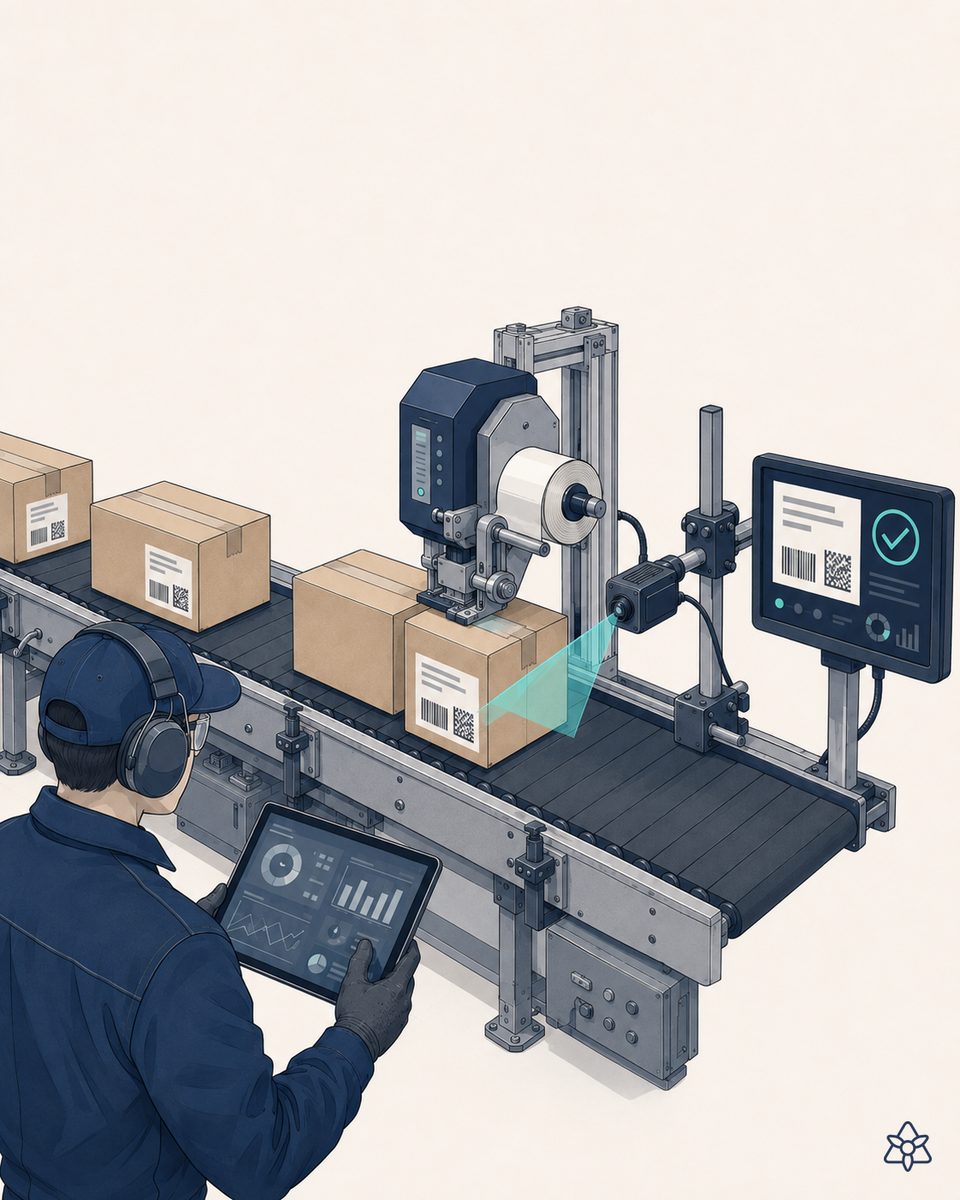
The UDI does not break on paper — it breaks on the line, right before aggregation.
A prefilled syringe autoinjector that reaches the market clean is the cross-check of four data points living in four different systems:
- The assigned UDI-DI — the unique device identifier that the corporate serialization system generated for this unit.
- The printed UDI-PI — the batch, the expiry date and the serial number that the printer applied on the syringe body or on the autoinjector.
- The readable DataMatrix — the actual image, with its contrast, its position and its content, exactly as it ends up after assembly and insertion into the autoinjector.
- Aggregation to case and pallet — the SSCC and the reconciliation with the national medicines verification system.
The QA manager knows this, but cannot inspect every unit by eye. The line runs at 200-400 units per minute. The standard camera reads the code, but does not cross-check it against the serialization queue — it only says "I read it" or "I don't". The classic setup works 99.8% of the time. The remaining 0.2% is the one that triggers a recall when that aggregated case reaches the customer with two duplicate codes or a code that does not exist in the national system.
iLEAN Tracer does not replace your serialization system — it seals the cracks between serialization, printing, vision and aggregation.
The corrupt UDI-DI problem is not a lack of information: it is information living on four islands that, at the critical moment (the unit passing under the camera), is not cross-checked in time. iLEAN Tracer acts as the filler that closes those gaps, without asking you to change SAP, the corporate serialization system, or the assembly line.
Tracer assigns UDI-DI per unit. Edge reads the DataMatrix before aggregation. Connect captures the serialization queue wherever it comes from. The agent cross-checks, holds if it does not add up, and prepares the dossier. The person signs — never the other way round.
The iLEAN pieces applied to UDI-DI serialization of prefilled syringe autoinjectors:
- Tracer (functional layer on top of Edge) — assigns the UDI-DI to each unit by consuming the queue from the corporate serialization system, and keeps the syringe-autoinjector-carton-case-pallet traceability alive without losing the chain of association. Every unit carries its number, and every number carries its evidence.
- Edge — terminal with machine vision (CNN) on the assembly line. It reads the printed DataMatrix in milliseconds, validates content, contrast and position, and fires the rejector if the unit does not match the next expected item in the queue. It works without a network. If the plant loses its connection to the corporate system, Edge keeps reading and rejecting with its local buffer — because what is critical cannot depend on connectivity.
- Connect — captures the serialization queue whether it comes from the modern corporate system, from a pharma-vertical MES, or from a CSV file the IT manager drops into a shared folder. And it also captures what arrives from outside (a notified body alert, a rule change in the national system) at second zero.
- Agent — cross-checks the assigned queue, the Edge visual reading, the shift history and the regulatory rules (FDA 21 CFR Part 11, EU MDR, UDI). If there is a deviation, it does not send an email at 10pm: it holds batch release and alerts the QA manager through whichever channel they use. The person validates and signs; release does not go out on its own.
UDI verification with a standalone camera vs. cross-checked verification with iLEAN Tracer
| Aspect | Standalone vision camera + checklist | With iLEAN Tracer + Edge + Agent |
|---|---|---|
| UDI-DI assignment | Corporate queue, not cross-checked on the line | Assigned per unit and cross-checked against the visual reading |
| DataMatrix verification | Read/no read — content not checked against the queue | Content, contrast and position cross-checked against the expected unit |
| Duplicate UDI detection | Shows up at aggregation, already in the case | Before aggregation, on the line, in milliseconds |
| Operation without a network | Camera keeps going, queue drifts out of sync | Edge keeps reading with a local buffer and reconciles on reconnection |
| Reconciliation with the national system | Rebuilt by hand when it fails | Automatic batch dossier, with a DataMatrix image per unit |
| Batch release | Signing without cross-checked evidence | Person signs on the complete dossier, AI proposes, holds if it does not add up |
Impact estimate for your plant — to be validated with your numbers.
The block below is an estimate to be validated with the specific data of your plant. We put it forward so the committee has an order of magnitude; we refine it during the diagnostic.
- Combination device line at 200-400 units per minute, multi-SKU with several autoinjector presentations, aggregation to case and pallet with SSCC.
- Tracer pilot on one line (Edge camera over the DataMatrix + rejection actuator + integration with the corporate serialization system and the ERP). First value expected within a few weeks.
- Expected reduction in units mass-rejected due to desynchronization between queue and printing: ≥ 30% over the baseline incident rate of your line.
- Indicative payback between 4 and 9 months, depending on the frequency of documented incidents and the average cost of disaggregation and reprocessing at your customer.
- The hard lever is a single recall for a corrupt UDI avoided: product recovered from the hospital chain, reverse logistics, destruction, brand damage and a letter to the notified body. One recall pays for the pilot and the ones after it.
And the reasonable doubt of the pharma CAIO
"What if the AI gets it wrong and lets a badly serialized unit through?" — hallucination is a problem of free generation, not of anchored tasks. In tasks where the AI is limited to recontextualizing a data point from one system into another (reading the DataMatrix and comparing it against the expected queue), the best models brought the error below 1.5% [1]. And even then, what is critical is not decided alone: iLEAN Tracer holds the release and the person signs. The three safety rings are there for exactly this.
[1] OpenAI paper "Why Language Models Hallucinate", 2025 — on the reliability of AI in anchored tasks.
What people ask about prefilled syringe autoinjector UDI-DI serialization
What does UDI-DI require on a prefilled syringe autoinjector?
An autoinjector with a prefilled syringe is a combination device under FDA and EU MDR/IVDR — it needs a unique device identification (UDI) made up of a device identifier (UDI-DI) plus a production identifier (UDI-PI) carrying batch, expiry date and serial number where applicable. That forces per-unit serialization, encoding the data in a machine-readable DataMatrix, and keeping the unit-batch-dossier link alive throughout the shelf life. The number is not the problem: the cross-check is — every unit has to preserve its traceability across the syringe, the autoinjector, the carton and the aggregated case, without losing a single association.
How do you verify UDI-DI per unit without slowing the line?
By cross-checking what is printed against what is seen. iLEAN Tracer assigns the UDI-DI to each unit from the serialization system, and a terminal with inline vision (CNN) reads the printed DataMatrix in milliseconds to confirm readability, content and position. If the code is broken, unreadable, or does not match the one expected from the serialization queue, the system fires the rejector before aggregation. The line does not stop — it only ejects the affected unit and logs the event in the batch dossier.
What happens if a badly serialized syringe reaches aggregation?
Without inline verification it reaches packaging — and by the time someone catches it in QA, it is already aggregated into a case with another 49 units and reported to the national system. Recovering that case means manually disaggregating the whole batch, which costs more than reprocessing it entirely. With iLEAN Tracer the rejection happens before aggregation: the bad unit is ejected, the dossier logs the event, and reconciliation with SAP/MES closes out at the end of the shift. Nothing slips through to the national system with a corrupt UDI.
Can iLEAN Tracer sign off batch release per unit?
Tracer prepares the complete batch dossier — UDI-DI per unit, DataMatrix image, rejector log, reconciliation with the corporate serialization system — and leaves it ready for the person responsible for release to sign. The system holds, the person signs. That is the pattern of the three IRIS safety rings: the AI proposes, validates and prepares the evidence; the critical decision stays human. Release never goes out on its own.
What does it cost to serialize a prefilled syringe line with iLEAN?
The order of magnitude of a Tracer pilot on a combination device line is comparable to any Edge pilot in a pharma plant: an initial investment covering vision terminals + cameras + actuator + integration with the serialization system and the ERP/MES, plus an annual licence. The payback you can reasonably present to the committee sits in the range of several months — the hard lever is a single recall for a corrupt UDI avoided, which in pharma is orders of magnitude above the cost of the pilot. We ask for your plant data and send you the estimated ROI in 48h, using your numbers.
More cases in ilean tracer
- Your plant serves five OEMs and each one brings its own CSR — one mixed dossier and you lose the approval.iLEAN Tracer applies each OEM's own CSR (Stellantis, VW, Renault, Ford) in a multi-customer tier-1…
- DSCSA DataMatrix for saleable units in the US — a badly printed code is not a defect, it is a verification that bounces back at the wholesaler.iLEAN Tracer assigns the DSCSA DataMatrix to every saleable unit of capsules for the US — in-line print…
- An HV transformer FAT is alive or it is nothing — a summarised PDF does not answer the question that arrives 5 years later.iLEAN Tracer records the HV transformer FAT piece by piece, with insulation curve and serial of every…
- The same line manufactures for four chains and for your own brand — cross one specification and you lose the retailer.iLEAN Tracer separates private label from own brand with per-retailer labelling in food plants serving…
- One tanker collects from eight farms — and when the inbound analysis tests positive, nobody knows for sure which ones are inside.Every collection stop is captured: the tanker arrives with its composition known, a positive is…
- Genealogy of a sterile fill-finish batch — the dossier your auditor asks for is not reconstructed, it is composed.iLEAN Tracer composes sterile fill-finish batch genealogy by shift, room and operator — a dossier ready…
Tell us about your case and within 48h we send you the estimated ROI of this AI project for your combination device line.
We work on your plant's real data, not ours. Diagnostic with no commitment.
Request estimated ROI in 48h See iLEAN Tracer