The same line manufactures for four chains and for your own brand — cross one specification and you lose the retailer.
A food plant supplying private label to several grocery chains and discounters while keeping its own brand manages five different specifications on the same line: banned ingredients, labelling by language, QA frequencies, customer dossier. iLEAN Tracer separates the flow by recipient from the production order onwards and assembles each retailer dossier. A person signs.
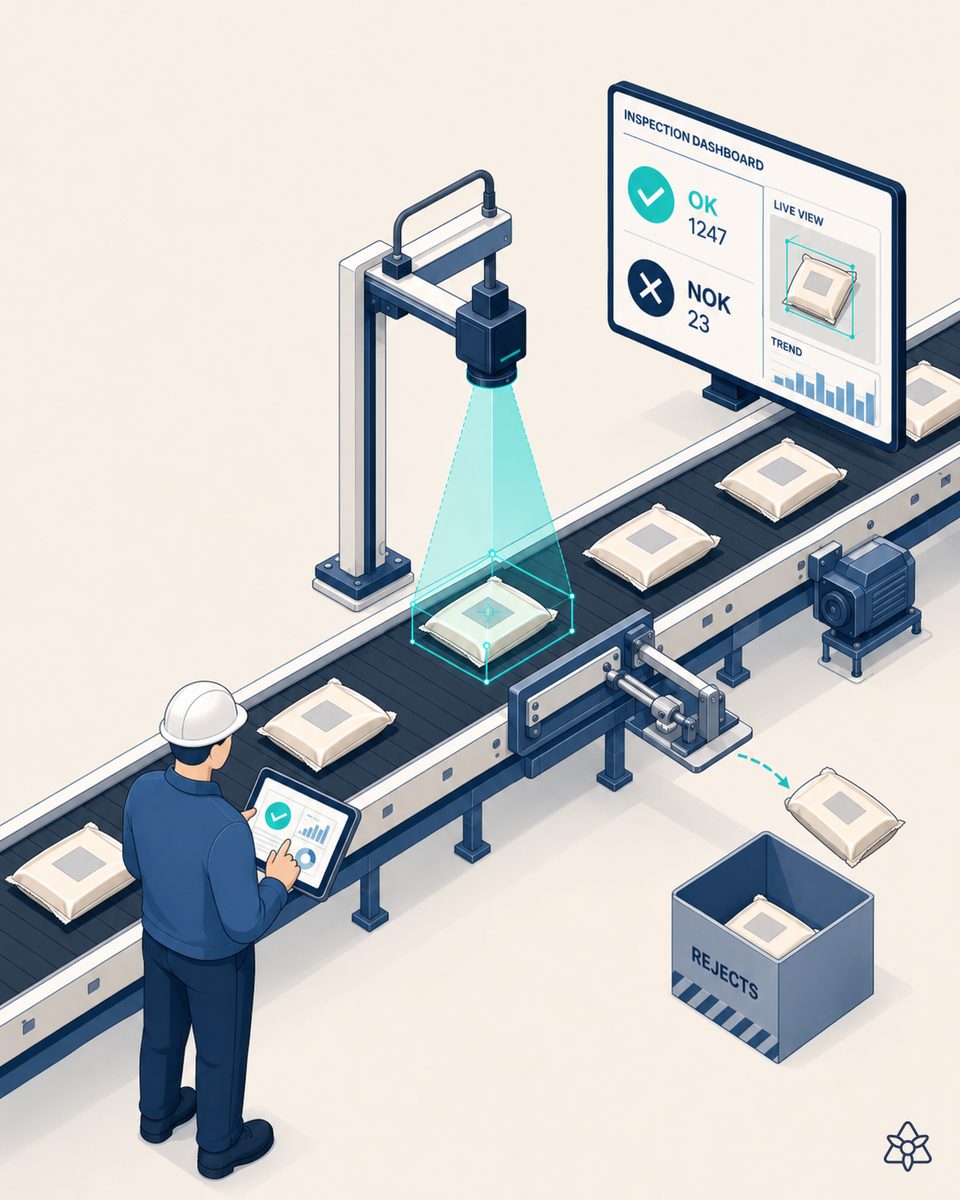
Five specifications on the same line — and the retailer brand does not forgive.
A multi-retailer food plant manufactures the same base product under different rules depending on who puts their name on the label:
- Permitted ingredients by chain — one retailer bans palm oil, another demands a sustainable source for cocoa, a third asks for natural flavouring instead of nature-identical. The same recipe does not work for everyone.
- Labelling by language and by market — a German discounter wants DE-FR-IT, a UK discounter asks for EN with a UK nutritional table, a Spanish chain asks for Spanish and Portuguese, a French hypermarket group FR-NL. A change of SKU is a change of specification.
- Different QA frequencies — one retailer asks for an analysis of every batch, another one per shift, another a weekly one with a retained sample. The line cannot run at the cadence of the strictest without killing the margin.
- A QA dossier per retailer — one in the supplier portal, another in its own supplier system, another in its quality centre. The quality technician keeps as many spreadsheets as accounts the plant has.
- Your own brand, on top — with its own internal specification, its own labelling and its own QA cycle.
The quality technician knows all this — but cannot watch five portals at once. And when control is lost over which batch answers to which specification, what breaks is not the recipe: it is the relationship with the retailer. A batch rejected for wrong labelling, a banned additive or an incomplete dossier is not an incident: it is an escalation at the supplier committee.
iLEAN Tracer does not add a sixth portal — it seals the cracks between the five specifications you already manage.
The problem of the multi-retailer plant is not a lack of information: it is information living in islands (one specification per chain, one portal per account, one spreadsheet per technician) that, at the critical moment (a SKU changeover, a specification revision published on a Friday afternoon), does not reach the decision maker in time. iLEAN Tracer acts as the filler that closes those gaps, without asking you to change your ERP or your QMS.
Tracer tags every batch with the retailer it is going to. Connect captures that retailer current specification. The agent assembles the QA dossier in the format of the customer portal. A person signs — the batch does not ship on its own.
iLEAN Tracer is the piece that combines Connect (capture by channel) and Agents (regulatory cross-check plus per-customer dossier) applied to the multi-retailer food plant:
- Connect — captures the current specification of each retailer from the supplier portal, the revision that arrived by email from a discounter QA department, the packaging change a chain uploaded this morning, the message from the importer of a French group with the new shelf-life window. It also captures what is inside: the batch recipe in the ERP, the MES data, the lab analyses. All at second zero.
- Agents — cross-check the batch recipe, the recipient retailer, the current version of the specification and the process and QA data. If the next unit is going to a retailer with a banned additive, they apply the rule before packaging. If a specification revision leaves a batch in progress out of compliance, they hold the shipment and alert the quality technician through whichever channel they use.
- QA dossier assembly per retailer — the agents build the dossier per batch and per retailer in the format that retailer demands (supplier portal, discounter supplier system, hypermarket quality centre), with analyses, cleaning records, label photos and authorised deviations. Ready to upload. The technician reviews and signs.
The three security rings guarantee that critical customer information (recipes, confidential specifications) stays separated per retailer — lateral leakage between accounts is not an acceptable risk, and Tracer blocks it by architecture.
Manual multi-specification management vs. per-retailer segmentation with iLEAN Tracer
| Aspect | Manual management (spreadsheets + portals) | With iLEAN Tracer |
|---|---|---|
| Current specification per retailer | The technician downloads it and saves it in a folder | Automatic capture from the portal, linked to the batch |
| SKU changeover between two retailers | Manual checklist by the shift supervisor | Tracer applies the new retailer specification to the next batch |
| Labelling by language and market | Template picked by hand by the operator | Label linked to the batch recipient, verified before closing |
| Ingredients banned by retailer | Knowledge held in the quality technician head | Active rule per batch, blocking if the recipe does not match |
| QA dossier per customer | Five cross-referenced spreadsheets, one per account | Dossier per retailer in its format, automatic, ready to sign |
| IFS/BRC audit plus customer audit | Reconstructing the history weeks in advance | Traceability per batch, per retailer, per specification version |
Impact estimate for your plant — to be validated with your numbers.
The block below is an estimate to be validated with the actual data of your plant. We put it forward so the committee has an order of magnitude; we refine it during the diagnostic.
- Food plant with 3-5 active private label retailers plus its own brand, several lines, daily SKU changeover and at least one batch rejection or escalation in recent years caused by mixed specifications, labelling or an incomplete dossier.
- Tracer pilot on one line plus two retailers (specification capture + per-batch segmentation + QA dossier assembly). First value expected within a few weeks.
- Indicative payback between 4 and 9 months, depending on the frequency of rejections and escalations, the quality technician time spent assembling dossiers by hand and the average cost of the last rejected batch or rework.
- The hard lever is a single protected retailer relationship: dropping one rung at the supplier committee, or staying on list A instead of list B, is worth more than the system.
- Expected reduction in manual QA dossier assembly time ≥ 30%.
And the reasonable doubt of the quality director
«What if the AI mixes two specifications without us noticing?» — hallucination is a problem of free generation, not of anchored tasks. In tasks where the AI is limited to recontextualising a piece of data from one system into another (reading the retailer specification and applying it to the right batch), the best models brought the error below 1.5%[1]. And even so, what is critical is not decided alone: Tracer assembles the dossier and a person signs. The three security rings are there precisely for this.
[1] OpenAI paper «Why Language Models Hallucinate», 2025 — on the reliability of AI in anchored tasks.
What people ask about private label segmentation
What extra requirements does a retailer add to its private label compared with your own brand?
The retailer protects its brand with a specification of its own: detailed recipe, list of permitted and banned ingredients, organoleptic parameters, shelf-life window, incident handling, QA frequencies, packaging and, increasingly, sustainability criteria. Every large grocery chain and every discounter has its own private label specification — and each private label SKU travels with those requirements, different from the ones that apply to the brand you manufacture under your own name.
How does iLEAN Tracer separate private label from own brand on the same line?
Tracer tags every batch from the production order with its recipient (retailer A, retailer B, own brand) and the applicable version of the specification. Connect captures the batch recipe and the agents cross-check it against that retailer current specification. The next unit may go to a Spanish grocery chain (without one specific additive, labelled in Spanish and Portuguese) and the one after that to a German discounter (DE-FR labelling, allergen list in a different order) — Tracer applies the rule unit by unit, with no line reconfiguration.
What happens when a retailer changes its specification without warning in time?
It happens often: the retailer quality department publishes a revision and the email gets stuck in the inbox of the plant quality technician. Meanwhile the line keeps running the previous version. Connect captures the change at second zero (retailer email, supplier portal), the agents check it against that retailer batches in progress and, if there is a deviation, they hold the shipment. A person validates the change before delivery resumes.
How is the QA dossier for each retailer assembled automatically?
Every chain demands its QA dossier in its own format — one through its supplier portal, another through its own supplier system, another through its quality centre. Tracer agents gather, per batch and per retailer, the lab analyses, the intermediate cleaning records, the label photos and the authorised deviations — and assemble the dossier in the format that retailer requires. The quality technician reviews and signs.
Does it work in a plant that mixes references from several retailers on the same day?
Yes — that is exactly the scenario it was designed for. Tracer works at batch level, not at shift or SKU level. Connect captures the production order of each batch and the agents apply the correct retailer specification to every unit. If the line switches from one chain to another between two batches, Tracer verifies the intermediate cleaning each specification requires and only releases the second batch once a person signs. The line does not restart on its own.
More cases in ilean tracer
- DSCSA DataMatrix for saleable units in the US — a badly printed code is not a defect, it is a verification that bounces back at the wholesaler.iLEAN Tracer assigns the DSCSA DataMatrix to every saleable unit of capsules for the US — in-line print…
- An HV transformer FAT is alive or it is nothing — a summarised PDF does not answer the question that arrives 5 years later.iLEAN Tracer records the HV transformer FAT piece by piece, with insulation curve and serial of every…
- Prefilled syringe autoinjector UDI-DI serialization — a corrupt code is not an error, it is a market recall.How iLEAN Tracer assigns UDI-DI per prefilled syringe autoinjector unit, verifies it with inline vision,…
- One tanker collects from eight farms — and when the inbound analysis tests positive, nobody knows for sure which ones are inside.Every collection stop is captured: the tanker arrives with its composition known, a positive is…
- Genealogy of a sterile fill-finish batch — the dossier your auditor asks for is not reconstructed, it is composed.iLEAN Tracer composes sterile fill-finish batch genealogy by shift, room and operator — a dossier ready…
- A closed-PDF as-built does not survive the first field incident.iLEAN Tracer keeps the as-built of every wind turbine nacelle: torque of every critical bolt and serial…
Tell us about your case and within 48h we will send you the estimated ROI of this AI project for your multi-retailer plant.
We work on the real data of your plant, not on ours. Diagnostic with no commitment.
Request estimated ROI in 48h See iLEAN Tracer