DSCSA DataMatrix for saleable units in the US — a badly printed code is not a defect, it is a verification that bounces back at the wholesaler.
DSCSA requires every saleable unit (the capsule carton) to carry a GS1 DataMatrix with GTIN + serial + batch + expiry, and every actor in the chain to verify it. An unreadable or duplicated code is discovered late — at the wholesaler, at the pharmacy, or by the federal inspector. iLEAN Tracer assigns the right DataMatrix to every unit, verifies the print in line with vision and holds the unit before the master case. A person signs every batch — the system does not decide for them.
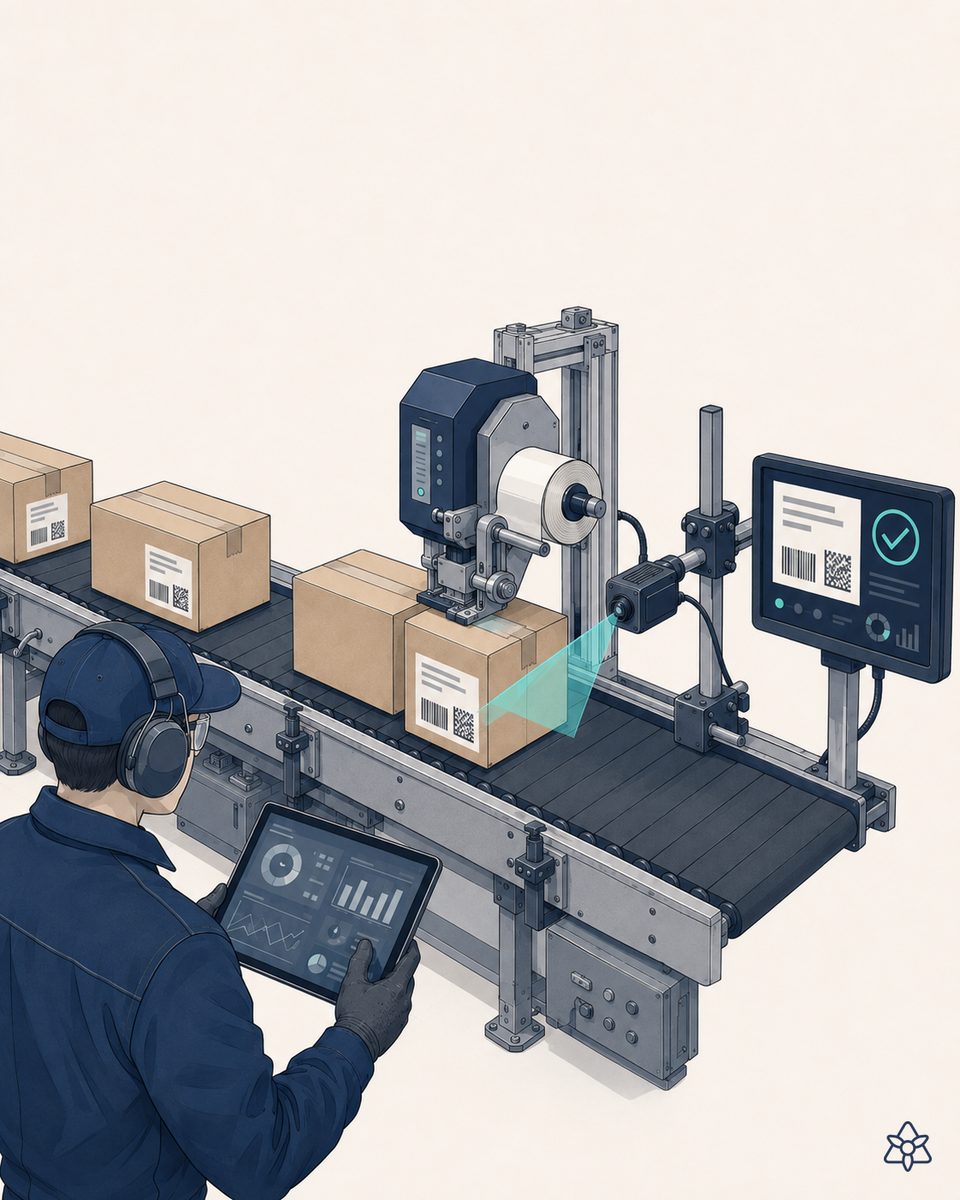
Printing the DataMatrix is not serializing — verifying that it is right and that it matches the unit is.
In a pharmaceutical plant exporting to the US, the DSCSA flow touches at least three levels that rarely meet at second zero:
- The corporate serialization system (Adents, Systech, Antares, Tracelink…) that manages the serial pool and the EPCIS repository.
- The packaging line — cartoner or blister line — with its thermal or laser printer that prints the DataMatrix on every saleable unit.
- The operator who changes SKU, mounts the new reel, adjusts the print head and signs off the first pack.
The problem is not serialization itself; your corporate system solves that. The problem is the gaps in between: the code printed badly because of head wear, the duplicated serial from a bad resynchronization between system and line, the batch change that never reached the serial pool. The wholesaler detects the problem during saleable unit verification, and the whole shipment comes back. Every rejection is hard cost (reverse logistics, recoding, possible repackaging) plus reputational cost with the wholesaler — which weighs more in the medium term.
iLEAN Tracer does not compete with your serialization system — it seals the gap between the serial pool, the printer and the real unit coming off the belt.
Corporate serialization does its job well: it manages the pool, maintains the EPCIS repository, talks to the chain. What stays exposed is the last metre — the actual print on the capsule carton, the readability verification, the cross-check with the physical unit entering the master case. iLEAN Tracer is the piece of the IRIS category that acts as filler in that last metre, without asking you to change your serialization system or your line.
Edge sees the printed DataMatrix. Connect reads MES, serial pool and badge wherever they are. The agent cross-checks, validates and composes the signed EPCIS event. A person signs — the system does not decide for them.
How the work is split between the iLEAN pieces for this case:
- Edge — a terminal on the cartoner/blister line with an industrial camera. It reads the printed DataMatrix in milliseconds, validates the ANSI/ISO grade, checks that the serial matches the range assigned to the batch. If the code is unreadable, does not match or is duplicated, it triggers the rejector before the master case. It works without network: Edge keeps verifying on cabinet power.
- Connect — captures the manufacturing order from the MES, the serial range reserved in the corporate serialization system, the operator badge at SKU changeover. It also captures what arrives from outside (an email from the US wholesaler about a verification that bounced) at second zero.
- Tracer agent — composes the signed EPCIS event (commission, aggregation, decommission, shipping) with timestamp, batch, location and operator. If tree integrity fails during aggregation (one serial in two master cases at once), it holds and alerts the manager. A person signs — the line does not restart on its own.
Classic serialization vs. serialization with iLEAN Tracer verification
| Aspect | Serialization system + printer | With iLEAN Tracer |
|---|---|---|
| Serial assignment | Central pool → line | Pool + cross-check with MES + operator badge |
| Print verification | Presence sensor, sometimes ANSI grade | CNN vision + ANSI/ISO grade + hold |
| Duplicated serial detection | Later verification by the wholesaler | In line, before the master case |
| Aggregation integrity | Trust in the physical order | Validated by the agent, hold if it fails |
| Operation without network | n/a — depends on the repository | Edge keeps verifying, events signed locally |
| Dossier for FDA/inspection | Reconstructed afterwards | Signed EPCIS, self-contained |
Impact estimate for your plant — to be validated with your numbers.
The block below is an estimate to be validated with the specific data of your plant. We set it out so the committee has an order of magnitude; we refine it during the diagnostic.
- Pharma plant with 1-4 packaging lines (cartoner/blister line) under active DSCSA, with a corporate serialization system already running.
- Tracer pilot on one line (Edge with a DataMatrix camera + integration with MES and serial pool + EPCIS agent). First expected value within a few weeks: the first unit rejected for an unreadable code or an out-of-range serial.
- Indicative payback between 4 and 9 months, depending on the documented frequency of shipments rejected in the US and the average cost of reverse logistics + recoding.
- Expected reduction of rejections in saleable unit verification ≥ 30%. The hard lever is a single shipment rejected at customs avoided.
And the reasonable doubt of the serialization manager
«What if the AI puts noise into the EPCIS event and the repository rejects it?» — hallucination is a problem of free generation, not of anchored tasks. Composing an EPCIS event from MES + pool + camera is exactly an anchored task, where the best models brought the error below 1.5% [1]. And even so, the critical part is not signed on its own: Tracer holds the unit and a person signs. The three iLEAN security rings are designed precisely so that the OT network only accepts what has been validated, packaged, signed and approved by a person.
[1] OpenAI paper "Why Language Models Hallucinate", 2025 — on the reliability of AI in anchored tasks.
What people ask about DSCSA DataMatrix saleable units
What does DSCSA require for a saleable unit in the US?
The Drug Supply Chain Security Act (DSCSA) requires every saleable unit (the smallest sellable unit — the capsule carton) to carry a GS1 DataMatrix with four elements: GTIN, unique serial number, batch number and expiry date. Every movement along the chain (manufacturer → wholesaler → pharmacy/hospital) generates an EPCIS event of the transaction information / history type. The saleable unit verification phase forces every actor to check that the code exists and has not been falsified before reselling it.
How does iLEAN Tracer assign the DataMatrix to each capsule saleable unit?
Tracer cross-checks the manufacturing order from the MES, the serial range reserved for that batch in the corporate serialization system and the reading from the thermal/laser printer on the blister line or cartoner. The agent assigns the right DataMatrix to the right unit, records the EPCIS event and sends the pair (serial, unit) to the EPCIS repository. Edge on the line verifies the printed code with vision (CNN) — if the DataMatrix is unreadable or does not match the expected unit, it triggers the rejector before the master case. The line does not restart on its own: a person signs off the deviation.
What about parent-child aggregation? Bundle, master case, pallet?
Tracer records the full aggregation hierarchy following GS1 EPCIS: saleable unit inside bundle, bundle inside master case, master case inside pallet. Each level signs its event with timestamp, batch, location and operator. If a later decommission shows a unit claiming to be in a master case that was already disaggregated — the classic counterfeiting antipattern — the agent holds it and alerts the serialization manager. Tree integrity is validated at every step.
Is it compatible with existing serialization systems (Adents, Systech, Antares, Tracelink)?
Yes. iLEAN Tracer does not compete with your corporate serialization system — it complements it. Systems such as Adents, Systech, Antares or Tracelink solve the serial pool logic, the EPCIS repository and the connection to the chain. Tracer adds what is hard for them: in-line capture with vision, the cross-check against the operator badge, the integration with your plant's old MES, and the agent that holds the unit when print verification fails. Edge lives next to the line, Connect captures, the agent decides the hold, a person signs.
How much does it cost to implement DSCSA DataMatrix with iLEAN Tracer?
The order of magnitude of a Tracer pilot on a pharmaceutical packaging line under DSCSA is close to that of any Edge+Connect+Agent pilot in pharma — a terminal per line, integration with MES and serialization, a library of signed EPCIS events. A reasonable payback sits in the range of several months; the hard lever is a single shipment rejected at US customs or blocked in saleable unit verification. Send us your plant data and we will send you the estimated ROI within 48h.
More cases in ilean tracer
- mRNA vaccine batch in a -70 °C chain — an unrecorded break is not an incident, it is an invalidated batch.iLEAN Tracer signs every -70 °C ultra-cold chain break of an mRNA vaccine batch with timestamp, owner…
- EU, UK and Swiss nutrition labelling per SKU — a pallet that crosses the border with the wrong label is a rejection, not an incident.iLEAN Tracer segments EU, UK and Swiss nutrition labelling by destination for every SKU, without…
- Your plant serves five OEMs and each one brings its own CSR — one mixed dossier and you lose the approval.iLEAN Tracer applies each OEM's own CSR (Stellantis, VW, Renault, Ford) in a multi-customer tier-1…
- An HV transformer FAT is alive or it is nothing — a summarised PDF does not answer the question that arrives 5 years later.iLEAN Tracer records the HV transformer FAT piece by piece, with insulation curve and serial of every…
- Prefilled syringe autoinjector UDI-DI serialization — a corrupt code is not an error, it is a market recall.How iLEAN Tracer assigns UDI-DI per prefilled syringe autoinjector unit, verifies it with inline vision,…
- The same line manufactures for four chains and for your own brand — cross one specification and you lose the retailer.iLEAN Tracer separates private label from own brand with per-retailer labelling in food plants serving…
Tell us about your case and within 48h we will send you the estimated ROI of this AI project for your DSCSA US line.
We work on the real data of your plant, not on ours. Diagnostic with no commitment.
Request estimated ROI within 48h See iLEAN Tracer