EU, UK and Swiss nutrition labelling per SKU — a pallet that crosses the border with the wrong label is a rejection, not an incident.
The same yoghurt carries three different labels depending on whether it goes to Madrid, Manchester or Zurich — EU 1169/2011, the UK FSA with traffic-light and HFSS, and the Swiss FIO with its language nuances and thresholds. iLEAN Tracer cross-checks batch recipe, SKU destination and the rules in force per country, and composes the correct label for that reel without reprinting the line. A person signs off the reel change.
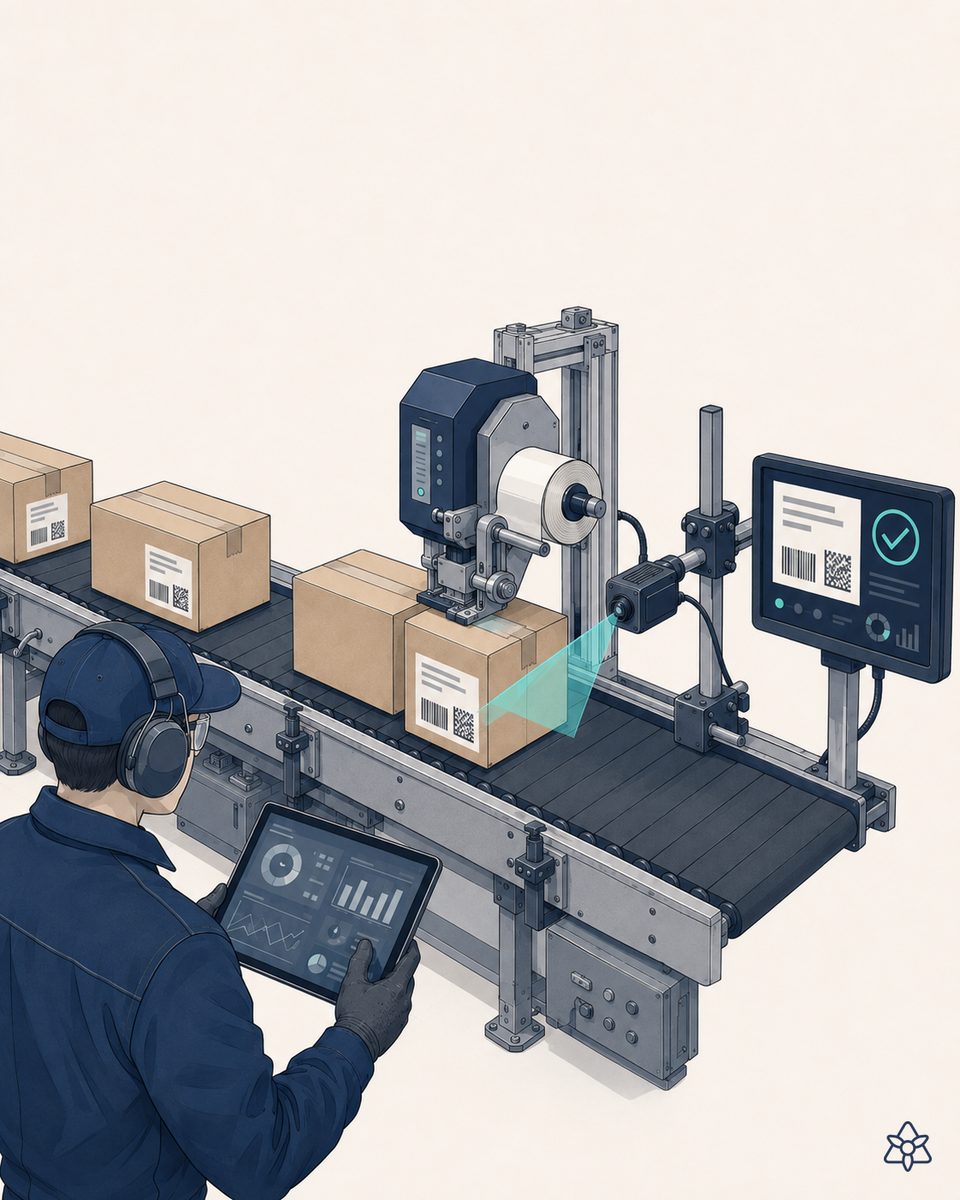
Three regulatory frameworks for the same SKU — and the label reel does not wait.
A European food company exporting to the United Kingdom and Switzerland no longer makes one yoghurt, it makes three regulatory yoghurts:
- EU — Regulation 1169/2011: nutrition table per 100 g, 14 allergens highlighted, batch and date in specific formats.
- UK — after Brexit, the FSA keeps most of the EU framework but adds the voluntary traffic-light scheme and HFSS rules (its own thresholds for fat, sugar and salt) that affect how the product may be advertised.
- CH — the Swiss FIO: nuances in declarations, possible DE/FR/IT languages, and ingredient-origin requirements that are often stricter for dairy and meat.
The quality manager knows this. The packaging operator does not — their screen only says "SKU 47213, reel A, start". If reel A carried the EU label and the sales order was for the UK, the pallet leaves, reaches Dover, the inspector opens it and it goes back. If the reel passed as Switzerland but did not carry the language of the destination canton, the pallet sits in Swiss customs paying storage. The classic system — a master spreadsheet plus a checklist plus the shift manager's eye — works 95% of the time. That 5% is the rejected pallet.
iLEAN Tracer is not a new printer — it is the filler between your ERP, your packaging machine and each country's rules in force.
Multi-country labelling is not a printing problem: it is a problem of cross-checking data that lives on separate islands. The recipe is in the ERP, the destination in the sales order, the rules in a regulatory PDF, the reel in the operator's hands. iLEAN Tracer is the piece of the IRIS category that seals that gap — without asking you to change ERP, MES, packaging machine or printer. It is the filler, not the wall.
Edge sees the reel. Connect reads recipe and destination wherever they live — ERP, sales order, the exporter's spreadsheet. The agent composes the correct label for that country. A person signs off the reel change — never the other way round.
How the work is shared between the iLEAN pieces in this case:
- Edge — a terminal with vision at the packaging machine. It reads the loaded reel (artwork, language, batch) in seconds. If the reel does not match what the agent expected for the SKU on the order, it triggers the traffic light and holds the line before the first sealed pack. It works with no network.
- Connect — captures the batch recipe from the modern ERP, from the vertical MES or from the R&D manager's spreadsheet. It also captures the destination on the sales order and the exporter's notices (an email from the UK importer with the new HFSS rule, a message from the Swiss distributor) at second zero.
- Tracer agent — cross-checks recipe + destination + country rules in force, composes the correct label and sends it to the thermal printer with the ZPL or the template it already uses. If there is a deviation (the loaded reel is for another country), it holds the change and alerts the quality manager over the channel they use. The person validates and signs off.
Manual multi-country labelling vs. segmented labelling with iLEAN Tracer
| Aspect | Manual labelling + master spreadsheet | With iLEAN Tracer |
|---|---|---|
| Source of the recipe | R&D manager's spreadsheet, copy on the shop floor | Batch recipe unified at second zero |
| Source of the destination | Sales rep's order, on paper in the office | Sales order read by Connect, cross-checked with the SKU |
| Per-country rules | Regulatory PDF in the quality manager's drawer | Versioned library of EU/UK/CH templates |
| Reel change | Operator loads the right one, shift manager signs off | Tracer composes, Edge verifies, a person signs off |
| Error detection | Inspector at the UK border, Swiss customs | Before the first sealed pack, on the line |
| Regulatory update | Manual rollout of the new PDF to the plant | New template uploaded and promoted without stopping the line |
Impact estimate for your plant — to be validated with your numbers.
The block below is an estimate to be validated with your plant's actual data. We set it out so the committee has an order of magnitude; we refine it during the diagnostic.
- Food plant with several packaging lines and an EU/UK/CH mix, an SKU mix with variable recipes and different reels per destination.
- Tracer pilot on one line (Edge at the packaging machine + integration with the ERP sales order + library of per-country templates). First value expected within a few weeks.
- Indicative payback between 4 and 9 months, depending on the documented frequency of pallets rejected at the border and the average cost of return/rework.
- Expected reduction in the cost of labelling non-conformities of ≥ 30% in the first year — a single pallet rejected at the UK border usually covers several months of licence.
And the regulatory manager's reasonable doubt
"What if the AI picks the wrong template and sends a UK label to the EU pallet?" — hallucination is a problem of free generation, not of anchored tasks. Composing a label from a template plus ERP data is exactly the kind of anchored task in which the best models brought error below 1.5% [1]. And even so, nothing critical is decided alone: Tracer holds the reel change and a person signs off. The three safety rings exist precisely for this.
[1] OpenAI paper "Why Language Models Hallucinate", 2025 — on the reliability of AI in anchored tasks.
What people ask about EU/UK/CH nutrition labelling
How does nutrition labelling differ between the EU, the UK and Switzerland for the same product?
The same yoghurt sold in Madrid, Manchester and Zurich carries three different labels. The EU requires the format of Regulation 1169/2011, with the nutrition table per 100 g and the 14 allergens. After Brexit, the UK adds the FSA's voluntary Nutri-Score / traffic-light scheme and its own HFSS rules (foods high in fat, sugar and salt). Switzerland applies its own FIO (Food Information Ordinance), with nuances on languages (DE/FR/IT) and on some declarations. Printing the EU label on a pallet bound for the UK is a border rejection; printing it for CH is a cantonal fine.
How does iLEAN Tracer segment the label by destination without stopping the line?
Tracer cross-checks three pieces of data that today live on separate islands: the batch recipe held in the ERP, the SKU destination held in the sales order or in the exporter's packing list, and the set of rules in force per country, which lives in a regulatory PDF. The agent composes the correct label for that destination and sends it to the packaging machine's thermal printer before the reel goes on line. If the destination changes mid-run (rarely, but it happens), Tracer holds the change and a person signs off the new reel.
Do we have to replace the packaging machine or the thermal printer to implement Tracer?
No. iLEAN Tracer sits next to the packaging machine, not inside it. It reads the packaging order from the MES or the ERP through the integration you already have (OPC-UA, REST, file drop) and sends the composed template to the thermal printer over the channel it already uses. If the printer is old and only understands ZPL, Tracer generates ZPL; if it is modern and understands templates, Tracer fills the template in. Nothing you already own has to be thrown away — that is the IRIS filler rule.
And if the regulation changes? Who updates the rules?
The rules live in a single place inside iLEAN — a versioned repository of per-country templates, maintained by the quality/regulatory team with the agent's support. When a new rule comes into force (for example, a change to the UK HFSS threshold), the team uploads the new template, validates it against a sample of SKUs and promotes it. Tracer starts using it on the next batch. There is no software deployment, no plant shutdown — it is a template update.
How much does it cost to segment multi-country labelling with iLEAN Tracer?
The order of magnitude of a Tracer pilot on one multi-country packaging line is close to that of any Edge+Connect+Agent pilot in a food plant — an on-line terminal, integration with ERP/MES, and a library of templates per destination. A reasonable payback sits in the range of several months; the hard lever is a single pallet rejected at the UK border or fined by a Swiss canton. We ask for your plant's data, your destinations and your SKU mix, and we send you the estimated ROI within 48h using your numbers, not ours.
More cases in ilean tracer
- EUDR dossier for a mango reefer container — a container held at customs is not paperwork, it is shelf life thrown away at the port.How iLEAN Tracer closes the EUDR dossier of a mango reefer container with plot coordinates and country…
- GS1 SSCC label on a multi-SKU mixed pallet — one error is not an incident, it is a pallet rejected at the dock.How iLEAN Tracer builds the GS1 SSCC label of a multi-SKU mixed pallet for retail in real time, with no…
- mRNA vaccine batch in a -70 °C chain — an unrecorded break is not an incident, it is an invalidated batch.iLEAN Tracer signs every -70 °C ultra-cold chain break of an mRNA vaccine batch with timestamp, owner…
- Your plant serves five OEMs and each one brings its own CSR — one mixed dossier and you lose the approval.iLEAN Tracer applies each OEM's own CSR (Stellantis, VW, Renault, Ford) in a multi-customer tier-1…
- DSCSA DataMatrix for saleable units in the US — a badly printed code is not a defect, it is a verification that bounces back at the wholesaler.iLEAN Tracer assigns the DSCSA DataMatrix to every saleable unit of capsules for the US — in-line print…
- An HV transformer FAT is alive or it is nothing — a summarised PDF does not answer the question that arrives 5 years later.iLEAN Tracer records the HV transformer FAT piece by piece, with insulation curve and serial of every…
Tell us about your case and within 48h we'll send you the estimated ROI of this AI project for your multi-country packaging.
We work on your plant's real data, not ours. Diagnostic with no commitment.
Request estimated ROI within 48h See iLEAN Tracer