A closed-PDF as-built does not survive the first field incident.
Every wind turbine nacelle operates for decades with its own winds, its own maintenance crews and its own degradation. iLEAN Tracer keeps the as-built unit by unit, with the tightening torque of every critical bolt and the serial number of every component — captured at second zero, not consolidated at the end. The day O&M asks “how was this assembled?”, the answer exists. The person signs.
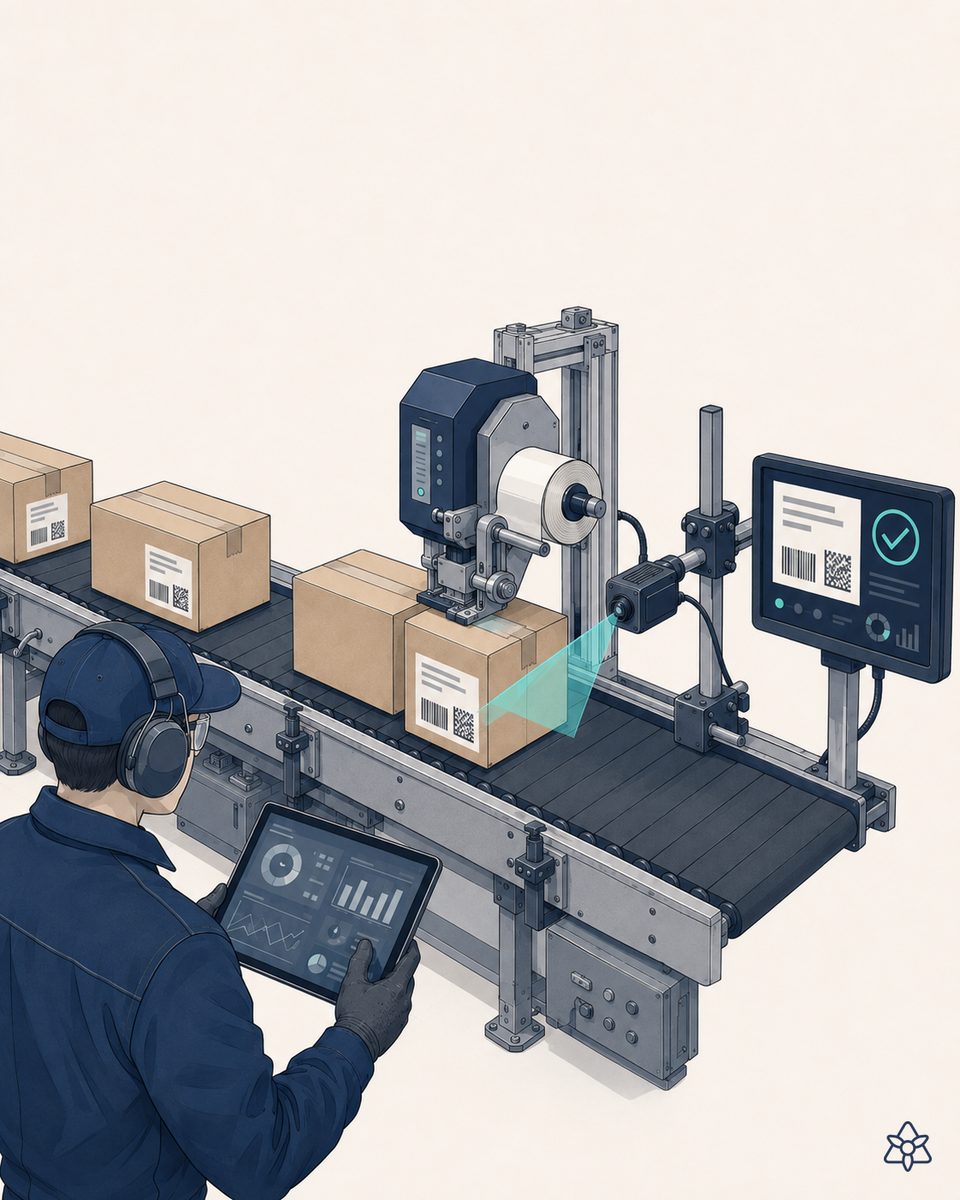
The classic as-built is assembled at the end of the FAT — and whatever never reached the PDF does not exist.
The classic documentation package for a nacelle runs to some 1,500 pages: component list with serials, tightening torque records by station, approved non-conformities, electrical and mechanical FAT results, certificates. It is consolidated at the end, in a quality office, out of very heterogeneous sources:
- Tightening tools that emit the real torque inside their own software — and dump it into a spreadsheet at the end of the shift (if nobody loses the USB stick).
- Component serial readings (gearbox, generator, converter, yaw drives) — done by hand with a scanner gun in many plants, with the chance of misreading or tying the serial to the wrong sub-assembly.
- Deviation approvals that cross the supervisor's desk verbally or on a signature sheet that ends up in the physical filing cabinet.
- FAT tests with their own templates, their own measurement systems and their own owners.
Consolidation works — most of the time. Until it does not: a nacelle delivered 18 months ago shows abnormal vibration in the field, and O&M asks for the exact torque used on the hub bolts. The data exists somewhere — but reconstructing it from signature books, the assembler's photos and the supervisor's memory takes weeks. And meanwhile, the turbine stays down or the customer stays doubtful.
The sector that knows this pain better than anyone is aerospace. The good news: the solution proven in aerospace fits wind.
iLEAN Tracer is the filler between the digital tools, the operator and the living dossier.
The data exists — it is in the tightening tool, on the component label, in the supervisor's voice. What is missing is capturing it at second zero and tying it to the nacelle ID, instead of consolidating it two days later into a PDF. iLEAN Tracer sits on top of the line without asking you to change tools, MES or suppliers.
Connect reads the tool and the supervisor's voice. Edge reads the serial on the component label. The agent builds the living as-built per nacelle. The person signs — never the other way round.
The iLEAN pieces applied to unit-by-unit as-built:
- Connect on tightening tools — captures the real torque of every shot at second zero and ties it to the specific bolt via the operation sequence. If the tool is old and only outputs its curve on a local industrial PC, Connect reads it from there. If the supervisor approves a deviation by voice, it is recorded with a timestamp and a signature.
- Edge on assembly stations — a vision terminal that reads the label of every component (gearbox, generator, converter, yaw) and the nacelle ID. If the network drops, it keeps reading and recording locally. Zero manual note-taking by the operator for data a camera can read.
- As-built agent — builds the living dossier per nacelle: torques by bolt, serials by component, approved deviations, electrical and mechanical FAT. When the question comes from the customer or from post-sale O&M, the answer is immediate and queryable. If a pattern shows up (a fastener supplier with out-of-range torques, a gearbox batch with a recurring assembly stamp), the agent flags it. The person signs every conclusion that affects handover or a field campaign.
As-built consolidated into a PDF vs. living as-built with iLEAN Tracer
| Aspect | Classic PDF as-built | With iLEAN Tracer |
|---|---|---|
| Tightening torque capture | USB stick from the tool at end of shift | Stream at second zero, bolt by bolt |
| Component serial reading | Manual scanner gun, risk of wrong association | Edge reads and associates automatically |
| Approved deviations | Signature sheet in a physical cabinet | Approval with timestamp and signature in the system |
| O&M question 18 months later | Weeks of manual reconstruction | Direct query in the living dossier |
| Cross-nacelle pattern detection | Impossible without massive reconstruction | The agent flags it automatically |
| Behaviour if the network drops | n/a | Edge keeps reading and recording locally |
Impact estimate for your plant — to be validated with your numbers.
The block below is an estimate to be validated with the actual data of your plant. We lay it out so the committee has an order of magnitude; we refine it during the diagnostic.
- Nacelle plant with 2-3 critical stations (hub, drivetrain, electrical integration). Connect on tightening tools + Edge on component serial reading as the pilot.
- First value expected within a few weeks: a living as-built running for the nacelles that pass through the pilot station, demonstrable to customer and to O&M.
- Indicative payback between 4 and 9 months, depending on the historical average cost of post-handover claims whose root cause takes long to reconstruct and on the weight of premium wind customers in your portfolio.
- Hard levers: reduction of dossier reconstruction hours ≥ 30% of the historical baseline; claims closed in hours instead of weeks; commercial premiums tied to demonstrable traceability.
And the quality director's reasonable doubt
“What if the AI ties a torque to the wrong bolt?” — hallucination is a problem of free generation, not of anchored tasks. In tasks where AI merely recontextualises an existing data point (tying a torque shot to a bolt according to the operation sequence), the best models pushed the error below 1.5% [1]. And even so, nothing critical is decided alone: the agent proposes, the person signs. The three security rings are there precisely for this — the assembly OT network is never touched, it is only handed a signed envelope that a human decides to open.
[1] OpenAI paper “Why Language Models Hallucinate”, 2025 — on the reliability of AI in anchored tasks.
What people ask about unit-by-unit as-built on wind turbine nacelles
What is the as-built of a nacelle and why does it matter unit by unit?
The as-built is the real record (not the theoretical design) of how each nacelle was built: which serial number each component carries (gearbox, generator, converter, yaw system, hubs), with which tightening torques every critical bolt was mounted, which procedure deviations were approved in the factory, which FAT tests it passed. It matters unit by unit because each turbine operates for decades at different sites, with different winds and different maintenance crews — and the first question O&M asks in every incident is “how exactly was this assembled?”.
Why does a closed PDF as-built fail 10 years later?
The classic package is a 1,500-page PDF with the data consolidated at the end of the FAT. The problem: if a shop-floor data point never reached the PDF (a torque corrected mid-line, a deviation the supervisor approved verbally, a component serial swapped at the last minute), nobody sees it until it fails in the field. And then it has to be reconstructed from signature books, the assembler's photos and the supervisor's memory — years after dispatch.
How does iLEAN Tracer capture the torque of every critical bolt?
Modern tightening tools emit the real torque on every shot. iLEAN Connect captures that stream at second zero and ties it to the specific bolt (via Edge vision over the operation or via the documented operation sequence). If the tool is old and only outputs its curve locally, Connect reads it from the industrial PC. The operator writes nothing down — the data enters on its own.
Does it serve the customer handover dossier and post-sale O&M?
Yes, through the same door. Every nacelle leaves the factory with its full as-built in a queryable format (not a dead PDF): customer and O&M can search unit by unit years later, compare seemingly identical nacelles, spot patterns (a fastener supplier with systematically out-of-range torques, a gearbox with a recurring assembly stamp). The living dossier is worth as much at handover as in maintenance 5 years later.
What does it cost to deploy unit-by-unit as-built in a nacelle plant?
An iLEAN Tracer pilot on one assembly station covers capture from the tightening tools, the Edge OCR readers over component labels, integration with your manufacturing ERP/MES and the annual licence. A reasonable payback sits at several months — the hard lever is avoiding a single post-handover claim whose root cause takes months to reconstruct, plus the premium paid by demanding wind customers for demonstrable traceability. Send us your plant data and we send back the estimated ROI in 48h.
More cases in ilean tracer
- The same line manufactures for four chains and for your own brand — cross one specification and you lose the retailer.iLEAN Tracer separates private label from own brand with per-retailer labelling in food plants serving…
- One tanker collects from eight farms — and when the inbound analysis tests positive, nobody knows for sure which ones are inside.Every collection stop is captured: the tanker arrives with its composition known, a positive is…
- Genealogy of a sterile fill-finish batch — the dossier your auditor asks for is not reconstructed, it is composed.iLEAN Tracer composes sterile fill-finish batch genealogy by shift, room and operator — a dossier ready…
- Heat lot per aluminum sub-coil — losing the melt is not an administrative slip, it is product without a certificate.How iLEAN Tracer keeps the heat lot per sub-coil when an aluminum pallet is slit for several customers,…
- Allogeneic TCR-T — one donor, several doses, several patients and a single custody chain.iLEAN Tracer keeps the custody chain of an allogeneic TCR-T donor with several recipients — one batch,…
- CAR-T against B-cell lymphoma — the cell is the patient and the window cannot be repeated.iLEAN Tracer syncs apheresis, cell bank and infusion in CAR-T against B-cell lymphoma — the critical…
Tell us your case and in 48h we send back the estimated ROI of iLEAN Tracer for your nacelle plant.
We work on your plant's real data, not on ours. Diagnostic with no commitment.
Request estimated ROI in 48h See Tracer