One tanker collects from eight farms — and when the inbound analysis tests positive, nobody knows for sure which ones are inside.
The route is documented with paper delivery notes and the tanker's actual composition is reconstructed afterwards, by hand. iLEAN Tracer captures every collection stop — farm, liters, time, sample — so the tanker arrives with its composition known, the inbound analysis decides the segregation before unloading to the silo, and the farm→tanker→silo→batch genealogy stays live for any selective recall. The person signs.
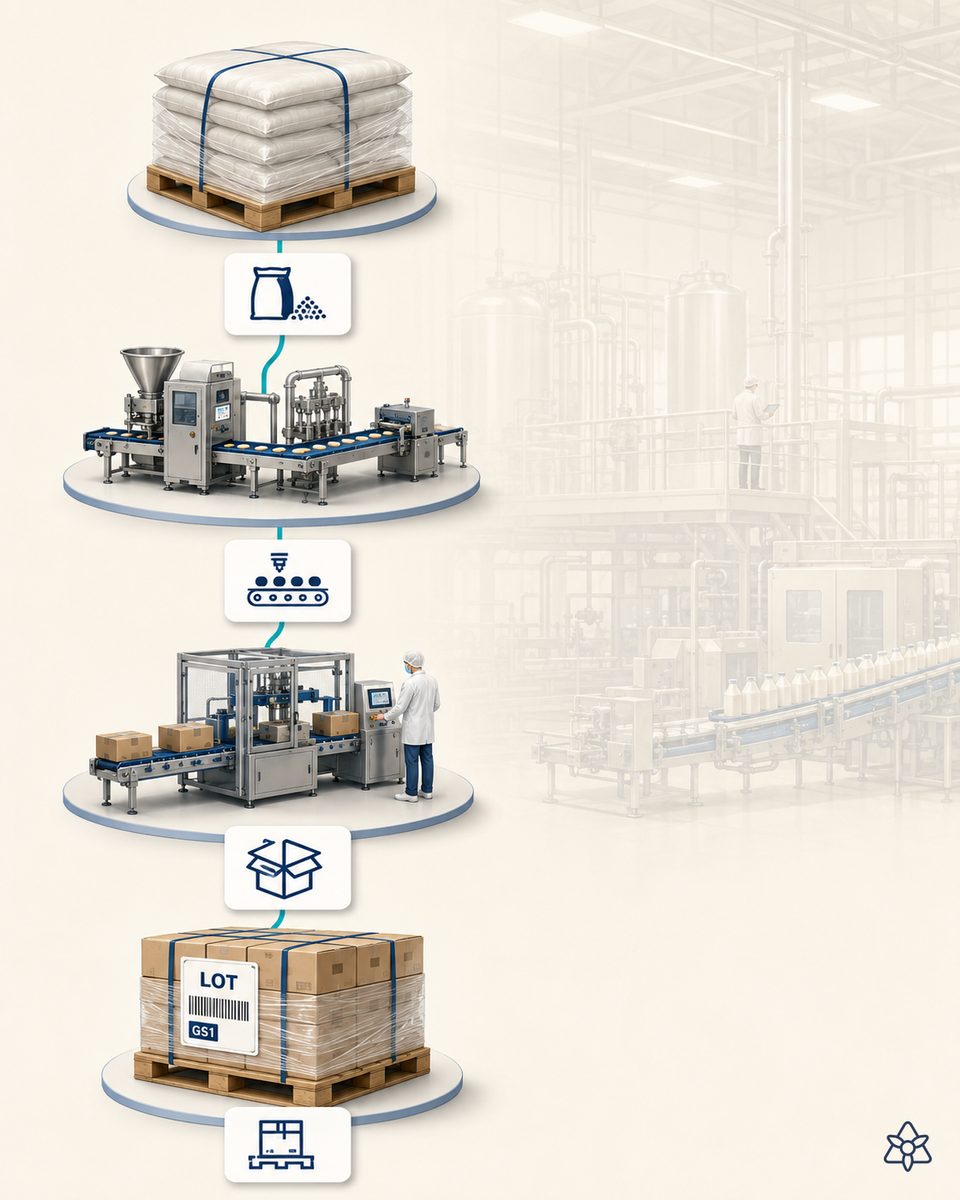
The route takes eight hours and is documented on paper — the positive arrives in twenty minutes.
A collection tanker does not carry the milk of one farm: it carries the blend of a route. Six, eight, twelve stops, each with its liters, its time, its cooling-tank temperature and its sample. When the tanker enters the plant dock, the receiving lab runs its analysis — inhibitors, somatic cells, aflatoxin M1, freezing point, fat and protein — and with that result someone has to decide in minutes what to do with those 25,000 liters.
The problem is not the analysis. The problem is that, at that moment, the exact composition of the tanker lives on a paper route slip that rides in the cab folder and does not get typed up until the next day. The receiving manager knows which route it is and roughly which farms make it up, but does not have in front of them the liters stop by stop or the mapping of which sample belongs to which farm.
- Reactive: the analysis tests positive for inhibitors. Without a reliable composition, the defensive answer is to reject the whole tanker. The milk of the compliant farms is dumped along with the responsible one's, the day's volume is lost, and the liability dispute with the farmers gets settled weeks later, arguing over delivery notes.
- Worse still: the tanker is unloaded before the result arrives, because the dock is full and the truck cannot sit idle. When the positive shows up, the problem is no longer 25,000 liters: it is the 100,000 in the silo, plus everything manufactured from that silo that morning.
- Deferred: weeks later, an official control flags a specific farm. You need to know which tankers carried its milk, which silos they went to and which batches came out of those silos. On paper, that reconstruction takes days of work — and the result is a date-range sweep, not a list of batches.
The classic system works most of the time. The problem is the exception — and the exception costs a whole rejected tanker, a blocked silo or a recall far wider than necessary.
iLEAN Tracer is the filler between the truck cab, the receiving lab and the silo.
The dairy industry already has almost all the data — the problem is that each data point lives on an island and arrives late: the routing software with the planned stops, the tanker's flow meter with the actual liters, the paper delivery note with what really happened, the LIMS with the results, the receiving SCADA with the state of the silos, the ERP with the farmer's payment settlement. iLEAN Tracer does not ask you to change anything. It sits on top and joins what already exists around the identity of each stop, each tanker and each silo.
Connect captures the stop at the farm even without coverage. Edge reads the dock and the state of the silos. The agent proposes the unload destination with the analysis in hand. The person signs — never the other way round.
The iLEAN pieces applied to multi-farm tanker traceability:
- Connect in the cab — each collection stop is closed at the farm itself: farm identified, flow-meter liters, start and end time, cooling-tank temperature and sample code. The driver confirms on screen what the equipment has already read, instead of filling in a paper someone will type up tomorrow. If the farm is on a road with no coverage, it records locally and syncs when the signal returns.
- Edge at the receiving dock — the dock terminal cross-references in real time the composition of the tanker that just arrived, the inbound analysis result as the lab publishes it, and the actual state of each silo (level, content, planned destination). Everything on one screen, at the moment the decision has to be made. Without a network, the Edge keeps recording the unload locally.
- Genealogy agent — keeps the farm→tanker→silo→batch chain live and walks it in both directions. Given an alert about a farm, it returns the exact list of affected silos and batches; given a suspect batch, it returns the farms that fed it. The agent proposes the scope of the recall; the quality manager validates and signs.
Paper route slip vs. a tanker with known composition in iLEAN Tracer
| Aspect | Route documented on paper | With iLEAN Tracer |
|---|---|---|
| Tanker composition | Reconstructed afterwards from delivery notes | Known stop by stop on arrival at the dock |
| Sample per farm | Handwritten code, manual matching | Sample tied to the stop from the origin |
| Positive on inbound analysis | Whole tanker rejected | Narrowed to the responsible farm |
| Moment of the decision | Sometimes after unloading to the silo | Before the valve opens, with a proposed destination |
| Scope of a recall | Date-range sweep, wide out of precaution | Specific list of affected silos and batches |
| Farmer payment settlement | Double keying from delivery note and LIMS | Liters and grades already in the system, no rekeying |
| Operation without coverage on the route | n/a — paper | Captures locally, syncs when the network returns |
Impact estimate for your plant — to be validated with your numbers.
The block below is an estimate to be validated with the specific data of your plant. We put it forward so the committee has an order of magnitude; we refine it during the diagnostic.
- Dairy plant with its own or subcontracted collection, dozens of farms, several daily routes and a receiving dock with several silos. Stop capture in the cab + an Edge terminal at the dock as a pilot on two or three routes.
- First value expected within a few weeks: the pilot routes' tankers arrive with known composition and the segregation decision is documented before the unload.
- Indicative payback between 4 and 9 months, depending on the history of liters rejected in bulk over inbound positives and the average cost of the recalls you have had to run by dates instead of by genealogy.
- Hard levers: compliant milk that today gets rejected along with the non-compliant; silos that are not blocked because the decision is made before unloading; surgical recalls instead of sweeps; hours of manual route reconstruction and of liability disputes with farmers.
And the quality director's reasonable doubt
“What if the AI assigns a stop to the wrong farm?” — hallucination is a problem of free generation, not of anchored tasks. In tasks where the AI merely recontextualizes a piece of data (reading the flow-meter liters and tying them to that stop's farm), the best models brought error below 1.5% [1]. And even so, what is critical is never decided alone: the agent proposes the unload destination, the person signs. The three safety rings exist precisely for this.
[1] OpenAI paper “Why Language Models Hallucinate”, 2025 — on the reliability of AI in anchored tasks.
What people ask about multi-farm tanker traceability and inbound segregation
How is each collection stop on the tanker's route captured?
At each farm, the stop is recorded in the moment: farm identification, liters pumped read from the flow meter, start and end time, cooling-tank temperature and the code of the sample taken for the lab. The driver does not fill in a paper delivery note that someone later types up: they confirm on screen what the equipment has already read. With iLEAN Connect, capture works in the cab even without coverage on the farm road — it records locally and syncs when the network comes back. The result is that the tanker arrives at the plant with its composition known stop by stop, not with a list of farms with no liters and no order.
What happens if the tanker's inbound analysis tests positive for antibiotics or aflatoxins?
Today, a positive at the dock with the route reconstructed from paper delivery notes forces you to reject the entire tanker: you do not know with enough precision which farms are in it or in what proportion, so everything gets discarded. With iLEAN Tracer, the tanker's composition is already in the system before the result arrives, and the individual per-stop samples are tied to each farm. The positive is narrowed to the responsible farm in the counter-analysis, the incident is documented against that farm, and what to do with the rest of the volume is decided with judgment, not out of blind precaution.
Can the segregation be decided before unloading to the silo?
That is the main lever. The segregation decision has a very short window: between the inbound analysis delivering a result and the pump starting to unload. If the tanker is unloaded to a silo and the positive arrives afterwards, the problem is no longer one tanker but 60,000 or 100,000 liters of silo, plus everything manufactured from that silo. iLEAN Tracer puts the analysis result, the tanker's composition and the state of the silos on the same dock screen, proposes a destination (silo A, holding silo, rejection) and the receiving manager signs. The decision is made before the valve opens, not after.
How does the farm→tanker→silo→batch genealogy serve a selective recall?
Because the link never breaks at any jump. Every liter that enters the silo carries behind it which tankers composed it, and every tanker which farms and how many liters each one contributed. Every finished-product batch carries behind it which silo it was filled from and in which time window. When an alert appears about a specific farm — weeks later, from an official control or a deferred lab result — the system walks the chain in both directions: from the farm to the batches that may contain its milk, and from a suspect batch to the farms that fed it. The recall goes from a date-range sweep to a specific list of batches and pallets.
How does it integrate with the receiving lab and with the ERP?
The lab does not change its method or its equipment. iLEAN Tracer connects to the LIMS or to the receiving lab's results sheet and ties each result to the sample code already generated at the route stop or at the dock — antibiotics, somatic cells, aflatoxin M1, fat, protein, freezing point. On the ERP side, each dairy farmer's payment settlement comes from the same liters and the same quality grades already in the system, with no double keying. iLEAN sits on top of what you already have: it does not replace the LIMS, the ERP or the routing software, it joins them around the identity of each stop, each tanker and each silo.
More cases in ilean tracer
- An HV transformer FAT is alive or it is nothing — a summarised PDF does not answer the question that arrives 5 years later.iLEAN Tracer records the HV transformer FAT piece by piece, with insulation curve and serial of every…
- Prefilled syringe autoinjector UDI-DI serialization — a corrupt code is not an error, it is a market recall.How iLEAN Tracer assigns UDI-DI per prefilled syringe autoinjector unit, verifies it with inline vision,…
- The same line manufactures for four chains and for your own brand — cross one specification and you lose the retailer.iLEAN Tracer separates private label from own brand with per-retailer labelling in food plants serving…
- Genealogy of a sterile fill-finish batch — the dossier your auditor asks for is not reconstructed, it is composed.iLEAN Tracer composes sterile fill-finish batch genealogy by shift, room and operator — a dossier ready…
- A closed-PDF as-built does not survive the first field incident.iLEAN Tracer keeps the as-built of every wind turbine nacelle: torque of every critical bolt and serial…
- Heat lot per aluminum sub-coil — losing the melt is not an administrative slip, it is product without a certificate.How iLEAN Tracer keeps the heat lot per sub-coil when an aluminum pallet is slit for several customers,…
Tell us your case and in 48h we'll send you the estimated ROI of iLEAN Tracer for your raw milk receiving.
We work on your plant's real data, not ours. Diagnostic with no commitment.
Request estimated ROI in 48h See Tracer