Genealogy of a sterile fill-finish batch — the dossier your auditor asks for is not reconstructed, it is composed.
The genealogy of a sterile fill-finish batch is the cross-reference of shift + room + operator + intervention + HVAC classification. EU GMP Annex 1 and FDA 21 CFR Part 11 require it with an electronic signature. iLEAN Tracer composes that genealogy in real time — the batch dossier for EMA or FDA comes out self-contained in hours, not weeks. A person signs every critical close — the system does not do it for them.
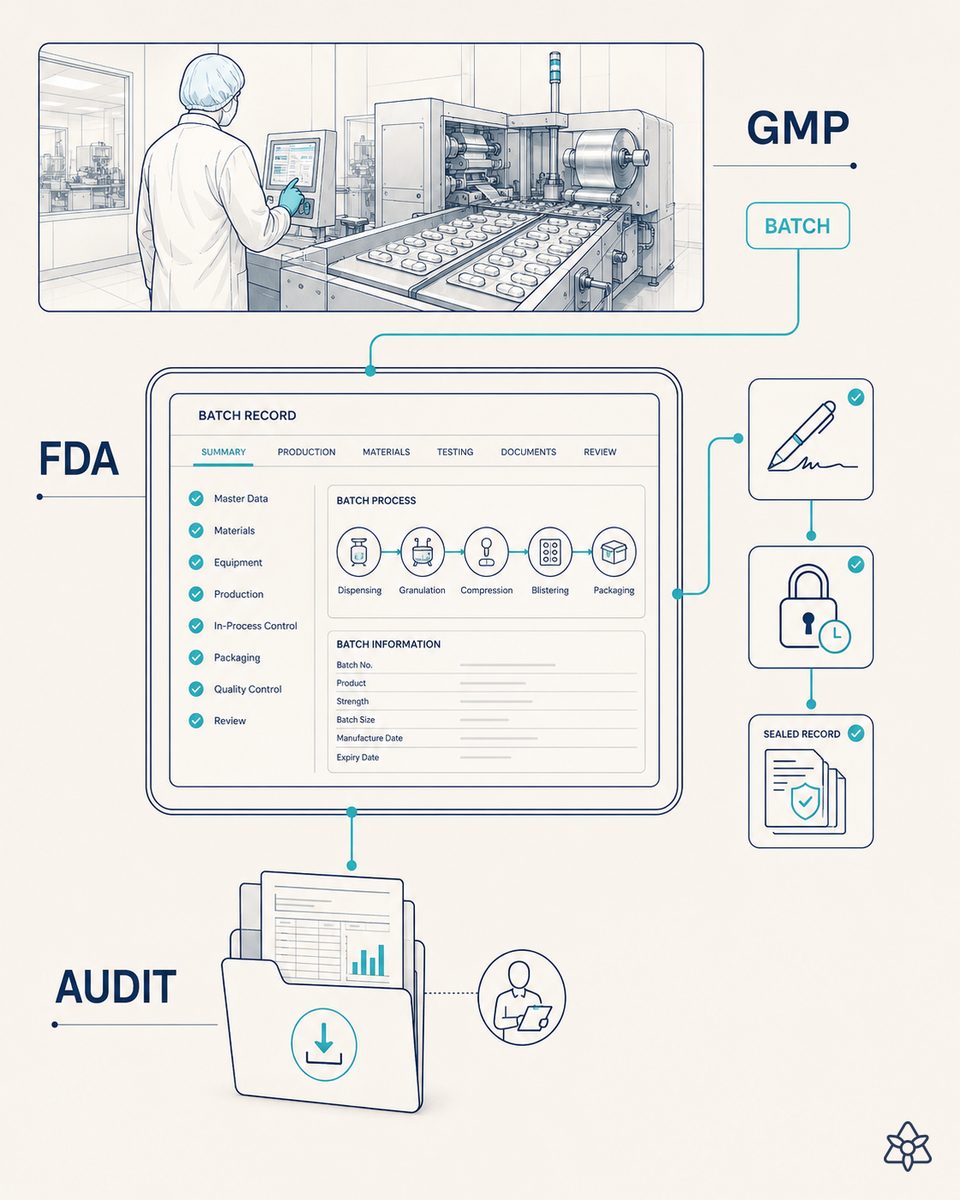
A sterile fill-finish batch is not a process — it is a constellation of systems and people that the dossier has to reconstruct.
A sterile fill-finish batch touches at least five systems and two shifts. When the EMA or FDA inspection arrives, the QA team reconstructs the genealogy by hand, cross-referencing:
- The pharma MES — which batch was active, which materials went in, which manufacturing order was followed.
- The BMS / HVAC — what classification the room held at each moment (Grade A/B/C/D), whether there were particle or differential-pressure deviations.
- Access control — which operators entered the room, in which time window, on which shift.
- The manual intervention log — the intervention in a Grade A zone, a thousand times over the weakest point of the audit, recorded on paper or on an unfriendly tablet.
- The preceding CIP/SIP — what cleaning and sterilisation in place was performed before the batch, with what validation.
The QA team knows it. The maintenance team knows it. The plant manager knows it. But between those five systems there are gaps filled in by hand weeks later — and the Annex 1 reviewer knows exactly where to look to find them. A critical observation for incomplete traceability of a manual intervention in Grade A can cost the batch release and leave an inspection report that is hard to close.
iLEAN Tracer does not add a sixth system — it seals the cracks between the five you already have.
The problem with sterile fill-finish genealogy is not a lack of data: it is that the data lives on five separate islands and nobody cross-references it at second zero. iLEAN Tracer is the piece of the IRIS category that acts as filler between the MES, the BMS, access control, the shift plan and the intervention log — without asking you to change any of them.
Edge sees the room. Connect reads badge, MES, BMS, shift and interventions wherever they live. The agent composes the signed genealogy. A person signs every critical close — never the other way round.
How the work is split between the iLEAN pieces for this case:
- Edge — a terminal in each critical room (Grade A/B). It reads the sterile zone camera and records the manual intervention event with photo and local timestamp. It works without a network: the event is signed locally and syncs when the network comes back.
- Connect — captures the room access badge, the batch phase from the MES, the live classification from the BMS, the shift planning and the operator's declaration (tablet, earpiece). It also captures what arrives from outside (a procedure review email, an alert from the vial supplier) at second zero.
- Tracer agent — composes the signed event with shift + room + operator + phase + intervention + reason. If the intervention was not authorised for that phase, or the room lost classification during the opening, it leaves the batch "under review" and alerts the QA manager. The person validates — release is never signed on its own.
Reconstructed genealogy vs. genealogy composed with iLEAN Tracer
| Aspect | Manual post-batch reconstruction | With iLEAN Tracer |
|---|---|---|
| MES + BMS + badge cross-reference | QA spreadsheet, weeks | At second zero, automatic |
| Grade A manual intervention | Paper or unfriendly tablet | Edge photo + voice + badge, signed |
| Live room classification | BMS curve exported by hand | Cross-referenced with every batch event |
| Shift + operator | Manual note by the shift leader | Shift plan + badge, automatic |
| Dossier for EMA/FDA | Weeks of QA, risk of gaps | Self-contained, ready in hours |
| Critical close signature | Manual, needs coordination | A person signs, the system does not decide alone |
Impact estimate for your plant — to be validated with your numbers.
The block below is an estimate to be validated with the specific data of your plant. We set it out so the committee has an order of magnitude; we refine it during the diagnostic.
- Pharma plant with 1-3 Grade A/B sterile fill-finish rooms, MES installed, BMS operational, badge access control.
- Tracer pilot in one room (Edge in the cabinet + integration with MES, BMS, badge and shift plan). First value expected within a few weeks: the first genealogy composed at batch close.
- Indicative payback between 4 and 9 months, depending on the documented frequency of batches with an audit observation and the average QA team time spent preparing dossiers.
- Expected reduction in batch dossier preparation time of ≥ 30%. The hard lever is avoiding a critical observation in an Annex 1 inspection over traceability of a manual intervention in Grade A.
And the QA manager's reasonable doubt
"What if the AI introduces noise into the genealogy and the inspection rejects it?" — hallucination is a problem of free generation, not of anchored tasks. Composing an event from MES + BMS + badge + camera is exactly an anchored task, where the best models brought the error below 1.5% [1]. And even so, nothing critical is signed on its own: Tracer leaves the batch "under review" and the person signs. The three iLEAN security rings are designed precisely so the OT network only accepts what has been validated, packaged, signed and approved by a person.
[1] OpenAI paper "Why Language Models Hallucinate", 2025 — on the reliability of AI in anchored tasks.
What people ask about sterile fill-finish genealogy
What is the genealogy of a sterile fill-finish batch?
The genealogy is the complete tree of the batch — which materials went in, in which room it was processed, what cleanliness classification that room held at that moment, which shift and which operators intervened, what CIP/SIP was performed beforehand, which deviations were recorded and how they were closed. EU GMP Annex 1 and FDA 21 CFR Part 11 require it to be reconstructed with user identity, signed timestamp and traceability of every step. Without a system that composes it on the fly, the QA team spends weeks building the dossier of each batch for inspections.
How does iLEAN Tracer build the genealogy by shift?
Tracer cross-references three axes that today live in different systems: the active batch in the pharma MES, the shift and operator present in the room (access badge + shift plan), and the room classification (Grade A/B/C/D under Annex 1) held in the HVAC/BMS system. Every batch event — vial opening, operator intervention, particle alarm, batch close — is signed with shift, room, operator, value and reason. The genealogy is not reconstructed; it is composed in real time.
What about manual interventions in a Grade A room? How are they traced?
That is exactly where Tracer adds the most value. An operator intervention in a Grade A zone is the most vulnerable point of the batch — and, until now, the worst traced. iLEAN Edge in the room cabinet reads the zone camera and records the intervention event; Connect captures the operator badge, the reason declared on the tablet (or the earpiece) and the timestamp; the agent cross-references it with the live room classification and with the batch phase. If the intervention was not authorised for that phase, the batch is left under review and the QA manager signs. The system does not close the batch on its own.
Is this compatible with revised EU GMP Annex 1 and FDA 21 CFR Part 11?
Yes. The Annex 1 revision has tightened the contamination control strategy requirement and the trace of interventions; Part 11 requires an electronic signature with identity, timestamp and non-repudiation. Every Tracer event meets both: user identified by badge/SSO, cryptographically signed timestamp, raw and aggregated value, mandatory reason field whenever there is a deviation. The batch dossier comes out self-contained for EMA or FDA — chronology, events, signatories, photo/sensor evidence — with nothing reconstructed by hand.
How much does sterile fill-finish genealogy with iLEAN Tracer cost?
The order of magnitude of a Tracer pilot in a sterile fill-finish room is close to that of any Edge+Connect+Agent pilot in pharma — a terminal per critical room, integration with MES, badge, BMS and shift plan, and a library of signed events. A reasonable payback sits in the range of several months; the hard lever is cutting the time to prepare the batch dossier for inspection and avoiding the deviation that triggers a critical observation. Send us your plant data and we will send you the estimated ROI within 48h.
More cases in ilean tracer
- Prefilled syringe autoinjector UDI-DI serialization — a corrupt code is not an error, it is a market recall.How iLEAN Tracer assigns UDI-DI per prefilled syringe autoinjector unit, verifies it with inline vision,…
- The same line manufactures for four chains and for your own brand — cross one specification and you lose the retailer.iLEAN Tracer separates private label from own brand with per-retailer labelling in food plants serving…
- One tanker collects from eight farms — and when the inbound analysis tests positive, nobody knows for sure which ones are inside.Every collection stop is captured: the tanker arrives with its composition known, a positive is…
- A closed-PDF as-built does not survive the first field incident.iLEAN Tracer keeps the as-built of every wind turbine nacelle: torque of every critical bolt and serial…
- Heat lot per aluminum sub-coil — losing the melt is not an administrative slip, it is product without a certificate.How iLEAN Tracer keeps the heat lot per sub-coil when an aluminum pallet is slit for several customers,…
- Allogeneic TCR-T — one donor, several doses, several patients and a single custody chain.iLEAN Tracer keeps the custody chain of an allogeneic TCR-T donor with several recipients — one batch,…
Tell us about your case and within 48h we will send you the estimated ROI of this AI project for your fill-finish room.
We work on your plant's real data, not on ours. Diagnostic with no commitment.
Request estimated ROI within 48h See iLEAN Tracer