FSMA in the United States, MERCOSUR in Brazil, EUDR in the EU — three regulations, one single packaging line.
A food and beverage plant exporting to several regulatory markets keeps three different dossiers on the same SKU: FSMA 204 KDEs for the United States, RTM labelling and health registration for MERCOSUR, farm geolocation and a due diligence statement for EUDR in the EU. iLEAN Tracer switches the dossier per sales unit without reconfiguring the line, and composes each one in the format its authority demands. A person signs.
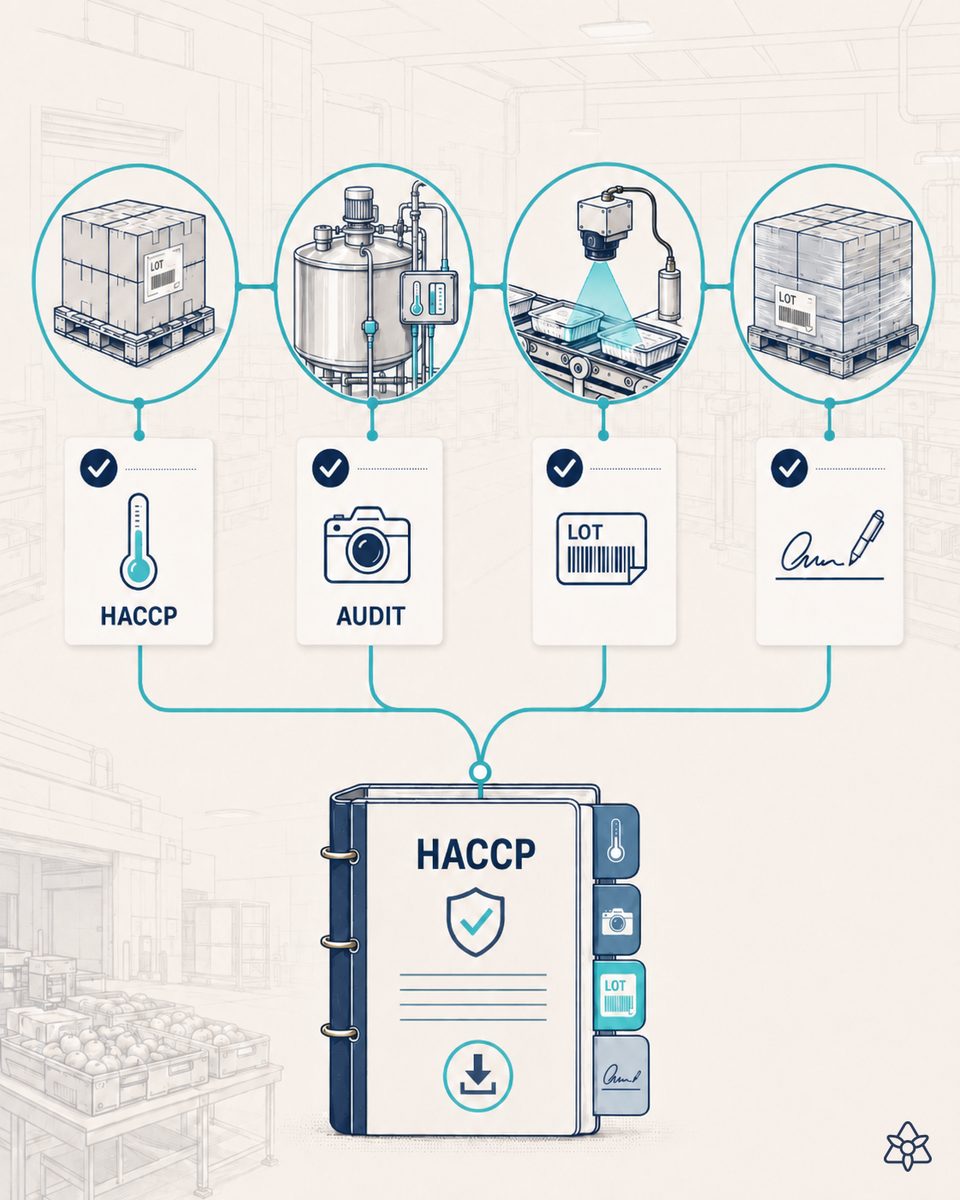
Three regulations, three different logics — and none of them forgives a badly built list.
A food and beverage plant exporting to several regulatory blocs lives three realities at once on the same SKU:
- FSMA (United States) — Foreign Supplier Verification Program, HARPC plan, and, for products on the Food Traceability List, capture of KDEs (Key Data Elements) at every Critical Tracking Event. The FDA wants the CSV ready within 24 hours when there is a foodborne outbreak.
- MERCOSUR (Argentina, Brazil, Paraguay, Uruguay, Bolivia) — MERCOSUR Technical Regulation on labelling, health registration per country (RENAEM in Brazil, RNE in Argentina, INAN in Paraguay), MERCOSUR certificate of origin. Without a valid national registration, the container does not get in.
- EUDR (EU) — geolocation of every farm of origin, due diligence statement, proof of no deforestation after 31-12-2020, validation in TRACES NT. It applies to soy, cocoa, coffee, palm oil, timber, rubber, cattle — and to their derivatives.
Each authority asks for different data, different formats and different signatures. And switching destination is not the operator's decision: one unit goes to Miami, the next to São Paulo, and the third to Rotterdam. The compliance manager knows this — but cannot keep three live dossiers running on three different logics without something slipping through. A single badly filled field in the EUDR due diligence statement is a shipment blocked in TRACES; a missing FSMA 204 KDE is an FDA visit when there is an outbreak.
iLEAN Tracer does not add a fourth regulation — it seals the cracks between the three you already manage.
The multi-market exporter's problem is not a lack of information: it is information living on islands (one system per regulation, one spreadsheet per market, one person per dossier) that, at the critical moment (a change to the FSMA Food Traceability List, a new EUDR phase, a MERCOSUR RTM revision), does not reach the decision-maker in time. iLEAN Tracer acts as the filler that closes those gaps, without asking you to change your ERP or your QMS.
Tracer tags every sales unit with its regulatory destination. Connect captures the data required by that destination's regulation. The agent composes the right dossier in the authority's format. A person signs — the shipment does not leave on its own.
iLEAN Tracer is the piece that combines Connect (capture by channel) and Agents (regulatory cross-checking + dossier by destination) applied to the multi-market regulatory exporter:
- Connect — captures the regulations in force: FDA Food Traceability List updates, MERCOSUR RTM revisions, European Commission delegated guidance on EUDR. It captures the required data: KDEs from every Critical Tracking Event (receiving, transformation, shipping), RTM labelling, farm coordinates, origin records. It captures delivery notes and MES records without asking you to rewrite the MES.
- Agents — cross-check the sales unit, the regulatory destination, the version of the regulation in force and the captured data. If a unit is heading to the United States and a KDE is missing, they hold the shipment. If a unit is heading to the EU and a farm of origin has no post-2020 geolocation, they pull it out of the shipment. If a unit is heading to Brazil and the RENAEM registration has expired, they hold it and raise the alert.
- Regulatory dossier composition by destination — the agents assemble, per sales unit: the KDE CSV for FSMA in FDA format, the RTM dossier plus health registration for MERCOSUR, the EUDR due diligence statement with coordinates and proof of no deforestation. In the format each authority demands. The compliance manager reviews and signs.
The three safety rings are more than an architecture here: they are direct alignment with the European AI Act on human oversight of high-risk AI. The system lets a person sign the critical compliance decisions — and leaves a cryptographic trace of who signed what.
Manual multi-market management vs. dossier segmented by destination with iLEAN Tracer
| Aspect | Manual management (spreadsheets + folders) | With iLEAN Tracer |
|---|---|---|
| Regulation in force per market | The compliance manager reviews it when there is time | Automatic capture from the official bulletin / regulatory portal |
| FSMA 204 KDEs | Spreadsheet with data copied by hand from the MES | Captured by Connect at the event, in FDA-CSV format |
| MERCOSUR RTM labelling | Template picked by the operator, human risk | Template bound to the batch destination, verified before closing |
| EUDR farm geolocation | Coordinates in a paper field book | Digitised and linked to the batch produced |
| Due diligence statement | Word document with data copied by hand | Automatic composition + human signature |
| Audit / authority inspection | Rebuilding the history weeks in advance | Traceability per unit, per destination, per regulation |
Impact estimate for your plant — to be validated with your own numbers.
The block below is an estimate to be validated with the specific data of your plant. We put it forward so the committee has an order of magnitude; we refine it during the diagnostic.
- An exporter present in at least two of the three regulatory blocs (FSMA, MERCOSUR, EUDR), several SKUs, growing compliance pressure from the importer and at least one shipment held or returned in recent years because of an incomplete dossier.
- Tracer pilot on one SKU plus two regulatory blocs (regulation capture + segmentation per sales unit + dossier composition). First value expected within a few weeks.
- Indicative payback between 4 and 9 months, depending on how often shipments are held, how much of the compliance manager's time goes into composing dossiers by hand, and the average cost of the last shipment blocked in TRACES NT, at FDA Prior Notice or at MERCOSUR customs.
- The hard lever is a single authority inspection passed with no findings: a foodborne outbreak under FSMA 204 that triggers an FDA inspection carries a cost that pays for the system many times over; so does an EUDR shipment blocked by broken geolocation.
- Expected reduction in manual time spent composing the regulatory dossier: ≥ 30%.
And the compliance manager's reasonable doubt
«What if the AI applies the wrong regulation to a unit?» — hallucination is a problem of free generation, not of anchored tasks. In tasks where the AI merely recontextualises a data point from one system into another (reading the KDE from the MES and packaging it into the FDA CSV), the best models brought error below 1.5%[1]. And even so, the critical call is never made alone: Tracer proposes the dossier and a person signs. The three safety rings are there precisely for this, aligned with the human oversight logic of the European AI Act.
[1] OpenAI paper «Why Language Models Hallucinate», 2025 — on the reliability of AI in anchored tasks.
What people ask about the FSMA, MERCOSUR and EUDR dossier by destination
What do FSMA, MERCOSUR and EUDR require — and why can't they be handled with the same dossier?
FSMA (Food Safety Modernization Act, United States) requires a Foreign Supplier Verification Program, a HARPC plan, reinforced traceability and, for the FSMA 204 list, capture of KDEs (Key Data Elements) per event. MERCOSUR (Argentina, Brazil, Paraguay, Uruguay, Bolivia) requires the MERCOSUR Technical Regulation on labelling, national health registrations (RENAEM in Brazil, RNE in Argentina) and specific certificates of origin. EUDR (EU Deforestation Regulation, in force in the EU) requires geolocation of the farm of origin, a due diligence statement and proof of no deforestation after 2020. Each one asks for different data, different formats and different signatures — a unified dossier complies with none of them.
How does iLEAN Tracer switch the dossier per exported sales unit?
Tracer tags every sales unit with its regulatory destination (US/FSMA, MERCOSUR, EU/EUDR, others) from the manufacturing order onwards. Connect captures the data required by that destination's regulation: KDEs for FSMA 204, RTM labelling for MERCOSUR, farm geolocation for EUDR. The agents compose a different dossier per destination, in the format each authority demands, ready to upload to the importer's portal or present at customs. A person signs the dossier before shipment.
How are FSMA 204 KDEs captured without rewriting the MES?
FSMA 204 requires capturing Key Data Elements at Critical Tracking Events (receiving, transformation, shipping) for products on the Food Traceability List. Connect captures the KDEs wherever they live: the manufacturing order in the ERP, the weighing record in the MES, the batch from packaging, the transport record. It does not ask you to rewrite the MES — it captures what is already there and packages it into the CSV format required by the FDA. The agents verify the set is complete before releasing the batch for shipment to the United States.
How is EUDR farm geolocation complied with?
EUDR requires geolocation (polygon or coordinates) of every farm the raw material comes from, plus proof of no deforestation after 31-12-2020. Connect captures the coordinates from the grower's field book, the supplier's PDF or the land registry, and the agents cross every batch produced against its farms of origin — it only releases to the EU market if every farm complies. The due diligence statement composes itself, ready for the responsible economic operator. A person signs.
What happens when a regulation changes (FSMA revision, new EUDR phase)?
Authorities publish revisions fairly often: the FDA updates the Food Traceability List, MERCOSUR revises the RTM, the European Commission publishes delegated guidance on EUDR. Connect captures the change at second zero (official bulletin, technical guidance for the economic operator, alert from the regulatory body), the agents check it against batches in progress and, if any required data point is missing, they hold the shipment to that destination. A person validates the change before resuming.
More cases in ilean tracer
- The drying-house batch groups thousands of pieces that share no history — and one problem puts them all on hold.iLEAN Tracer assigns an ID to every cured ham from salting to labeling and rebuilds its full history…
- Cut-flower reefer: the auction price is decided in the cracks of the cold chain.iLEAN Tracer holds the cold chain of a cut-flower reefer from farm to auction, with projected vase life…
- Dairy cow — the collar knows, the meter knows, the ERP knows — and nobody knows it together.iLEAN Tracer records individual yield per milking for every dairy cow with GPS collar, heat and…
- A PDO bottle that cannot prove its parcel is no longer PDO — it is table wine with a shiny label.iLEAN Tracer assigns the PDO/PGI parcel and municipality to every bottle of wine or tin of olive oil,…
- You export to twelve countries and each one bans different pests — one wrong certificate and the consignment comes back from the port.iLEAN Tracer keeps the phytosanitary certificate per destination country for every exported SKU, with…
- Fresh meat pallet cold chain segregation — one break on one truck should not cost thirty pallets on hold.How iLEAN Tracer segregates the cold chain of a fresh meat pallet as it crosses trucks and cross-dock…
Tell us about your case and within 48h we'll send you the estimated ROI of this AI project for your multi-market export operation.
We work on your plant's real data, not ours. Diagnostic with no commitment.
Request estimated ROI in 48h See iLEAN Tracer