Cut-flower reefer: the auction price is decided in the cracks of the cold chain.
A cut flower arrives at the auction looking beautiful and still sells badly — because the buyer projects the vase life and penalises the hours the reefer spent out of range. iLEAN Tracer links farm precooling, the reefer curve, route events and the MPS label into a single signed custody chain, and projects vase life before the auction. The person validates.
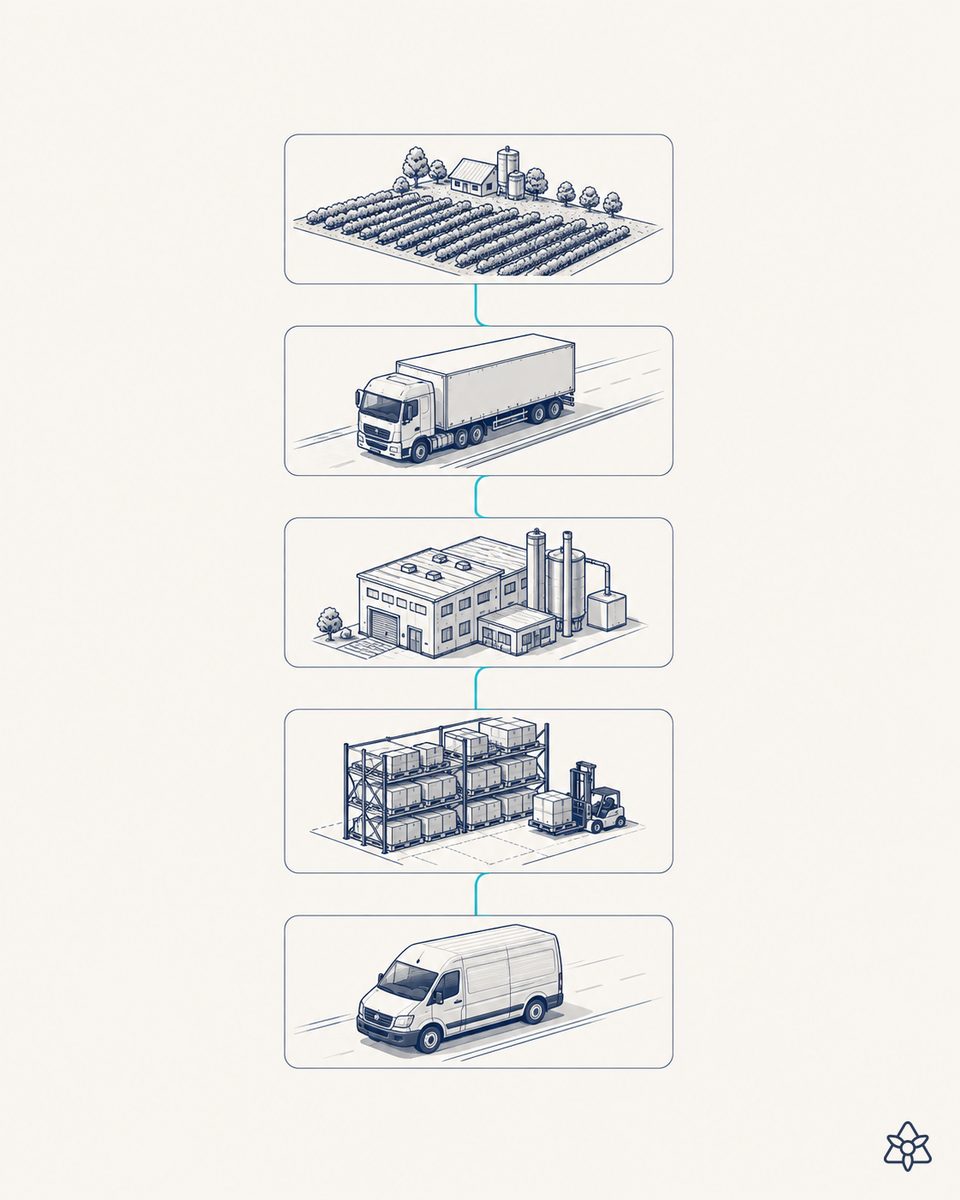
The flower arrives beautiful and still loses the price.
A reefer of rose, lisianthus or gypsophila travelling from an African or South American farm to a European auction passes, between the farm cooler and the buyer's trolley, through at least four custodies: farm → origin airport handler → carrier (sea or air) → destination airport handler → auction platform. The cold chain does not break in one of them — it erodes at every hop:
- Farm: precooling takes as long as it takes — it depends on how loaded the cooler was and on the ambient temperature that day. The operator writes it down on a sheet.
- Airport handler: ULD or pallet waiting for the plane or the ship. A six-hour wait outside the 0.5–4°C range eats vase life.
- Reefer datalogger: it emits the curve at the end, as a PDF or a Cold Chain EDI — it arrives when the batch is already at the auction.
- Auction: the buyer projects the vase life they will offer the florist or the retailer. They penalise with price, not with a claim.
The exporter knows this, but cannot be in four places at once. When the buyer penalises, no email arrives — the auction clock price arrives, and there is no renegotiation. The classic system works 95% of the time. That 5% is what erodes the margin batch after batch — and an eroded margin in cut flowers is the difference between exporting next year or not.
iLEAN Tracer does not add one more system — it seals the cracks between the four custodies already involved.
The vase-life problem is not a lack of information: it is information living on four islands which, at the critical moment (the batch entering the auction trolley), does not reach the person who sets the price in time. iLEAN Tracer acts as the filler that closes those gaps, without asking the carrier, the handler or the auction to change their software.
Edge reads the MPS label, the reefer seal and the batch QR. Connect captures the datalogger PDF, the handler's message and the airline EDI. The agent projects vase life before the clock. The person validates.
The iLEAN pieces applied to a cut-flower reefer heading to auction:
- Edge — a terminal with computer vision (CNN) at the farm cooler and at auction reception. It reads the CC label, the MPS-Florimark code, the batch QR, the reefer seal and the photo of the datalogger display. It works without a network: at an airport handler with no stable WiFi, the read-and-sign cycle carries on.
- Connect — captures everything arriving through loose channels: the reefer datalogger PDF, the carrier's Cold Chain EDI, the airline AWB, the handler's message at the airport, the customs agent's email. Every message enters the batch custody chain at second zero, with nobody forwarding anything.
- Agent — crosses farm precooling, the reefer curve, route events and the species/variety of the batch. It projects the expected vase life in the vase before the batch enters the auction. If the projection falls below the threshold agreed with the buyer, it holds the batch for human review and alerts the quality manager. The person validates and signs; the batch does not go to the clock on its own.
A blind cold chain vs. a cold chain signed with iLEAN Tracer
| Aspect | Farm sheet + datalogger PDF | With iLEAN Tracer |
|---|---|---|
| Farm precooling | In/out times on a sheet | Real curve linked to the batch and the MPS |
| Reefer curve in transit | PDF after the fact, arrives late | Captured by Connect, crossed with route events |
| Wait at the airport handler | Visible only if the handler warns you | Detected and signed as an event |
| MPS-Florimark label | Validated by eye at reception | Edge reads it and crosses it with the farm origin |
| Projected vase life | Estimated by the buyer at the clock | Projected before the auction, defensible |
| Post-auction claim | Rebuilt by hand, weeks | Dossier per batch, automatic, with photo and human signature |
Impact estimate for your plant — to be validated with your numbers.
The block below is an estimate to be validated with the concrete data of your operation. We put it forward so the committee has an order of magnitude; we refine it in the diagnostic.
- An exporter with 3-6 reefers a week (rose, gypsophila, lisianthus), two farms, one or two transit hubs and a European auction as the main market.
- A Tracer pilot on one farm and one reception at the auction platform (Edge for MPS + seal + datalogger on display, Connect for datalogger PDFs + AWB + the handler's messages, an agent projecting vase life). First value expected within a few weeks: the first batches already arrive with a defensible projected vase life.
- Indicative payback between 4 and 9 months, depending on the share of batches auctioned today below the expected price because of undocumented cold chain incidents.
- Reduction of vase-life penalties at auction of ≥30%, with a defensible floor well below the cost of every post-auction claim lost for want of evidence.
- The hard lever is the price defended at auction: two or three cents more per stem, multiplied by the weekly boxes, pay for the pilot in a few months.
And the quality manager's reasonable doubt
«What if the AI projects vase life badly and we leave a good batch on the floor?» — hallucination is a problem of free generation, not of anchored tasks. In tasks where the AI merely recontextualises a piece of data from one system into another (reading the datalogger curve and crossing it with the farm precooling), the best models brought the error below 1.5% [1]. And even so, what is critical is not decided alone: iLEAN holds the batch and the person validates. The three safety rings are there precisely for this.
[1] OpenAI paper "Why Language Models Hallucinate", 2025 — on the reliability of AI in anchored tasks.
What people ask about the cut-flower reefer heading to auction
Why is the cold chain so critical for cut flowers?
Because a cut flower is biology on a countdown: every hour outside the 0.5–4°C range (depending on species) burns vase life and lowers the auction price. A long-stem rose can drop from 12 days in the vase to 4-5 if the chain breaks for six hours at the transit airport. The auction (Royal FloraHolland and similar) penalises the batch not for visible damage — the flower arrives beautiful — but for the vase life the buyer projects, and that is what sets the price. The cold chain is not a certificate: it is the price of the batch.
How does Tracer cross the reefer with the farm precooling?
Tracer links three realities that today live apart: the farm precooling curve (how many hours and at what temperature the batch entered the cooler before transport), the reefer temperature and humidity in transit (the container datalogger, plus your own sensors if you have them) and the route events (airport transhipment, customs hold, change of hands at the auction platform). The agent projects the expected vase life on arrival at the auction — before the batch goes in. If the risk exceeds the threshold agreed with the buyer, it holds the batch for human review.
What if the reefer datalogger belongs to the carrier and not to us?
Tracer is designed for mixed chains. The reefer's official datalogger emits its curve at the end of the voyage as a PDF or a Cold Chain EDI; iLEAN Connect captures it through whatever channel it arrives on (the agent's email, the carrier portal, a photo of the display taken by the operator at unloading) and crosses it with the rest of the custody chain. You do not need to change the container — you need not to lose the data when it arrives.
Can Tracer read the importer's CC/MPS label in line?
Yes. iLEAN Edge with computer vision (CNN) reads the CC label, the MPS-Florimark code, the batch QR and the container seal at the loading bay and at reception. If the label declares «Kenya rose MPS-A» but the agent crosses it with the farm origin and the certificate does not match, it is not a suspicion — it is a signed event, with photo and timestamp. The quality manager validates — the batch does not go to auction on its own.
What is a projected vase life good for before the auction?
To negotiate the price of the batch with data, not with hope. The auction buyer and the retail chain (florist, European supermarket) set the price according to the vase life they expect on the shelf. If you arrive with the precooling curve, the reefer curve, the transit events and a defensible projected vase life, you defend the price. If you arrive with an after-the-fact datalogger PDF, you defend the claim. Tracer turns a blind chain into a dossier indexable by batch.
More cases in ilean tracer
- A PDO wheel is not one link in a batch — it is a unique asset with its own history.iLEAN Tracer assigns a code to every PDO cheese wheel on the rind itself and rebuilds its sanitary and…
- A cosmetic cream batch is a tree — and hand-drawn trees break at the first complaint.iLEAN Tracer builds the full genealogy of a cosmetic cream batch: master mixes, pH adjustments, bulk and…
- The drying-house batch groups thousands of pieces that share no history — and one problem puts them all on hold.iLEAN Tracer assigns an ID to every cured ham from salting to labeling and rebuilds its full history…
- Dairy cow — the collar knows, the meter knows, the ERP knows — and nobody knows it together.iLEAN Tracer records individual yield per milking for every dairy cow with GPS collar, heat and…
- FSMA in the United States, MERCOSUR in Brazil, EUDR in the EU — three regulations, one single packaging line.iLEAN Tracer switches the regulatory dossier by destination (FSMA US, MERCOSUR, EUDR EU) per exported…
- A PDO bottle that cannot prove its parcel is no longer PDO — it is table wine with a shiny label.iLEAN Tracer assigns the PDO/PGI parcel and municipality to every bottle of wine or tin of olive oil,…
Tell us your case and in 48h we'll send you the estimated ROI of this AI project for your cut-flower reefers.
We work on the real data of your operation, not on ours. Diagnostic with no commitment.
Request estimated ROI in 48h See Tracer