Dairy cow — the collar knows, the meter knows, the ERP knows — and nobody knows it together.
A dairy cow with a GPS collar, an electronic milk meter and an active vet generates more data per day than many industrial plants — heat, activity, rumination, kilos per milking, conductivity, somatic cells, treatments. iLEAN Tracer stitches all that reality per animal and per milking, without asking you to change the parlour or the collar. The individual record stops living in four apps; the decision stays with the farmer and the vet.
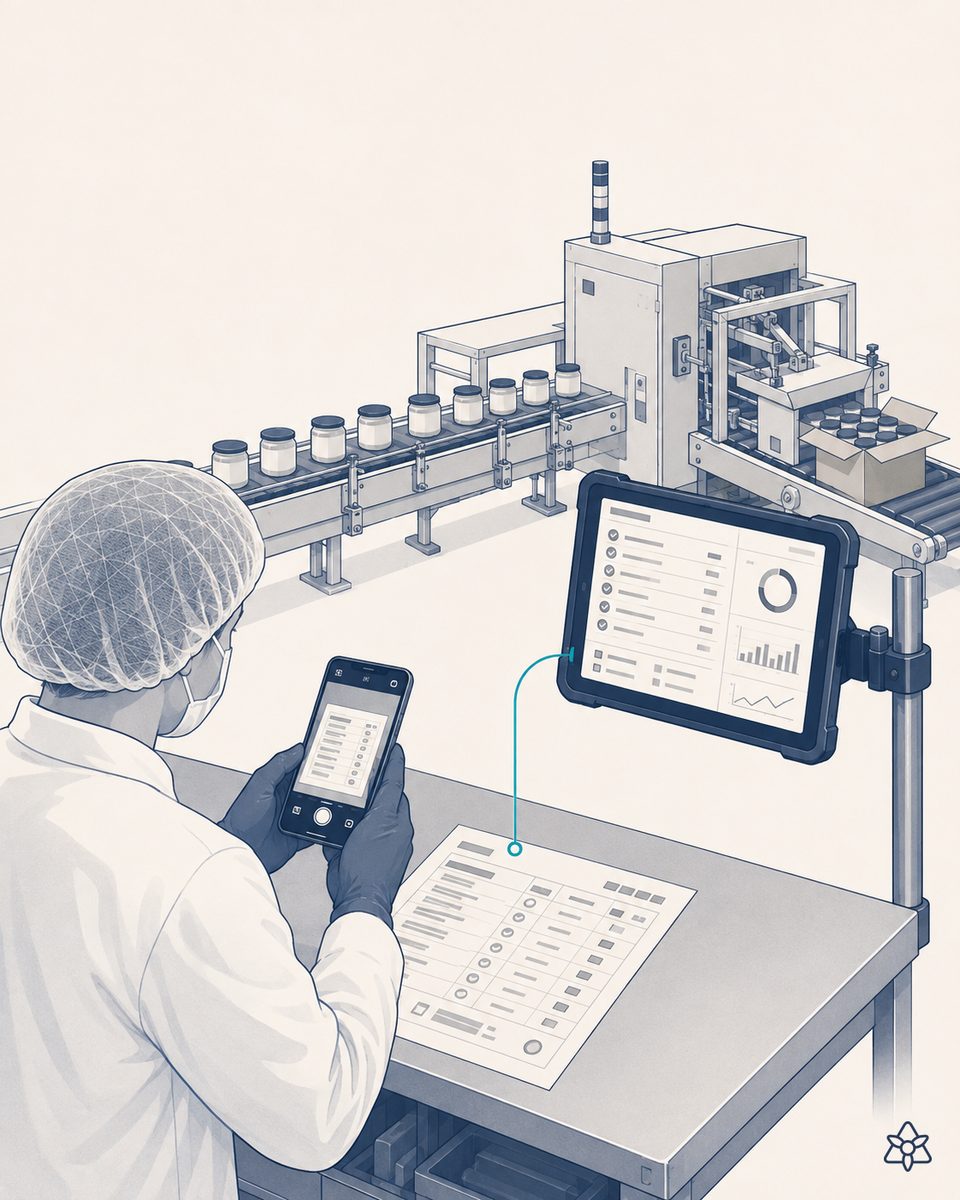
Four apps per cow, none of them talking to the others, and the heat is missed.
A modern dairy cow does not suffer from a lack of technology — she suffers because her reality lives in four silos that do not talk to each other:
- The GPS collar records activity, rumination, heat and lying time in its own app.
- The milking parlour, conventional or robotic, records kilos per milking, conductivity, somatic cells and milking time in its own system.
- The vet writes down treatments, calvings, dry-offs and diagnoses on a sheet, in a different app, or straight into the farmer's messaging app.
- The farmer's or the co-op's ERP collects litres delivered, price per kg, quality analyses and the settlement.
The farmer knows that cow number 247 is off. The collar said so yesterday; the milking dropped this morning; the vet has a note in another app. But nobody has the individual record of 247 stitched together first thing today. The classic system (apps + eye) works most of the time. The few times it does not, it turns into missed heats, late mastitis and chronic lameness — and every one of those has a hard cost.
iLEAN Tracer is not a fifth app — it seals the cracks between the four you already have.
The problem on a modern farm is not a lack of data: the collar, the parlour, the vet's app and the ERP do have the information. The problem is that it lives on four heterogeneous islands, mostly without a common API, and the individual record per animal exists in no system — only in the farmer's head. Tracer is the filler that fills those gaps, without asking you to change the collar, the parlour, the vet's app or the ERP.
Edge verifies the animal in the parlour. Connect captures the four apps. The agent stitches the individual record per animal and per milking. The person — farmer and vet — still decides.
The three iLEAN pieces applied to the dairy cow:
- Edge — a terminal with vision and a reader in the parlour that verifies that the animal entering the stall matches the one expected from the collar and from the programmed queue. If a cow slips in out of order, it records it and warns the farmer. It works with no network — on a rural farm connectivity comes and goes, and Edge keeps operating on the power from the panel.
- Connect — captures the collar (through the vendor API or the standard integration), the electronic milk meter, the vet's app and the ERP. It also captures what comes in from outside — an email from the external vet with an analysis result, a message from the co-op with a quality figure — without anyone forwarding anything.
- Agent — stitches the individual record by animal number and by milking. It flags deviations that would otherwise be found late (conductivity rising + rumination falling = early mastitis; high activity + predicted heat = insemination window). And it generates the digital farm logbook without anyone retyping it.
Four apps per cow vs. an individual record stitched with iLEAN Tracer
| Aspect | Collar + parlour + vet app + ERP | With iLEAN Tracer |
|---|---|---|
| Individual record per animal | Only in the farmer's head | Stitched per milking, on a single screen |
| Yield per milking | Only in the parlour | Cross-checked with heat, health and ration |
| Mastitis detection | When the cell count shows up days later | When conductivity and rumination diverge |
| Heat detection | Collar app, no milking cross-check | Collar + yield cross-checked per animal |
| Digital farm logbook | Retyped by hand from 4 apps | Generated automatically, signed |
| Change of parlour or collar make | History broken | Tracer stitches both sides, no swap needed |
Impact estimate for your operation — to be validated with your numbers.
The block below is an estimate to be validated with the actual data from your milkings and your animals. We set it out so the committee has an order of magnitude; we refine it during the diagnostic.
- Dairy farm with 150-500 cows in milk, conventional or robotic parlour, modern collars already installed, an active vet app.
- Tracer pilot on one parlour + the collar + the ERP (integration with the parlour make and the collar make you already run, no vendor swap). First value expected within a few weeks: the individual record stitched together and heats detected by crossing collar + milking.
- Indicative payback between 4 and 9 months, depending on the number of cows in milk, the annual mastitis incidence and the current heat detection rate.
- The hard lever is early detection of mastitis and heat: one cow pregnant on time or one mastitis stopped within 24h outweighs the whole investment. Expected reduction of indexable incidents ≥ 30% once the pilot is stabilised.
And the farmer's fair objection
“What if the AI gets it wrong and flags a mastitis that is not there?” — hallucination is a problem of free generation, not of anchored tasks. On tasks where the AI merely cross-checks the conductivity from the milk meter with the rumination from the collar and puts the pattern in front of you, the best models brought the error below 1.5%[1]. And even then, nothing critical is decided alone: Tracer puts the case in front of the vet, who signs. The three rings are there precisely for this.
[1] OpenAI paper “Why Language Models Hallucinate”, 2025 — on the reliability of AI in anchored tasks.
What people ask about GPS collars and yield per milking on dairy cows
What does a GPS collar add on a dairy cow beyond locating the animal?
A modern GPS collar measures activity (steps, rumination, lying time), detects heat through pattern deviation, flags early lameness through gait changes and lets you locate the animal at pasture. The question is not whether the information exists — every mainstream collar vendor generates it — the question is whether it arrives stitched to individual milking, to the ration and to the farmer's ERP, or whether it lives in a separate app that is only opened once the animal is already lame. Tracer acts as the filler between those systems.
How does Tracer stitch individual yield per milking with heat and behaviour?
Connect reads the collar (through its API or through the vendor integration), the electronic milk meter in the parlour, whatever its make and whether it is conventional or robotic, and the farmer's ERP. An agent stitches, by animal number, the kilos per milking, the conductivity, the somatic cell count, the collar activity and the predicted heat. Edge in the parlour verifies that the animal entering the stall matches the one expected from the collar; if it does not add up, it raises a flag and the farmer signs. The individual record stops living in four apps.
What if the milking parlour and the collar are from different vendors?
That is exactly the case Tracer is designed to solve. The iLEAN filler seals what the ERP, the parlour and the collar system left exposed, without asking you to change any of the three. Whichever parlour brand you run and whichever collar brand you run, conventional or robotic, Connect captures both sides and the agent stitches the individual record. There is no warranty break and no vendor swap — and the farmer keeps the knowledge already built up around each make.
Does Tracer comply with the digital farm logbook and EU 2017/625?
The digital farm logbook (RD 1054/2022 in Spain) and EU Regulation 2017/625 on official controls require reliable records of treatments, movements, feeding and production. Tracer does not reinvent the logbook: all it does is make sure the data from the collar, from the milk meter and from the vet reaches the logbook without anyone retyping anything by hand. Traceability stays audited by the person; Tracer takes away the dumb work so they can focus on herd management and veterinary judgement.
What does it cost to start with Tracer on a dairy farm?
The order of magnitude of a Tracer pilot on a dairy farm is close to that of any Tracer pilot in a plant: integration with the milking parlour and the collar system (both makes, no vendor swap) + Edge in the parlour + integration with the farmer's or the co-op's ERP + annual licence. The reasonable payback to put in front of the committee is several months — the hard lever is early detection of lameness, mastitis and missed heats, where one cow pregnant on time or one mastitis stopped within 24h outweighs the whole investment. We ask for your milking and calving data and send you the estimated ROI in 48h, with your numbers.
More cases in ilean tracer
- A cosmetic cream batch is a tree — and hand-drawn trees break at the first complaint.iLEAN Tracer builds the full genealogy of a cosmetic cream batch: master mixes, pH adjustments, bulk and…
- The drying-house batch groups thousands of pieces that share no history — and one problem puts them all on hold.iLEAN Tracer assigns an ID to every cured ham from salting to labeling and rebuilds its full history…
- Cut-flower reefer: the auction price is decided in the cracks of the cold chain.iLEAN Tracer holds the cold chain of a cut-flower reefer from farm to auction, with projected vase life…
- FSMA in the United States, MERCOSUR in Brazil, EUDR in the EU — three regulations, one single packaging line.iLEAN Tracer switches the regulatory dossier by destination (FSMA US, MERCOSUR, EUDR EU) per exported…
- A PDO bottle that cannot prove its parcel is no longer PDO — it is table wine with a shiny label.iLEAN Tracer assigns the PDO/PGI parcel and municipality to every bottle of wine or tin of olive oil,…
- You export to twelve countries and each one bans different pests — one wrong certificate and the consignment comes back from the port.iLEAN Tracer keeps the phytosanitary certificate per destination country for every exported SKU, with…
Tell us your case and in 48h we will send you the estimated ROI of Tracer for your dairy farm.
We work on the real data from your milkings and your animals, not on ours. Diagnostic with no commitment.
Request estimated ROI in 48h See Tracer