A PDO bottle that cannot prove its parcel is no longer PDO — it is table wine with a shiny label.
A PDO/PGI winery or olive mill (DOP/IGP in Spain) takes in grapes or olives from dozens of parcels across several municipalities, runs a coupage or blend in the vat, and packs bottles that must carry the origin parcel by parcel, municipality by municipality. iLEAN Tracer captures the grower's delivery note, maintains the proportional calculation through every mixture and assigns the PDO/PGI parcels to each packed unit, with a dossier ready for the regulatory board. A person signs.
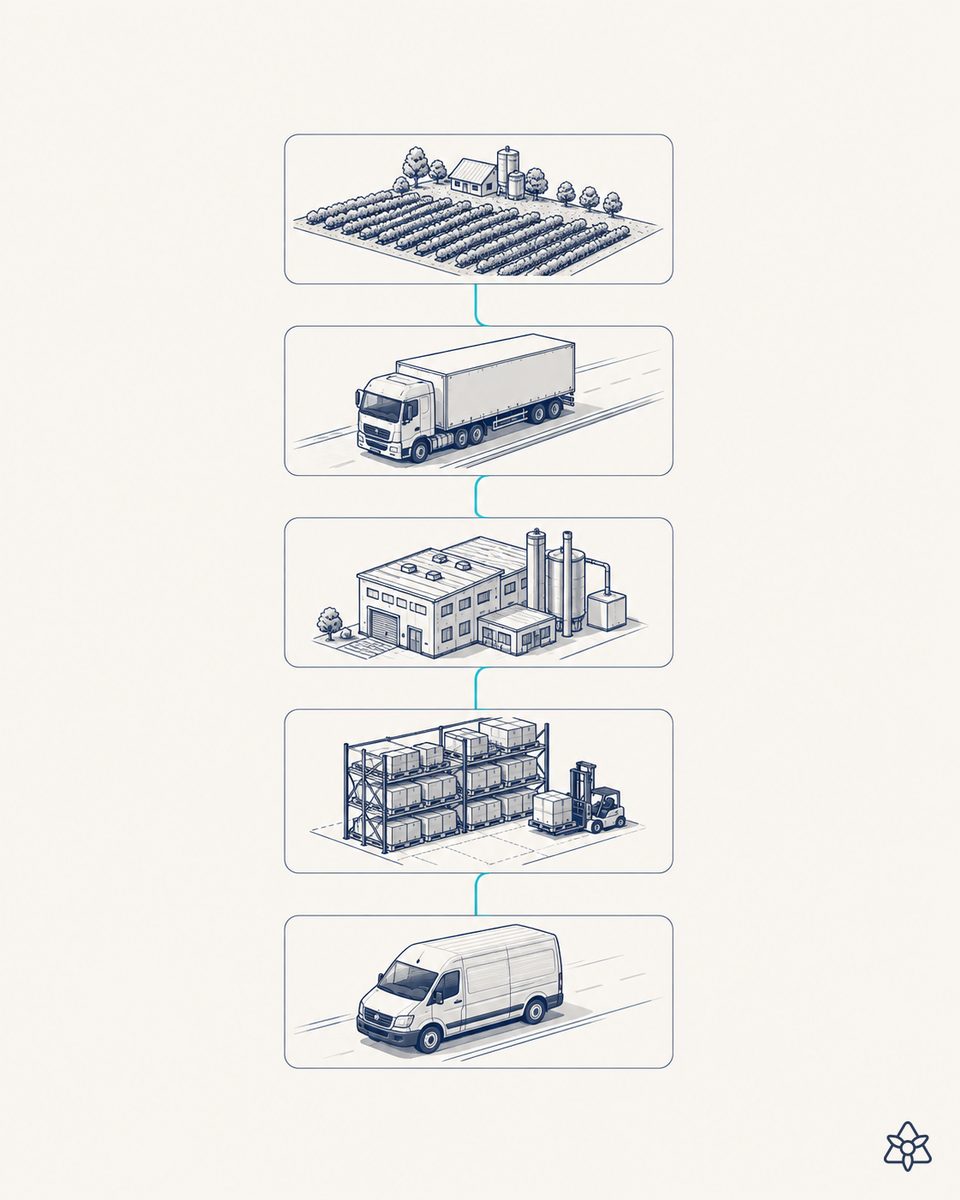
Dozens of parcels, several municipalities, a single vat — and the denomination does not forgive.
A PDO/PGI winery or olive mill lives with a map of origin that does not fit into a spreadsheet:
- Multiple registered parcels — the vineyard or olive register lists every plot and parcel of each grower with its surface area. A Rioja winery takes in grapes from a hundred growers; a Sierra Mágina mill takes in olives from dozens of picking crews and cooperatives.
- Coupage and blending in the vat — the winemaker mixes base wines from different parcels; the master miller combines early and late lots to compose the profile of the vintage. The final vat holds a percentage of each origin, and that cannot be lost.
- Numbered back label from the board — every PDO bottle carries its back label, allocated by the regulatory board against a declared volume. A mismatch in the stock declaration means a visit from the inspector.
- Annual inspections and mandatory declarations — harvest declaration, stock declaration, winery or mill logbook, tasting panel, physico-chemical analyses. Rebuilding the dossier by hand before the inspector's visit takes weeks of the quality manager's time.
- The value of the PDO/PGI brand — a bottle of Rioja Reserva is not worth the same as a table wine, and a tin of Picual from Sierra Mágina is not worth the same as a standard oil. Broken traceability is not a fine: it is the selling price you lose.
The winemaker and the quality manager know this — but a paper winery logbook and delivery notes in a folder do not scale when the board asks for traceability per packed unit. A packed unit without solid traceability down to the parcel is not a back-office failure: it is a direct risk to the seal that gives your brand its value.
iLEAN Tracer does not add a new winery logbook — it seals the cracks between the field and the bottle.
The PDO/PGI problem is not a lack of information: it is information living on islands (the grower's delivery note in a folder, the winery logbook on a desk, the vat record in another spreadsheet) which, at the critical moment (the harvest declaration, the back label request, the board inspection), cannot be cross-checked without effort. iLEAN Tracer acts as the filler that closes those gaps, without asking you to change your weighbridge, your press or your vats.
Tracer starts at grape or olive intake. Connect captures the grower's delivery note with plot and parcel. The agent maintains the composition through the coupage or blend, and assigns PDO/PGI parcels to each packed unit. A person signs.
iLEAN Tracer is the piece that combines Connect (capture by channel) and Agents (regulatory cross-checking + dossier per regulatory board) applied to PDO/PGI wine and olive oil:
- Connect — captures the intake delivery note of every grower with plot, parcel, municipality, kilos, degree or calibre, and the grower's field logbook, digital or on paper. It also captures the process side: weighbridge readings, press or destemmer data, fermentation records, decisions of the winemaker or the master miller. And it captures the regulatory board's notices (resolutions, back label allocations, inspection alerts) at second zero.
- Agents — maintain the proportional calculation along the chain: tank, fermentation, barrel ageing, final coupage, bottling; or hopper, press, decanting, tank, blend, packing. If a parcel in the mixture is not registered or the grower has lost qualification, the agents detect it before packaging and hold the batch for reclassification. If a harvest declaration does not match the intakes, they flag it before you file it.
- Building the regulatory board dossier — the agents assemble the file by PDO/PGI and by batch: harvest declaration, back label allocation, vineyard or olive register, physico-chemical analyses, tasting panel, winery or mill logbook, traceability per packed unit. In the format each board requires (Rioja, Ribera del Duero, Sierra Mágina, Baena, Les Garrigues). The quality manager reviews and signs.
The three security rings guarantee that the grower's sensitive information (what was harvested, on which parcel, at what quality) stays inside the winery or mill, and only leaves when a person signs the dossier for the board. Trust with the vine grower or olive grower is not an accessory — it is the raw material of the project.
Paper winery logbook vs. PDO/PGI parcel traceability with iLEAN Tracer
| Aspect | Manual management (logbooks + spreadsheet) | With iLEAN Tracer |
|---|---|---|
| Grower's delivery note | Paper in a folder, manual transcription | Digitised by photo / PDF, plot and parcel linked to the batch |
| Coupage or blend in the vat | Calculated by hand by the winemaker or master miller | Automatic proportional calculation, parcels preserved conservatively |
| Back label allocation | Spreadsheet table + request to the board | Calculated per batch, in the board's format, ready to sign |
| Winery or mill logbook | Paper, risk of crossing-out and loss | Digital, generated from the real process, no double entry |
| Harvest / stock declaration | Manual rebuild before the deadline | Continuous reconciliation of intake-stock-packing |
| Regulatory board inspection | Weeks preparing folders | Complete dossier per batch, accessible in minutes |
Impact estimate for your plant — to be validated with your numbers.
The block below is an estimate to be validated with the specific data of your winery or mill. We lay it out so the committee has an order of magnitude; we refine it during the diagnostic.
- PDO/PGI winery or mill taking in raw material from dozens of growers and cooperatives, routine coupage or blending, winery or mill logbook still partly on paper, annual regulatory board inspection.
- Tracer pilot over the current campaign (delivery note capture + traceability in the vat + back label allocation + board dossier). First value expected within a few weeks.
- Indicative payback between 4 and 9 months, depending on PDO/PGI packed volume, the time the quality manager and the winemaker / master miller spend on logbooks and declarations, and the cost of the last incident with the board (rejected declaration, back labels withdrawn, observation on the record).
- The hard lever is the protected PDO/PGI brand value: a bottle downgraded to table wine or a tin downgraded to standard oil loses a significant share of its price. Protecting that differential pays for the system.
- Expected reduction in manual time preparing the board dossier: ≥ 30%.
And the fair doubt of the winemaker or master miller
"What if the AI loses a parcel's data in the coupage?" — hallucination is a problem of free generation, not of anchored tasks. In tasks where the AI is limited to recontextualising a data point from one system to another (reading the grower's delivery note and maintaining the composition throughout the process), the best models brought the error below 1.5%[1]. And even so, nothing critical is decided alone: Tracer proposes the dossier and the person signs. The three security rings are there precisely for this.
[1] OpenAI paper "Why Language Models Hallucinate", 2025 — on the reliability of AI in anchored tasks.
What people ask about PDO/PGI traceability in wine and olive oil
What does PDO/PGI regulation require in terms of parcel traceability?
EU Regulation 1308/2013 and the product specifications of each regulatory board (Rioja, Ribera del Duero, Priorat, Jerez in wine; Sierra Mágina, Baena, Les Garrigues, Siurana in olive oil) require you to prove that every bottle or tin comes from grapes or olives grown on qualified parcels and municipalities inside the denomination area. Traceability runs from the vineyard or olive grove to the bottle: registered surface area, vineyard or olive register, winery or mill logbook, numbered back label issued by the board. A PDO bottle whose grapes or olives cannot be traced back to a qualified parcel is not PDO — it is table wine or standard oil, with all the brand cost that implies.
How does iLEAN Tracer assign parcel and municipality to each packed unit?
Tracer starts at grape or olive intake: Connect captures the grower's delivery note with plot, parcel and municipality (paper, PDF, digitised field logbook). Every batch of must, base wine, paste or oil carries that information through the operations (fermentation, ageing, decanting, filtering, bottling) and the agents maintain the proportional calculation whenever there is a coupage or a blend. When the packed unit leaves, it carries the PDO/PGI parcels that make up its content and the regulatory board back label. A person signs — the batch is never released on its own.
What happens with coupage (wine) or blend (oil) — how is the mixture traced?
Coupage in wine and blending in olive oil are the norm, not the exception — the winemaker or the master miller mixes lots to reach the profile of the vintage. Tracer maintains the proportional calculation: if a final vat holds 60% base wine from parcel X in municipality Y and 40% from parcel Z in municipality W, every bottle packed from that batch carries that composition. If a parcel was not qualified as PDO, the agents detect it before packaging and hold the batch, or redirect it to non-PDO product.
How is the dossier for the regulatory board put together?
Every regulatory board demands its own dossier: harvest declarations, allocation of numbered back labels, vineyard or olive register, physico-chemical analyses, tasting panel, winery or mill logbook. The Tracer agents assemble the records by batch and by PDO/PGI, in the format each board requires, ready for the inspector. The quality manager reviews and signs. The file is delivered complete instead of being rebuilt weeks before the annual inspection.
Does it work in a small winery or mill that still keeps paper logbooks?
Yes — that is exactly what it is for. Connect has a capture gradient: a person photographs the grower's paper delivery note and the agents extract plot, parcel and municipality; if the grower already sends a digital field logbook, direct integration. The winery or mill logbook is digitised once and Tracer keeps it up to date batch by batch. It does not force you to change your press, your vats or your weighbridge — it captures what you already have and cross-checks it against the board's rules.
More cases in ilean tracer
- Cut-flower reefer: the auction price is decided in the cracks of the cold chain.iLEAN Tracer holds the cold chain of a cut-flower reefer from farm to auction, with projected vase life…
- Dairy cow — the collar knows, the meter knows, the ERP knows — and nobody knows it together.iLEAN Tracer records individual yield per milking for every dairy cow with GPS collar, heat and…
- FSMA in the United States, MERCOSUR in Brazil, EUDR in the EU — three regulations, one single packaging line.iLEAN Tracer switches the regulatory dossier by destination (FSMA US, MERCOSUR, EUDR EU) per exported…
- You export to twelve countries and each one bans different pests — one wrong certificate and the consignment comes back from the port.iLEAN Tracer keeps the phytosanitary certificate per destination country for every exported SKU, with…
- Fresh meat pallet cold chain segregation — one break on one truck should not cost thirty pallets on hold.How iLEAN Tracer segregates the cold chain of a fresh meat pallet as it crosses trucks and cross-dock…
- Iberian pig — the PDO demands a record per animal, and that record lives in five different notebooks.iLEAN Tracer links the Iberian pig's RFID ear tag to the PDO, montanera days and the slaughterhouse —…
Tell us about your case and within 48h we'll send you the estimated ROI of this AI project for your winery or mill.
We work on the real data of your vintage, not on ours. Diagnostic with no commitment.
Request estimated ROI within 48h See iLEAN Tracer