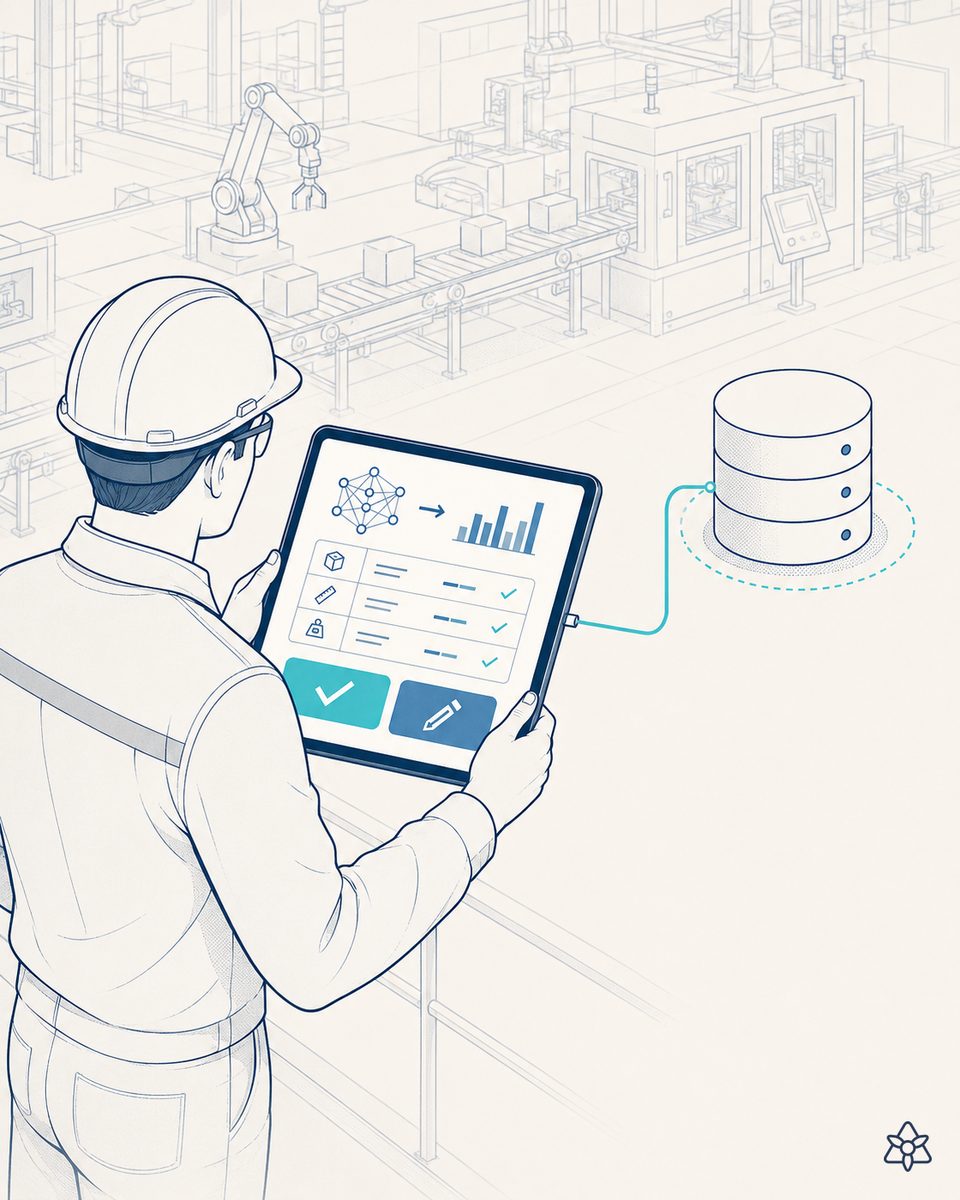
The operator fills the FAI from a phone on the shop floor — and the AS9102 reaches the OEM with no paper and no spreadsheet in between.
The FAI (First Article Inspection) is the gateway to serial production in aerospace: with no complete, signed AS9102, the OEM will not accept the shipment. iLEAN Connect builds the mobile form part by part — dimension by dimension with its tolerance, an optional photo, the operator's signature. The Agents assemble the AS9102 with raw material and special processes cross-checked. Quality validates and signs. No paper, no typing.
The FAI lives in six places — and the AS9102 pulls them together one by one, by hand.
The FAI of a new aerospace part (or of a transfer, or of a process change) has to reach the OEM as a complete, signed AS9102: identification, raw material, special processes, and every drawing characteristic verified. The problem is not the standard — it is that FAI information lives scattered across systems that do not talk to each other:
- The drawing in the PLM system, with its dimensions and tolerances.
- The measured dimensions in the metrology room, with their own report.
- The photos of the part on the shop supervisor's phone.
- The raw material certificate in a network folder.
- The special process certificates (heat treatment, NDT, surface finish) in another one.
- The blank AS9102 form, waiting for somebody to fill it in.
Somebody — the quality manager — has to open the six sources, cross-check dimension by dimension, type up the AS9102 and chase the signatures. Days of qualified work on a single part, multiplied by every FAI of the year. And the classic system (intermediate spreadsheet + folder + email) is fragile to copy-paste: one value miscopied into an AS9102 can pass the shipment, reach the OEM, and come back as a finding weeks later.
Connect captures at the bench — the Agents assemble the AS9102 — quality signs.
The FAI is not a standards problem: it is a problem of data islands. The dimensions, the photos, the certificates and the drawing each live in their own system, and today's AS9102 pulls them together by hand. iLEAN acts as the filler that seals that crack between the operator's bench and the signed AS9102, without replacing your PLM, your metrology room or your document system.
Connect captures the FAI at the bench, at second zero. The Agents recontextualise it into an AS9102 with raw material and special processes cross-checked. The person signs every shipment. No intermediate spreadsheet, no paper, no copy-paste.
The three iLEAN pieces applied to the aerospace FAI:
- Connect — builds the mobile form specific to the part from the drawing (every characteristic with its tolerance, waiting for a measured value and a photo). The operator works dimension by dimension at the bench, takes the photo, signs. It works with no signal: if the shop has a dead zone, it captures locally and syncs afterwards.
- Agents — take the data from the bench, cross-check it against the raw material certificate and the special process certificates (heat treatment, NDT, surface finish), and assemble the AS9102 form 3 for the batch — ready for the quality manager to review. They flag doubts and discrepancies before the shipment.
- Three rings — the FAI data lives in ring 3 (fast capture). It passes through validation in ring 2 (does the raw material match what the drawing requires? is the special process certified and in date?). It only enters the closed document system (ring 1) with the manager's signature. DO-326A formalises it for the sector.
FAI on a spreadsheet and a folder vs. FAI with the iLEAN mobile form
| Aspect | Classic FAI flow | With iLEAN Connect + Agents |
|---|---|---|
| Capture of measured dimensions | Notebook or a loose metrology report | Mobile form at the bench, dimension by dimension |
| Photos of the part | Shop supervisor's phone, scattered album | Tied to the dimension inside the FAI |
| Raw material and special processes | Separate folders, manual search | Cross-checked by the agent while assembling the AS9102 |
| Generation of the AS9102 form 3 | Typed up by hand by the manager | Auto-generated draft for human validation |
| Total time per FAI | 1-3 quality working days (estimate to be validated) | Reduction of ≥ 30% in total time |
| Copy-paste risk | High: one miscopied value goes to the OEM | Low: the AS9102 is built on the captured data |
Impact estimate for your plant — to be validated with your numbers.
The block below is an estimate to be validated with the concrete data of your plant. We put it forward so the committee has an order of magnitude; we refine it during the diagnostic.
- Tier 2 machining shop with several active OEM programmes, an average of several FAIs a month (between new parts, transfers and process changes), 1-2 quality managers.
- Connect pilot on one part family: automatic generation of the mobile form from the drawing + capture at the bench + AS9102 assembly. First value expected within a few weeks: one FAI closed end to end with no intermediate spreadsheet.
- Indicative payback between 4 and 9 months, depending on annual FAI volume, the current cost of a quality hour and the historic average cost of a FAI rejected by the OEM (customer charge + programme delay + reopening the pack).
- Expected reduction of the total time per FAI of ≥ 30%, once the bench captures straight into the form and the AS9102 is auto-generated.
- The hard lever is a single FAI rejection by the OEM avoided: one finding caused by a miscopied value in an AS9102 can pay for the pilot and keep the programme on schedule.
And the quality manager's reasonable doubt
"What if the agent pulls a dimension wrong or cross-checks the wrong certificate?" — hallucination is a problem of free generation, not of anchored tasks. Moving a value from the bench into a cell of the AS9102, and matching a certificate field against the drawing requirement, is exactly an anchored task: the best models brought the error below 1.5% [1]. And even so, the AS9102 does not go to the OEM until the manager signs. The draft arrives with doubts and discrepancies flagged. The three rings exist precisely for this.
[1] OpenAI paper "Why Language Models Hallucinate", 2025 — on the reliability of AI in anchored tasks.
What people ask about the aerospace FAI mobile form
What is a FAI and why does the aerospace industry require it?
The FAI (First Article Inspection) is the formal inspection of the first part of a new series, a line transfer, a process change or a supplier change. It is documented in the AS9102 format (forms 1, 2 and 3): part identification, raw material and special process certification, and every drawing characteristic verified with its actual measured value. If the FAI is not complete and signed, the aerospace OEM will not accept the shipment. It is the gateway to serial production.
Why is the classic FAI such a pain for the quality team?
Because FAI information lives scattered across many places: the drawing in the PLM system, the measured dimensions in a metrology room with its own report, the photos on the shop supervisor's phone, the raw material certificates in one folder, the special process certificates (heat treatment, NDT, surface finish) in another. Somebody has to collect all of that, type it into the AS9102, cross-check it against the drawing and sign. It is usually days of work for the quality manager on every single FAI.
How does iLEAN Connect let the operator fill the FAI from a phone?
Connect builds the mobile form specific to the part: every drawing characteristic appears as a field with its tolerance, waiting for a measured value plus an optional photo. The operator at the bench goes dimension by dimension, measures, takes the photo, signs. The agent turns that data into the AS9102 form 3 for the batch, cross-checks it against raw material and special processes, and leaves the pack assembled. The quality manager validates and signs — the AS9102 reaches the OEM without ever passing through an intermediate spreadsheet or paper.
What happens if there is no coverage in the shop or the operator is in a dead zone?
Connect works local first. The operator fills the FAI from the phone even with no signal: the capture is stored on the device, the photos too, the signature is recorded with a timestamp. When the signal comes back, everything syncs with the central system. What is critical does not depend on connectivity — it is the same principle as the Edge on the line: as long as it has power, it captures. The operator is never blocked waiting for the WiFi to return.
How much time is saved per FAI with the iLEAN mobile form?
A typical FAI on a machined part with several dozen dimensions, raw material and two or three special processes can take between 1 and 3 working days of the quality manager: collecting information, cross-checking, typing up the AS9102, signing. With capture on the shop floor from a phone and the AS9102 assembled automatically by the agent, the estimate to be validated is a reduction of the total FAI time of ≥ 30% and the removal of the intermediate spreadsheet stage. We fine-tune it with the data from your last real FAIs.
More cases in ilean connect
- From image to Excel, handwriting too. And the next sheet does itself.Convert a photo of a handwritten sheet to Excel with an AI agent. If it's a form you use every day, it…
- Your paper inspection checklists, tallied and watched by AI agents.Free printable daily equipment inspection checklist and defect check sheet. Check them off by hand, snap…
- Your paper maintenance log, read by AI agents.Free printable equipment maintenance log template. Techs fill it in by hand, snap a photo, and an AI…
- Paperless IFS/BRC audits — the tablet opens the form, the person signs, the dossier builds itself.An IFS/BRC auditor walks the food plant with a tablet; iLEAN Connect opens the mobile form that captures…
- Your 90s packaging line still runs on MS-DOS — and your BI has a hole the size of its counter.A 90s MS-DOS HMI on your packaging line: iLEAN Connect photographs the screen on a cycle and sends the…
- Your paper shift report, turned into your plant dashboard.Free end-of-shift and daily production report template. Snap a photo at shift change and AI agents give…
Tell us about your case and within 48h we'll send you the estimated ROI of this AI project for your aerospace FAIs.
We work on your plant's real data, not on ours. Diagnostic with no commitment.
Request estimated ROI in 48h See Connect