Your 90s packaging line still runs on MS-DOS — and your BI has a hole the size of its counter.
There is a line that produces well, pays the bills and has its HMI on a CRT screen running MS-DOS. Integrating it always cost more than the data was worth. That expired. iLEAN Connect puts a fixed camera in front of the screen, photographs it on a cycle, reads the counters the way a person reads them and delivers them to BI/MES without touching the PLC. The person signs — the old machine carries on exactly as before.
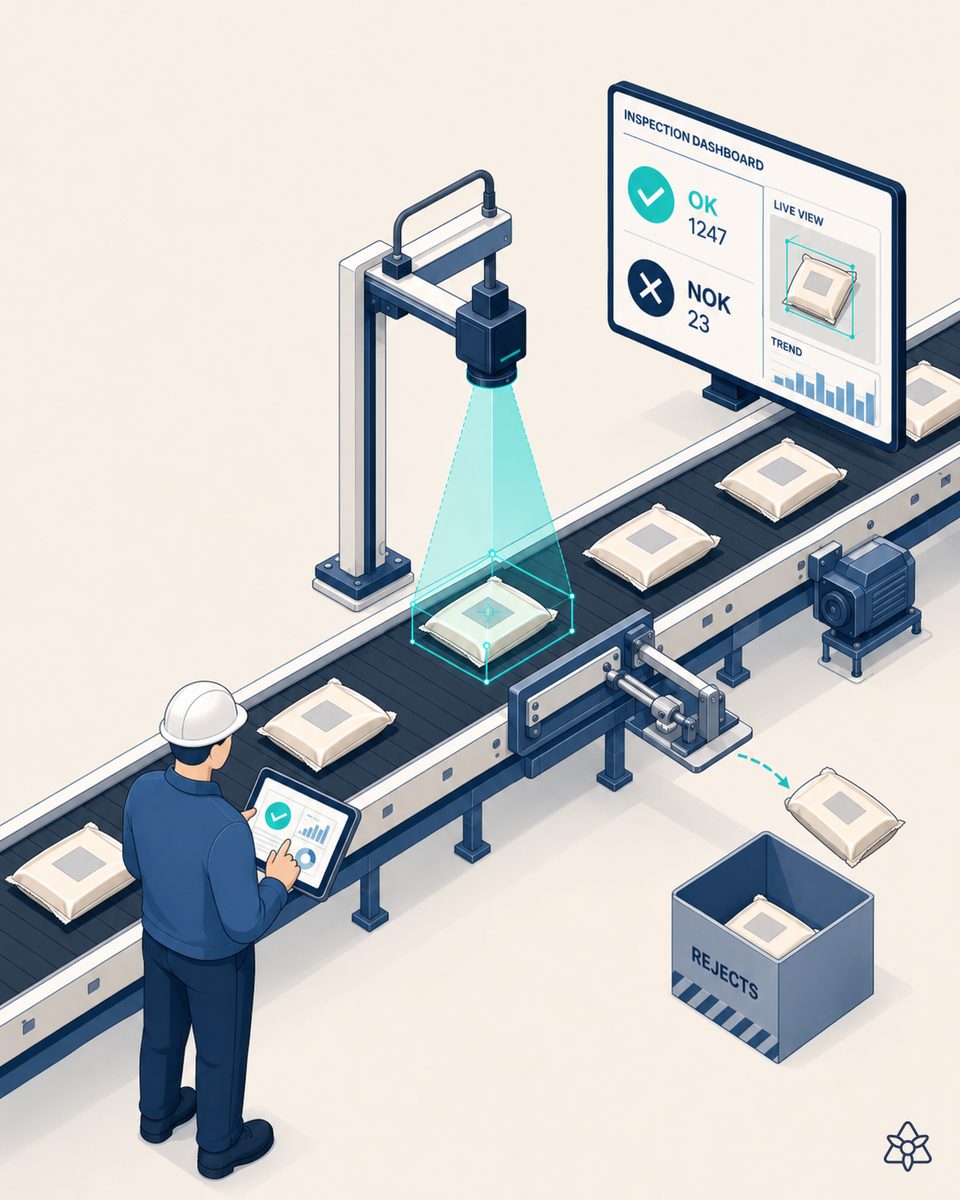
The old machine is still there — and nobody wants to touch it because it works.
The plant manager puts it plainly: "that line delivers OEE, it runs on its own, I am not stopping it for a retrofit". And they are right. The line produces, the shift operator reads the counters on the CRT screen and writes them down in a spreadsheet at the workstation. The corporate BI has a hole exactly the size of that line — and the IT director has been asking for budget to integrate it for years.
- The PLC retrofit costs more than it is worth. Not because the vendor is being difficult: because touching old OT without stopping production is a delicate, expensive operation.
- The physical spare part is no longer manufactured. Replacing the whole machine is not an option while it keeps making good product.
- The counter arrives late and by hand. The reality of that line reaches the BI in next day's spreadsheet, with typos and gaps.
The classic excuse — "I am not integrating that old machine because it costs more than it is worth" — was true for decades. That expired. It is not a moral flag: it is arithmetic. AI dropped the cost of recontextualizing formats through the floor. Today the screen is read the way a person reads it, without touching the PLC, without opening the OT ring.
iLEAN does not ask you to scrap the machine — it puts a camera in front of it and leaves the line alone.
Connect is the filler between the 90s line and the corporate BI. It does not tear out the tiles: it fills what was left hollow. In its manual/intermediate gradation — the one iLEAN's foundation designed precisely for machines that will not let themselves be touched — a fixed camera sees the screen the way a person sees it and the AI extracts the data.
The camera looks at the CRT. Connect reads the counters. The agent ties them to the batch and to the BI. The person signs — the PLC never even notices.
The iLEAN pieces applied to the MS-DOS line:
- Connect (manual/intermediate gradation) — fixed camera in front of the CRT screen, capture on a cycle (every X minutes or on event). It detects the expected tab; if the camera cannot see it, it does not invent: it flags the capture as uncertain. The gradation is decided line by line — there is no single recipe.
- Connect (listening outward) — it captures whatever falls around the line: the shift supervisor's message reporting a jam, the manufacturer's email with the shutdown procedure, the maintenance note from the last intervention. All of it enters the system at second zero.
- Agents — they cross the counter that was read with the production order, normalize it to the BI/MES format and deliver the data as if the line had been integrated all along. If they have doubts (an unexpected tab change, a counter stuck at zero for too long), they propose a verification to the shift supervisor, they do not invent. The person signs; the line does not restart on its own.
Counter written down by hand vs. counter read by camera with Connect
| Aspect | Shift spreadsheet + manual entry | With iLEAN Connect + Agents |
|---|---|---|
| Counter capture | The operator writes it in a spreadsheet | Fixed camera + reading by vision |
| Cost of touching the PLC | Expensive retrofit, line stoppage | Nothing is touched, neither PLC nor HMI |
| Arrival at the corporate BI | Next day, with errors and gaps | At second zero, normalized |
| Traceability of the capture | Trust in whoever wrote it down | Literal photo + timestamp + batch |
| OT ring isolation | Respected because nothing is integrated | Respected — a camera is not an OT network |
| Ability to compute real OEE | Approximate, delayed | Per shift, with a verifiable source |
Impact estimate for your plant — to be validated with your numbers.
The block below is an estimate to be validated with the specific data of your plant. We lay it out so the committee has an order of magnitude; we refine it during the diagnostic.
- Packaging line with an MS-DOS HMI, counters written down by hand by the shift today, corporate BI with a hole on that line.
- Connect pilot (fixed camera + reading by vision + normalization agent into the BI). First expected value in a few weeks: the first shift enters the BI with the figure read off the screen.
- Indicative payback between 4 and 9 months, depending on how much that line weighs in the consolidated OEE and on the hours spent today rebuilding the figure by hand.
- Reduction of the latency between line event and consolidated BI data of ≥ 30%. The underlying lever is not administrative efficiency: it is seeing the real OEE of that line for the first time.
And the IT manager's reasonable doubt
"What if the AI misreads the counter and injects noise into the corporate BI?" — hallucination is a problem of free generation, not of anchored tasks. Reading a counter on a CRT screen is an anchored task par excellence: the best models pushed the error below 1.5%[1]. And even so, what is critical is never decided alone: uncertain readings are not written to the BI — they are proposed to the shift supervisor for verification, and the person signs.
[1] OpenAI paper "Why Language Models Hallucinate", 2025 — on the reliability of AI in anchored tasks.
What people ask about reading an MS-DOS screen in packaging
Why keep a packaging line with an MS-DOS HMI?
Because it works. The line delivers product that passes quality control and replacing the machine costs a fortune — and the physical spare part is often no longer manufactured. The classic excuse was that integrating it cost more than the data you would get out of it. That expired: AI dropped the cost of reading an old screen through the floor. Today you can have the counter in your BI without touching the PLC and without changing the machine.
How does Connect read an MS-DOS CRT screen with no OT integration?
A fixed camera in front of the screen and a terminal with machine vision that triggers the capture on a cycle (every X minutes or on event). The AI extracts the counters (units, stoppages, alarms) reading them the way a person reads them, normalizes them to the MES/BI format and delivers them. Without touching the HMI, without touching the PLC, without opening the OT ring. This is the manual/intermediate gradation of Connect — the one that exists precisely so nobody is forced to change the machine.
What if the screen switches tab or an operator blocks the camera?
Connect identifies the expected tab and, if the camera cannot see it, it does not invent: it flags the capture as uncertain and leaves it pending. The agent asks the shift supervisor through the usual channel (messaging app or tablet), it does not make the figure up. The rule is stable: Connect transports, the Agents propose, the person signs.
Is it safe against the OT network isolation criteria?
Yes — and it is in fact the model that respects OT isolation best. There is no network protocol talking to the PLC, no foreign client inside the critical ring. The camera sees the screen the way a person sees it. The data crosses outward through the camera to ring 3 (the power ring) and, if it has to come back into the inner ring, it does so through a signed file drop. A security manager understands a camera far better than a proprietary driver on a flat network.
How much does it cost to get an old line's counter into the BI?
The order of magnitude of a Connect pilot on a vintage packaging line is close to any Connect pilot in a plant: camera plus terminal plus integration of the expected format with the BI/MES, plus an annual licence. The reasonable payback to present to the committee is several months — the hard lever is to stop flying blind on a line that weighs on your OEE. We ask for your plant's data and send you the estimated ROI in 48h, with your numbers, not ours.
More cases in ilean connect
- Your paper maintenance log, read by AI agents.Free printable equipment maintenance log template. Techs fill it in by hand, snap a photo, and an AI…
- The operator fills the FAI from a phone on the shop floor — and the AS9102 reaches the OEM with no paper and no spreadsheet in between.iLEAN Connect lets the operator fill the FAI from a phone on the shop floor — photos, dimensions,…
- Paperless IFS/BRC audits — the tablet opens the form, the person signs, the dossier builds itself.An IFS/BRC auditor walks the food plant with a tablet; iLEAN Connect opens the mobile form that captures…
- Your paper shift report, turned into your plant dashboard.Free end-of-shift and daily production report template. Snap a photo at shift change and AI agents give…
- The press stamps just fine. Its Siemens S5 tells nobody about it.How iLEAN Connect photographs the Siemens S5 screen of a stamping press each cycle and sends strokes,…
- A 24/7 plant where no smartphone is allowed — and andon still has to stay alive.24/7 plant where personal phones are banned: iLEAN Connect keeps andon alive by SMS to the shift lead's…
Tell us your case and within 48h we will send you the estimated ROI of this AI project for your MS-DOS line.
We work on your plant's real data, not on ours. Diagnostic with no commitment.
Request estimated ROI in 48h See iLEAN Connect