The press stamps just fine. Its Siemens S5 tells nobody about it.
On a stamping press with an isolated Siemens S5 HMI, the live data (strokes, pressure, SPM, alarms) lives on a screen the MES never sees. iLEAN Connect photographs it every cycle, a vision agent extracts the fields and pushes them into the MES — without touching the PLC, without opening a port, without stopping the press. Ring 1 stays sacred; the system stops being blind.
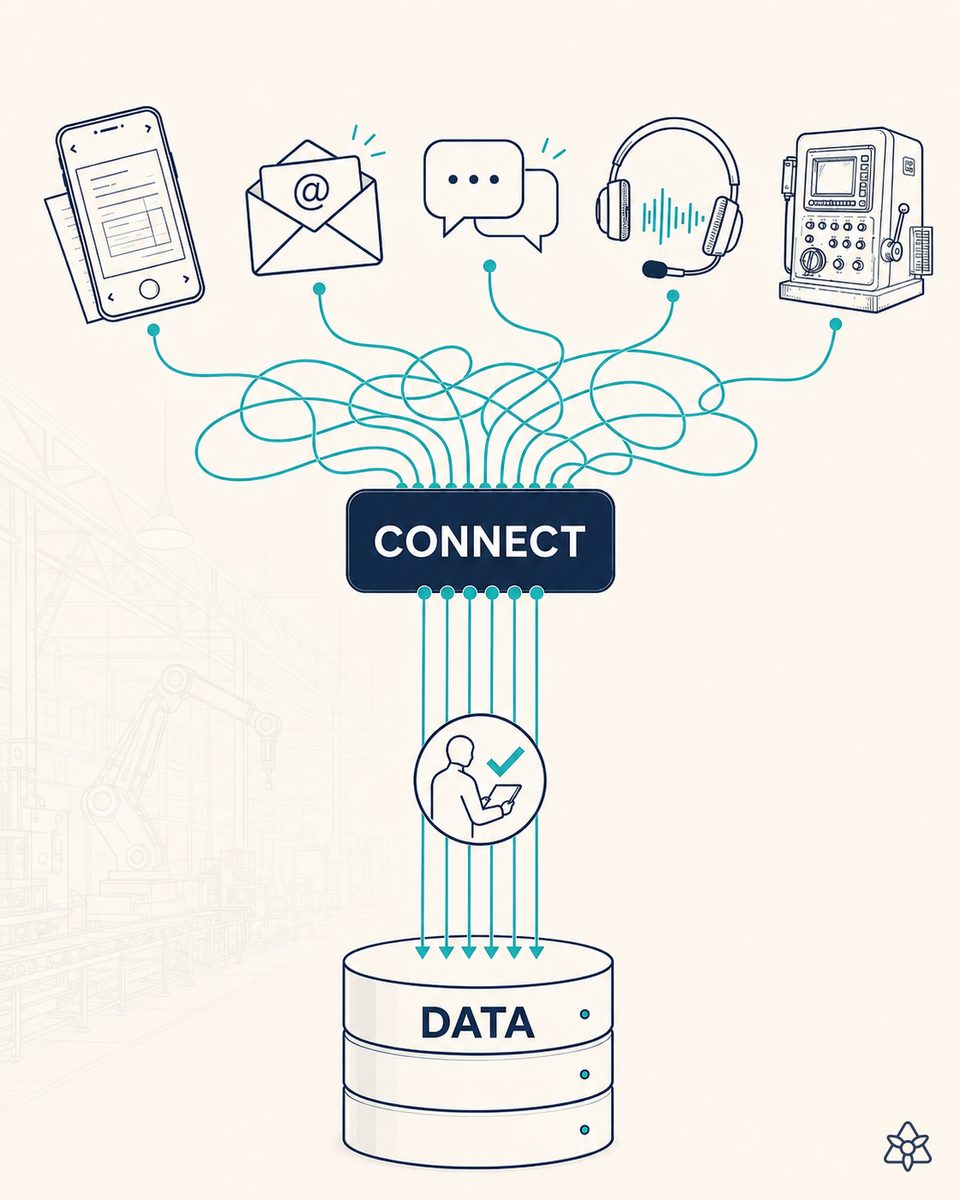
The data lives on a screen nobody ever integrated.
An automotive stamping press produces well. It is a machine worth hundreds of thousands of euros that holds up shift after shift. But the data that matters to the MES — and to real OEE, not the shift supervisor's notebook — lives on its Siemens S5 HMI screen:
- Real strokes per minute, not the theoretical figure on the datasheet.
- Pressure and force per stroke, with the real curve when the die wears out or when the coil arrives off-spec.
- Alarms and micro-stoppages, the gap between Monday's report OEE and the real one.
Why it happens: the Siemens S5 does its job, it has been running for decades, and swapping it for an S7 or TIA Portal means stopping the press for weeks. Integration cost more than it was worth, so it never happened. The operator writes down what matters on a sheet at shift change, the shift supervisor types it into the ERP on Monday, and the MES draws an incomplete reality. This is not sloppiness: it was the only reasonable option. That is what changed.
iLEAN Connect photographs the screen — filler from the outside, ring 1 stays sacred.
The classic OT customer is rightly suspicious of anything that gets near their PLC. iLEAN respects that boundary by design: the S5 is not touched, no port is opened on it, the OT network is not touched. Connect applies capture from the outside, in the physical world — a camera looks at the screen, just as a person would, and the data crosses into the system from ring 3.
The camera looks at the HMI. The agent recognises the field. The live data enters the MES. The PLC receives nothing.
The iLEAN pieces applied to a press with a Siemens S5:
- Connect (capture gradient, photo option). Camera pointed at the HMI, capture every cycle or on event. A vision agent (CNN + OCR) recognises the active view (process view, alarm view, die recipe view) and extracts strokes, pressure, SPM and active alarm. It works because it is trained on that machine's real screens, not in the abstract.
- Edge (optional). If the press has an additional visual bottleneck (coil feeding, ejection, defect ranking on the stamped part), an Edge terminal with a CNN can watch it in line. Not mandatory to start.
- Plant agents. They cross the data extracted from the screen with the production order, the source coil and the die maintenance plan. Real OEE, traced micro-stoppages, pressure anomalies linked to a specific die. When they spot an out-of-range pattern, they alert the shift supervisor through whichever channel they use.
- Three rings. The S5 lives in ring 1 (critical OT, untouchable). Connect captures from ring 3 (the physical world, the screen). The data passes through ring 2 (validation + signature) before reaching any system that takes a decision. The armoured mailbox only opens from the inside.
Blind S5 screen vs. photo capture with iLEAN Connect
| Aspect | Operator writing it down by hand | With iLEAN Connect + vision agent |
|---|---|---|
| Strokes per minute (SPM) | Datasheet figure, logged per shift | Real, every cycle, into the MES |
| Pressure per stroke | Only when the operator happens to look | Continuous curve, anomalies flagged |
| Alarms and micro-stoppages | Reconstructed by hand | Traced instantly, with root cause |
| Real OEE | "Approximate" | Calculated from live data |
| Touching the S5 PLC | n/a | Zero, no port opened on it |
| Die record | The maintenance lead's folder | History per die, automatic |
Impact estimate for your plant — to be validated with your numbers.
The block below is an estimate to be validated with the actual data from your plant. It is an order of magnitude so the committee can size it; we refine it during the diagnostic.
- Automotive Tier-1 with 3-5 stamping presses running an isolated Siemens S5 HMI and a per-die maintenance plan.
- Connect pilot (camera + vision agent) on one press. First value expected within a few weeks: real SPM and alarms travelling to the MES.
- Indicative payback between 4 and 9 months. Hard levers: reduction of uncounted micro-stoppages (defensible floor ≥30%), die maintenance planning based on real pressure, real OEE to decide whether a fourth press is needed or one is spare.
- Rollout to the other presses done by the plant team itself with their own trained people — without us.
And the reasonable IT/OT objection
"What if the OCR misreads a value and pushes a made-up SPM into the MES?" — hallucination is a problem of free generation, not of anchored tasks. Reading a number off a screen with known digits and pushing it to the MES is the anchored task par excellence: the best models keep the error below 1.5% [1]. And even so, ring 2 is there: out-of-range values go through validation before updating OEE or firing an alarm. The S5 never receives anything back; the data flows only from the screen towards the MES.
[1] OpenAI paper "Why Language Models Hallucinate", 2025 — on the reliability of AI in anchored tasks.
What people ask about photographing the Siemens S5 screen
Why does an automotive stamping press still run on Siemens S5?
Because the press is a machine worth hundreds of thousands of euros that does its job, and the Siemens S5 keeps running without trouble. Migrating to S7 or TIA Portal means stopping the press for weeks, rewiring, retraining maintenance — and usually with no extra business value for the part being stamped. The S5 is the reasonable choice: what is missing is not retiring it, but getting the live data from its HMI (strokes, pressure, SPM, active alarm) into the MES in real time, without touching the OT network it lives on. That is what changed, not the PLC.
How does iLEAN Connect read an HMI screen with no network access to the PLC?
Connect applies its capture gradient: if the HMI has no network port to the outside (the norm with an S5), the reading is done by photo. A camera looks at the screen every cycle, a vision agent (CNN + OCR) extracts the fields (stroke number, instantaneous pressure, SPM, alarm) and sends them to the MES. The PLC receives nothing, no port is opened on it, the OT network is not touched. Connect is the filler applied from the outside; ring 1 stays sacred.
What if the HMI switches screens mid-production?
That is normal on an S5: the display rotates between process view, alarm view and die recipe view. The agent recognises which screen is active and applies the matching OCR/extraction — because the model is trained on every view. When an alarm screen appears, that capture takes priority and the agent notifies the maintenance lead through whichever channel they use. The system allows it because the agent knows the context — it is not blind OCR.
What data does this surface that the MES did not have?
Three concrete blocks on an automotive stamping press: real strokes per minute (effective SPM, not the datasheet figure), pressure and force per stroke (the real curve, with anomalies from a worn die or off-spec material) and alarms and micro-stoppages (the gap between paper OEE and real OEE). With those three blocks, the plant agents cross-reference production order, coil batch and maintenance plan. Real OEE, not estimated.
How long does it take to see a return from photographing S5 screens?
It is one of the fastest first-value cases in automotive stamping: within a few weeks there is flow (camera pointed at the screen, OCR working, data entering the MES). The full pilot with alarm rules and a real-OEE dashboard fits in a quarter. And the rollout to the other presses and dies is done by the customer with their own trained people — the success of a good pilot is that they stop needing you. Ask for the estimated ROI and we send it in 48h, with your numbers.
More cases in ilean connect
- Paperless IFS/BRC audits — the tablet opens the form, the person signs, the dossier builds itself.An IFS/BRC auditor walks the food plant with a tablet; iLEAN Connect opens the mobile form that captures…
- Your 90s packaging line still runs on MS-DOS — and your BI has a hole the size of its counter.A 90s MS-DOS HMI on your packaging line: iLEAN Connect photographs the screen on a cycle and sends the…
- Your paper shift report, turned into your plant dashboard.Free end-of-shift and daily production report template. Snap a photo at shift change and AI agents give…
- A 24/7 plant where no smartphone is allowed — and andon still has to stay alive.24/7 plant where personal phones are banned: iLEAN Connect keeps andon alive by SMS to the shift lead's…
- SMS cold chain alert for a biologic vaccine — the alert does not wait for the cloud.iLEAN Connect sends an SMS to the carrier and the QP when a biologic vaccine thermograph goes out of…
- SMS HACCP CCP alert in a meat plant — alerting through the channel the shift lead actually carries.iLEAN Connect sends the HACCP CCP alert by SMS to the meat plant shift lead with no smartphone, with…
Tell us about your case and in 48h we'll send you the estimated ROI of this AI project for your Siemens S5 presses.
We work on your plant's real data, not ours. Diagnostic with no strings attached.
Request estimated ROI in 48h See iLEAN Connect