Zero-gap traceability, waste to destination
The capital pain of any C&D waste manager: every ton coming in must stay linked, with no gaps, to its final destination. The iLEAN flagship system coordinates Connect, Edge and Agents in four cross-checked verification rings.
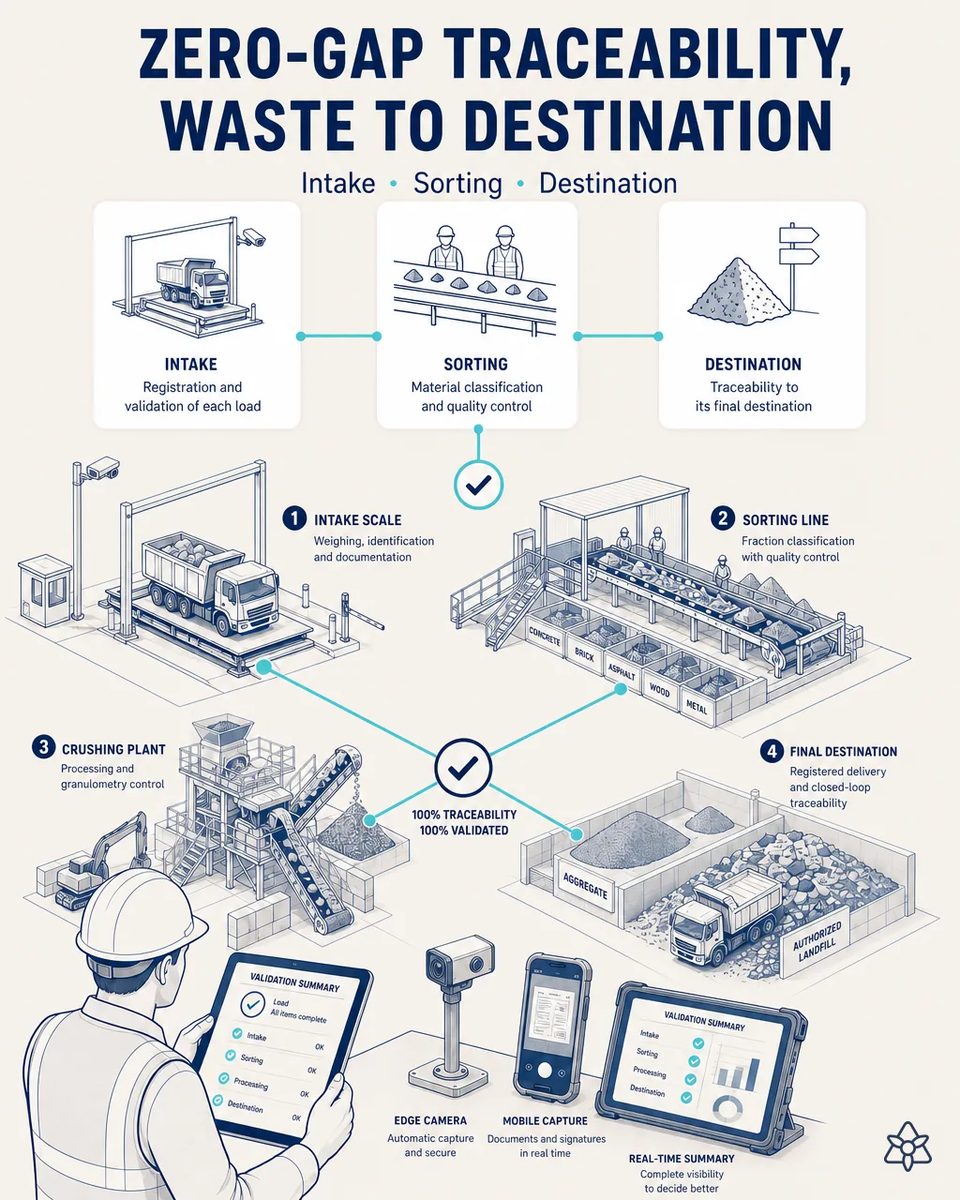
A traceability break is never one failure; it is a chain of small ones.
A break in intake-to-destination traceability is the sector's biggest legal and reputational risk. Every incident threatens the waste-management authorization and the relationship with construction clients who depend on that certificate for their own compliance.
- A form typed late, a weighing matched to the wrong truck, a contaminant that slipped past the cabin, a hopper signed off as empty when it was not. None of them is dramatic on the day.
- Each link looks acceptable on its own. Together they break the line between the ton that came in and the aggregate or landfill it ended up in.
- That break is the sector's biggest legal and reputational risk: every incident threatens the waste-management authorization, which no plant can afford to lose.
- And it hits the construction clients who rely on your certificate for their own compliance — they lose their evidence when you lose yours.
Four cross-checked rings — every previous case, orchestrated by Agents.
Four coordinated rings:
No ring is new on its own; what is new is that they check each other. A load whose intake, sorting, hopper and batch evidence stop agreeing is held before it leaves, not discovered at the next inspection. The certificate you issue then rests on four independent sources that agree.
- the intake-scale record (form, delivery note and weighing) with no manual entry;
- the sorting camera confirms the fraction actually separated;
- JIDOKA AI blocks a new batch's start-up unless the hopper is confirmed empty;
- every batch leaves with its evidence pack cross-checking the three prior rings. SMED AI speeds up changeovers between waste types so the plant's pace isn't penalized.
The four rings, and the gap each one closes
| Ring | Built from | Gap it closes |
|---|---|---|
| 1 · Weighbridge | Intake form (1) + panel (2) + delivery note (7) + scale-ERP link (8) | Which waste, from which site, at which weight — no manual entry |
| 2 · Sorting | Belt vision (9) + supervisor's headset (4) | The fraction actually separated, not the one declared |
| 3 · Hopper | Changeover validation (10), JIDOKA AI | No new batch starts on carryover |
| 4 · Case file | Evidence pack (11) | Every batch leaves with proof of rings 1-3 |
| Pace | SMED AI on waste-type changeovers | Traceability without slowing the plant |
| Gate | Two-tap validation (5) | No ring writes to the record without a person |
Traceability rebuilt after the fact with gap risk → continuous, verified-in-the-moment traceability, by case file.
Impact estimate — set against one serious traceability incident.
The block below is an estimate to be validated against your plant's actual data. We put it forward so the committee has an order of magnitude; we refine it during the assessment.
- Estimated payback 6-12 months, set against the cost of a single serious traceability incident — a figure to validate with management.
- Protection of the waste-management authorization, which is the plant's license to operate and the asset everything else depends on.
- Protection of the relationship with construction clients whose own compliance hangs on your certificate, and who choose their waste manager accordingly.
- And traceability moves from rebuilt after the fact, with gap risk, to verified in the moment, case file by case file, from the truck at the gate to the aggregate sold or the landfill cell.
Protects the waste-management authorization and the relationship with construction clients. Estimated payback 6-12 months against the cost of a single serious traceability incident. *Estimate to validate* with management.
And the fair question from the production manager
“Do we need all twelve cases before this works?” — no. The rings are built in layers and each case pays on its own; with the intake form and the weighbridge panel you already have most of ring 1. Each ring rests on anchored tasks — reading a form, a display, an image against its reference — where the best models drop below 1.5% error [1], and JIDOKA AI stops only on a verifiable discrepancy between sources. When the doubt is the model's, a person decides.
[1] OpenAI paper "Why Language Models Hallucinate", 2025 — on the reliability of AI in anchored tasks.
What people ask about zero-gap traceability
Which case should the rollout start with?
With the intake form photo at the weighbridge: fewest dependencies, shortest deployment, and the first link everything else hangs from. The weighbridge panel usually follows within weeks.
What does cross-checking add over each control alone?
It catches the chain. A misdeclared code passes the scale, a bit of gypsum passes the cabin, and only when the sources are compared does the batch stop agreeing with itself. That disagreement is the signal no single control can give.
What happens when two rings disagree by mistake?
The batch is held and escalated to a person with both sources side by side. JIDOKA AI stops on a verifiable mismatch, never on model uncertainty. Every hold is logged with its reason, so false alarms can be tuned out.
Does it slow the plant down at a C&D recycling plant?
SMED AI works on the waste-type changeovers precisely so traceability does not cost pace; the checks themselves take seconds. Throughput is measured before and after to prove it.
Can the return be estimated with our own data?
Yes: with your daily trucks, weekly changeovers, certificates issued per year and the cost of your last traceability incident, it is estimated layer by layer. That lets you choose the order of rollout by return, not by guesswork.
More cases from this series
- Site or carrier alert in secondsA contractor's WhatsApp message or a carrier's email warning of a critical change reaches one person who…
- The delivery note that self-loadsThe weighbridge operator photographs the carrier's delivery note and the waste identification form…
- Foreman's hands-free headsetThe plant supervisor spends the whole day walking between sorting, mobile plants and the landfill with…
- Photo of the weighbridge intake formEvery truck entering a C&D waste plant carries a hand-filled waste identification form. That paper…
- The aggregate quality Excel flies to ERPThe quality manager fills in a spreadsheet every batch with grading, contaminant and moisture data for…
- Validate in two taps at the scaleNothing iLEAN captures enters the central system before a human has seen it. In the scale booth, a…
Tell us where the line between incoming ton and final destination breaks in your plant today.
We work on your plant's real data, not ours. Assessment with no commitment.
Request estimated ROI within 48h ‹ See all cases of C&D waste recycling See waste and recycling