Hopper cleared before start-up
Switching from clean concrete to mixed C&D waste requires clearing the hopper so the new batch isn't contaminated. With iLEAN Edge, fixed cameras confirm the hopper is empty before allowing start-up.
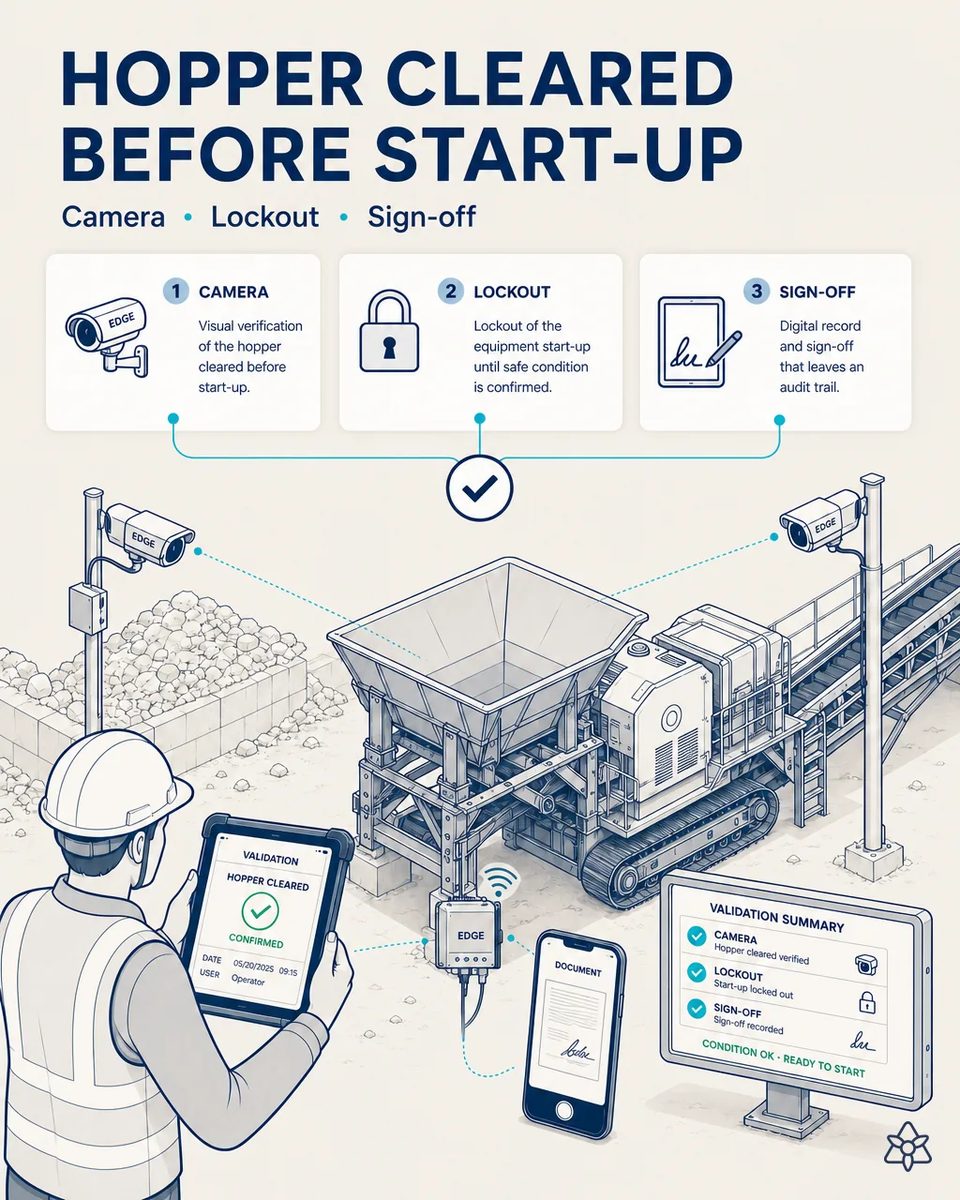
Batch traceability rests on a box ticked without evidence.
Batch traceability depends on there being no physical carryover between batches of different origin. Today the responsibility rests on a human 'hopper empty' sign-off with no objective visual evidence, and leftover material from the previous batch can contaminate the start of the new one.
- Switching from clean concrete to mixed C&D waste, or back, means clearing the hopper so the new batch starts clean. In a plant with several origins, that can happen many times a week.
- Today that rests on a human 'hopper empty' sign-off with no objective visual evidence behind it, often under pressure to restart because trucks are waiting and the crusher is the bottleneck.
- Leftover material from the previous batch contaminates the start of the next one: clean concrete aggregate inherits plaster, or a mixed batch inherits an origin it should not carry.
- When the batch is questioned, the investigation finds a signature and no proof — and the management certificate issued on that batch is exposed. It is not bad faith: a signature is not a measurement.
Edge with JIDOKA AI — the plant does not start until the cameras confirm and the supervisor signs.
Edge plus JIDOKA AI: industrial cameras with CNNs trained to recognize 'empty hopper vs. leftover material' compare the current state against the reference state. The plant doesn't start until the cameras confirm OK and the supervisor signs off on that evidence.
The camera does not decide alone and does not start anything on its own: it compares the hopper with its reference empty state and the supervisor signs on that evidence. What changes is not who decides, but what the decision rests on. A signature backed by an image holds up in an inspection; a tick does not.
The hopper sign-off by eye versus by camera
| Aspect | Today | With iLEAN Edge |
|---|---|---|
| What 'hopper empty' rests on | A ticked box | Image compared with the reference state |
| Carryover between origins | Found later, in the batch | Detected before start-up |
| Start of the new batch | Under suspicion | Released on evidence |
| Start-up lockout | None | Until OK and signature |
| Proof for the certificate | A signature | Before and after images, stored |
| More changeovers per week | More exposure | Same verification each time |
Blind sign-off with carryover risk between batches → evidence-based sign-off at each critical point.
Impact estimate — it scales with your weekly changeovers.
The block below is an estimate to be validated against your plant's actual data. We put it forward so the committee has an order of magnitude; we refine it during the assessment.
- We do not fix a payback range here: the return scales with the number of waste-type changeovers per week, and that varies too much between plants to give a single figure.
- What it protects is per-batch traceability and, with it, every management certificate issued on those batches and every client who relies on them.
- From a blind sign-off with carryover risk to an evidence-based sign-off at each critical point, stored with the batch it released.
- With your weekly changeovers and the cost of one questioned batch, the return is estimated with you before deploying, not promised in advance.
Protects per-batch traceability (and thus the issued management certificate), payback scaling with weekly waste-type changeovers. *Estimate to validate*.
And the fair question from the production manager
“What if the camera locks the plant over a few stones?” — the reference state is defined with you: what counts as empty is a tolerance agreed at commissioning, not the model's opinion. Comparing a hopper against its reference image is an anchored task where the best models drop below 1.5% error [1], and in case of doubt the system escalates to the supervisor, who signs on the image instead of being blocked silently. It stops on a verifiable difference, not on a hunch.
[1] OpenAI paper "Why Language Models Hallucinate", 2025 — on the reliability of AI in anchored tasks.
What people ask about validating the hopper changeover
Which points are checked besides the hopper?
The ones agreed at commissioning: typically the hopper, the feeder and the transfer points where material settles. Each has its own reference image. Adding a point later is a commissioning task, not a new project.
Does it add time to every changeover?
The check takes seconds. What adds time today is the margin people leave because there is no evidence, and SMED work on the changeover removes that too. The aim is a shorter changeover with more evidence, not a longer one.
Can the lockout be overridden when it is urgent?
Yes, with the supervisor's signature, and it is recorded as an exception. What cannot happen is a start-up with no trace of who decided it. Exceptions are counted, so a habit of skipping shows up quickly.
Does it work on mobile crushing plants?
Yes. The cameras go on poles or on the plant's own frame, and the Edge box travels with the plant when it moves between stockpiles. The reference images are retaken at each new position.
Where do the images end up?
In the batch's case file, before and after, linked to the signature. That is what feeds the evidence pack for the inspection. A questioned batch is answered with the image of its own start-up.
More cases from this series
- Site or carrier alert in secondsA contractor's WhatsApp message or a carrier's email warning of a critical change reaches one person who…
- The delivery note that self-loadsThe weighbridge operator photographs the carrier's delivery note and the waste identification form…
- Foreman's hands-free headsetThe plant supervisor spends the whole day walking between sorting, mobile plants and the landfill with…
- Photo of the weighbridge intake formEvery truck entering a C&D waste plant carries a hand-filled waste identification form. That paper…
- The aggregate quality Excel flies to ERPThe quality manager fills in a spreadsheet every batch with grading, contaminant and moisture data for…
- Validate in two taps at the scaleNothing iLEAN captures enters the central system before a human has seen it. In the scale booth, a…
Tell us how many waste-type changeovers your plant runs per week.
We work on your plant's real data, not ours. Assessment with no commitment.
Request estimated ROI within 48h ‹ See all cases of C&D waste recycling See waste and recycling