Zero wrong-heat or wrong-size shipments
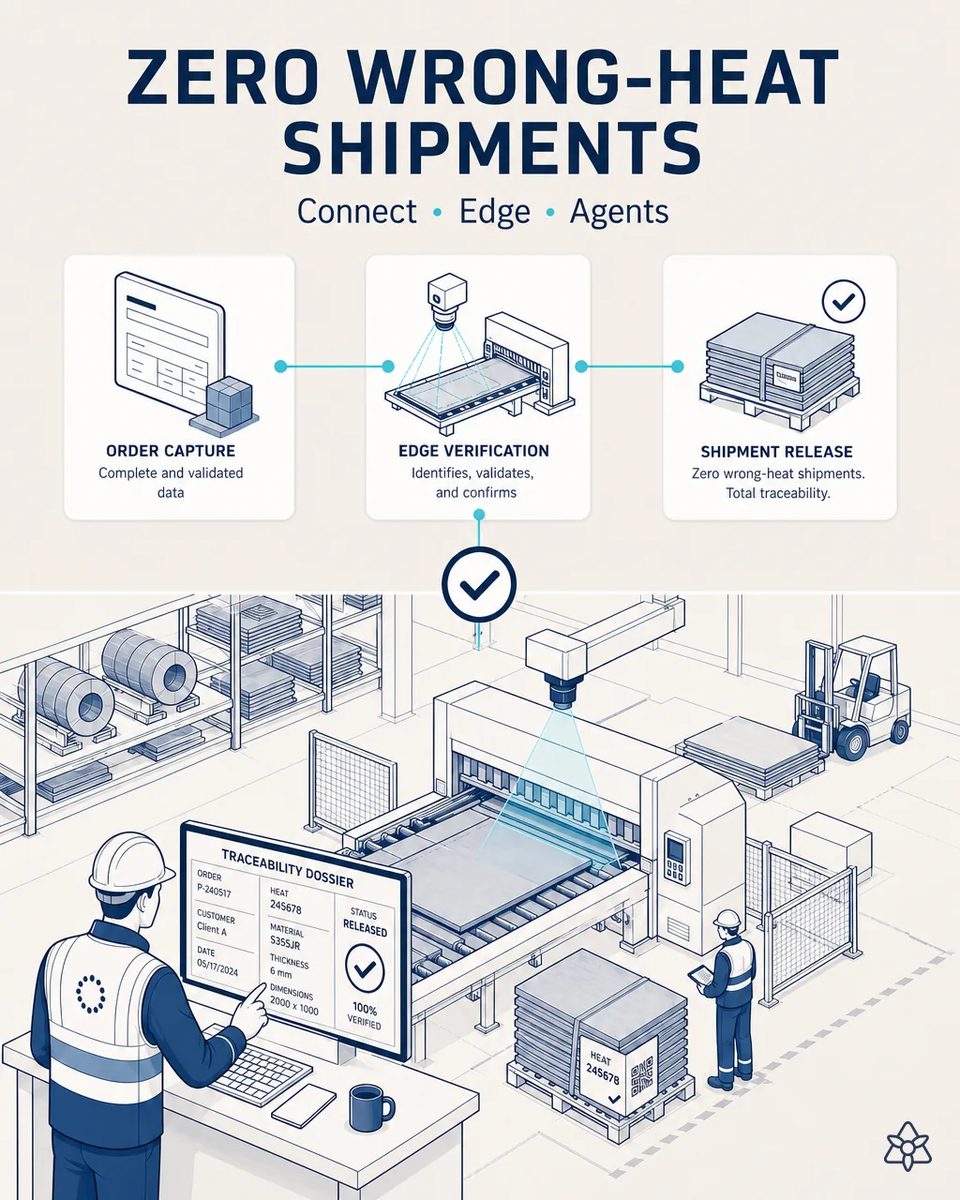
The structural risk for a steel service center is delivering a demanding customer a cut with the wrong heat or size, discovered late: once the customer has already installed it, or when a qualification auditor raises a non-conformance. Connect captures every signal in the order, from the cutting order to the received heat certificate, validated by a human.
The expensive failure is never one mistake. It is a chain of small ones.
The structural risk for a steel service center is delivering a demanding customer a cut with the wrong heat or size, discovered late: once the customer has already installed it, or when a qualification auditor raises a non-conformance.
- A size corrected by phone and never recorded. A heat number typed with a digit wrong at receiving. A batch started after a change nobody verified. A delivery note signed by somebody who never saw the pieces.
- Each link looks acceptable on its own and passes its own check. Together they produce the pallet that goes out with the wrong heat on it.
- It is discovered late, which is the whole problem: once the customer has welded it into their structure, or when a qualification auditor raises the non-conformance.
- For a stockholder that is not a reject, it is a reputation: the material has already been transformed, and the claim is for what was built out of it, not for the sheet.
Connect, Edge and Agents coordinated — three points that check each other.
Connect captures every signal in the order, from the cutting order to the received heat certificate, validated by a human. Edge visually verifies every piece and every calibration change before it ships (JIDOKA AI). Agents closes the loop with the full dossier, ready for any customer or auditor. SMED AI speeds up grade/thickness changes from the very first cut.
No single point solves it: every one of them already exists today in some form, and the pallet still goes out wrong. The strength is in the cross-check, because what gives a chain of small errors away is three independent sources ceasing to agree.
The verification points, and what each one closes
| Point | What it draws on | What it closes |
|---|---|---|
| 1 · The order | Photographed order, alerts, tablet sign-off | That what is cut is what was asked for |
| 2 · The material | Receiving, heat-control sheet, scale and WMS | That the heat and format used are the right ones |
| 3 · The cut | Shear panel, defect camera, change verification | That the piece leaves within tolerance |
| The dossier | Agents, on top of the other three | That all of it can be proven afterwards |
| Where it stops | JIDOKA AI, on a discrepancy between sources | Before the pallet is strapped and loaded |
| What is not replaced | ERP, WMS, shear, scale | Nothing: they are stitched, not swapped |
Structural risk discovered late with reputational cost → three-point verification before material leaves the warehouse.
Impact estimate — to be validated with your numbers.
The block below is an estimate to be validated against your plant's actual data. We put it forward so the committee has an order of magnitude; we refine it during the assessment.
- An order-of-magnitude reduction in wrong-heat and wrong-size shipments, as an estimate to validate against your own incident history.
- The saving is not the sheet: it is the claim for what the customer had already built out of it, plus the transport, the recut and the credit note.
- Supplier status with demanding customers, which is what decides whether you are on the list for their next project.
- And SMED AI on top: the grade and thickness change gets faster from the very first cut, which is where a stockholder's capacity actually goes.
Order-of-magnitude reduction in wrong-heat/wrong-size shipments. Estimate to be validated.
And the fair question from the production manager
“Do we have to deploy all twelve cases to get this?” — no, and framing it that way is the surest way never to start. The points are built in layers and each case pays on its own: with the photographed cutting order and receiving you already have point one and half of point two, which is where most of the missing traceability sits. The cross-check gets stronger as layers are added rather than requiring all of them. And wherever a model reads a document, the task is anchored, below 1.5% error [1], with a person confirming.
[1] OpenAI paper "Why Language Models Hallucinate", 2025 — on the reliability of AI in anchored tasks.
What people ask about the complete system
Where do we start?
With the case that has the fewest dependencies and the shortest deployment, which here is the photographed cutting order. What matters is that each layer pays for itself instead of waiting for the whole thing.
What does the cross-check give that each check alone does not?
Exactly what escapes today: the chain. A size corrected by phone passes its own check, a heat number typed wrong at receiving passes its own, and the pallet carrying both is the one that goes out wrong.
What if the system stops a shipment wrongly?
JIDOKA AI stops on a verifiable discrepancy between sources, not on model uncertainty. When the doubt belongs to the model, the case goes to a person instead of to a halt.
Does it replace our ERP or our WMS?
No. The whole design rests on the order in the ERP being the reference. iLEAN cross-checks the systems against each other and against what actually happened at the shear.
Can the return be estimated before committing?
Yes: with your returns log, the cost of the last wrong-heat claim and the number of changes per day, the return per layer is estimated before the order of deployment is decided.
More cases from this series
- Heat traceability, ready in secondsEvery critical cut automatically generates its traceability dossier, organized by order.
- A paperless cutting order, at zero latencyDigitize the cutting order and its corrections without changing the shear operator's routine.
- Validate before the data reaches the ERPA tablet at the cutting station summarizes what iLEAN captured; the operator confirms with 2 taps.
- Delivery note and heat certificate, one tap into the ERPPhotograph the delivery note and the supplier's heat certificate; after validation, it all goes to the…
- The heat-control spreadsheet, synced to the ERPiLEAN reads the heat-control spreadsheet on save and syncs it, validated, to the ERP.
- The mill alert that arrives on timeiLEAN reads a delayed-heat or measurement-change alert instantly and suggests the action to take.
Tell us what your last wrong-heat delivery ended up costing you.
We work on your plant's real data, not ours. Assessment with no commitment.
Request estimated ROI within 48h ‹ See all cases of steel sheet distribution See steel