Calibrated before the batch's first cut
Every time the shear switches grade or thickness, pressure and blade angle need recalibrating. Edge cameras at the critical points (blade, stop, hold-down) compare the current state to the calibrated reference.
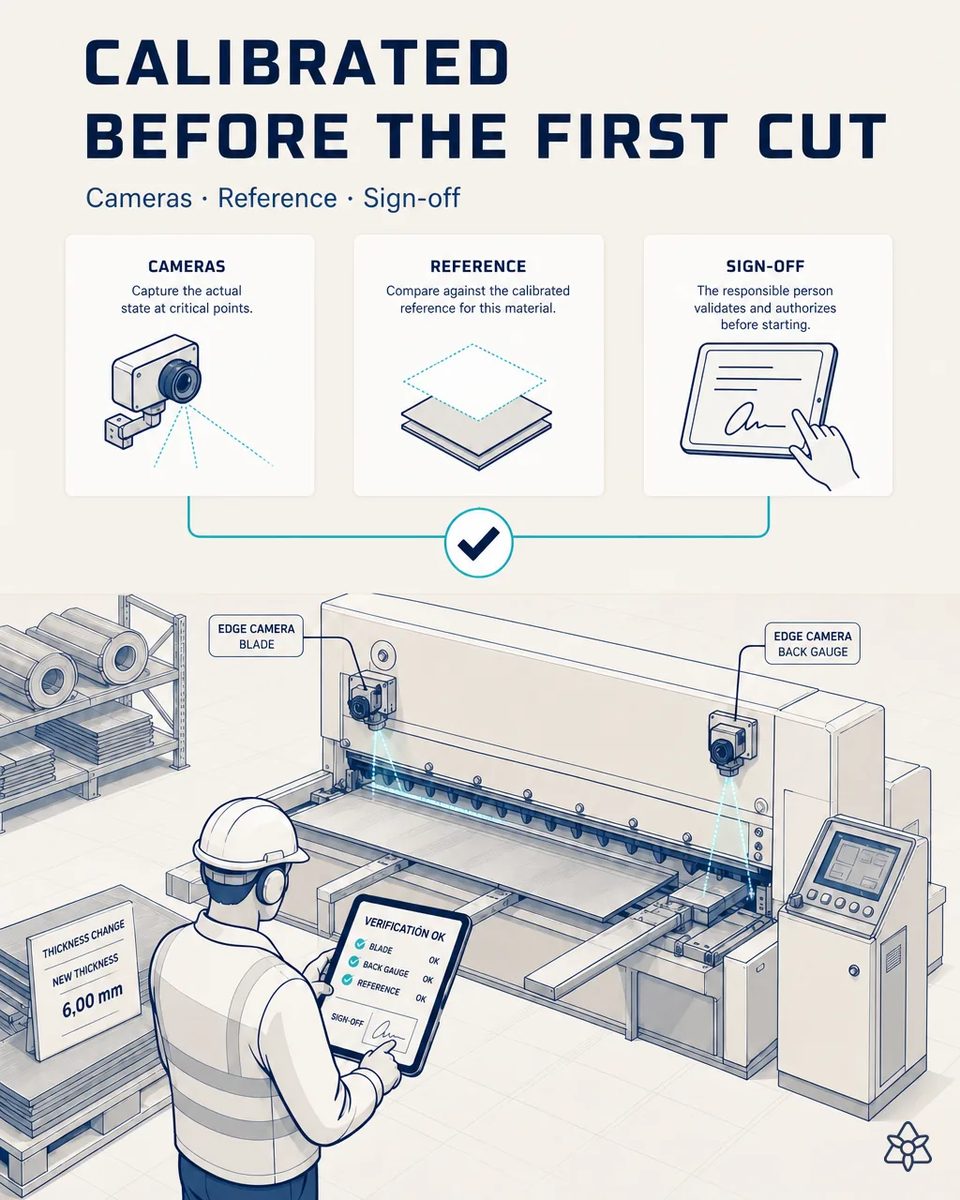
A change is confirmed by saying it is done, and the first pieces pay for it.
Every time the shear switches grade or thickness, pressure and blade angle need recalibrating. Today the operator confirms 'it's calibrated' with no objective visual check, and the batch's first pieces can come out of tolerance.
- A stockholder changes grade or thickness many times a day, because the orders are small and each one comes out of a different format.
- Every change means resetting blade clearance and rake angle, moving the back gauge to the new size and setting the hold-down for the new thickness. Three settings, three chances to leave one of them where the last batch left it.
- Today the operator says it is set and the batch starts. There is no objective check and no record of the state the machine was actually in.
- So the first pieces of a batch can come out with burr or out of square, and they are found at packing, at the customer, or not at all.
Edge with JIDOKA AI — the batch does not start until the cameras clear it and a person signs.
Edge cameras at the critical points (blade, stop, hold-down) compare the current state to the calibrated reference. JIDOKA AI: the new batch doesn't start until the cameras confirm OK and the quality manager signs off.
The cameras do not decide alone. Each point is compared against its calibrated reference for that thickness, and the quality manager signs on that evidence. What changes is not who decides, it is what they get to decide on.
Today's change versus the verified change
| Aspect | Today | With iLEAN Edge |
|---|---|---|
| Confirming the setup | Somebody says it is set | Blade, back gauge and hold-down checked |
| First pieces of the batch | Under suspicion | Verified before the first cut |
| Back gauge left from the last batch | Found in the pieces | Blocked before starting |
| Hold-down set for another thickness | Shows up as burr | Detected at the change |
| Record of the change | None | Images, values and a signature |
| With many changes a day | More changes, more exposure | More changes, the same check |
Out-of-tolerance pieces at every batch start → zero out-of-tolerance pieces from unverified calibration.
Impact estimate — to be validated with your numbers.
The block below is an estimate to be validated against your plant's actual data. We put it forward so the committee has an order of magnitude; we refine it during the assessment.
- Estimated payback 4-9 months, depending on how many grade and thickness changes you run per day.
- Zero pieces out of tolerance from a calibration nobody verified, which today is a quiet and entirely recurring cost.
- The first pieces of each batch stop being the ones you hope nobody measures.
- And every change leaves images, values and a signature behind it, which is what a qualification audit asks to see.
Estimated payback of 4 to 9 months depending on daily change frequency. Estimate to be validated.
And the fair question from the production manager
“What if the camera blocks the shear for no reason?” — that is the right objection, because a change sits on the critical path of the day. The check is made against the calibrated reference for that specific thickness and, in case of doubt, the system does not block silently: it escalates to the person in charge, who signs on the evidence. It stops on a verifiable discrepancy, not on model uncertainty — and on the reading side the task is anchored, where the best models drop below 1.5% error [1].
[1] OpenAI paper "Why Language Models Hallucinate", 2025 — on the reliability of AI in anchored tasks.
What people ask about verifying the grade change
What exactly do the cameras check?
Blade condition and clearance, back gauge position and hold-down setting for the new thickness, plus whatever else your own people say matters on that machine. The points are defined at commissioning with your maintenance team, not imposed from outside by somebody who has never run a shear.
Does it make the change longer?
The check takes seconds. What lengthens a change today is the margin people add because there is no evidence either way, plus the pieces recut when the setting turned out to be wrong — and those pieces come out of the same shift.
Can it be skipped when we are in a hurry?
An exception can be defined with a supervisor's signature, and it is recorded as an exception rather than hidden. What cannot happen is a batch starting with no trace at all of who decided to skip the check and why.
Does it work on the profile cutting table too?
Yes, with its own reference points: nozzle condition, standoff and gas settings for the thickness being cut. You start with the shear because that is where the changes actually pile up in a stockholder, several times a day, every day.
Is it worth it if we only change a few times a day?
It is worth more the more you change, so the honest answer depends on your own numbers. With a handful of changes a day the case is thinner, and we would rather say so up front than sell you a camera that pays for itself in four years.
More cases from this series
- Heat traceability, ready in secondsEvery critical cut automatically generates its traceability dossier, organized by order.
- A paperless cutting order, at zero latencyDigitize the cutting order and its corrections without changing the shear operator's routine.
- Validate before the data reaches the ERPA tablet at the cutting station summarizes what iLEAN captured; the operator confirms with 2 taps.
- Delivery note and heat certificate, one tap into the ERPPhotograph the delivery note and the supplier's heat certificate; after validation, it all goes to the…
- The heat-control spreadsheet, synced to the ERPiLEAN reads the heat-control spreadsheet on save and syncs it, validated, to the ERP.
- The mill alert that arrives on timeiLEAN reads a delayed-heat or measurement-change alert instantly and suggests the action to take.
Tell us how many grade and thickness changes your shear runs in a day.
We work on your plant's real data, not ours. Assessment with no commitment.
Request estimated ROI within 48h ‹ See all cases of steel sheet distribution See steel