The warehouse that dictates itself on the move
The warehouse manager walks the aisles all day with hands busy moving pallets. Connect voice mode with a Bluetooth earpiece and a custom wake-word.
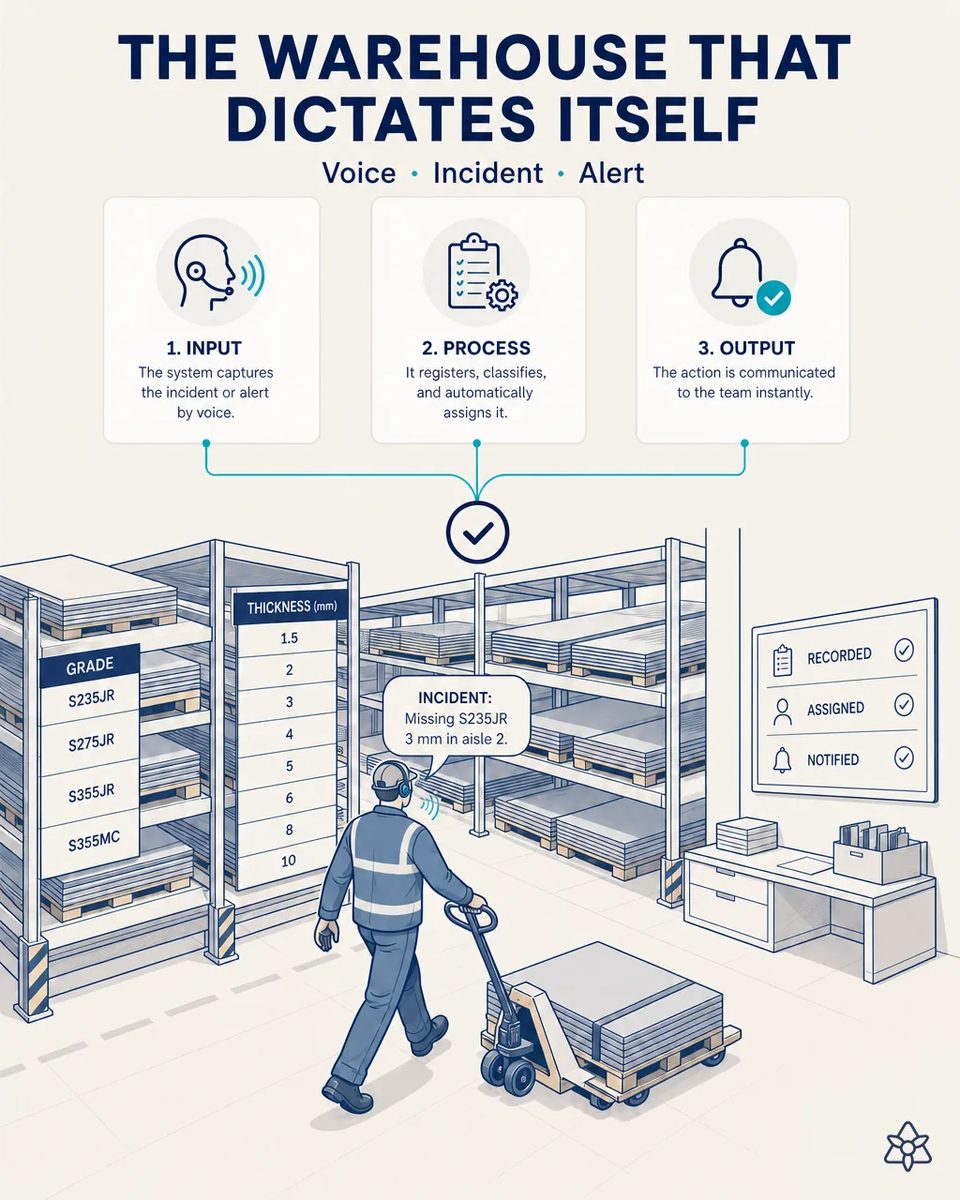
The person who knows what is really in the aisles cannot stop to type it.
The warehouse manager walks the aisles all day with hands busy moving pallets. Critical information — that a grade is running low, that a pallet arrived with a smudged label — dies at the end of the shift because nobody can type it in the moment.
- The warehouse manager walks the aisles all day with both hands busy: a pallet truck, a crane pendant, a strap under the arm. That is the job, and it is not going to change.
- What they see is what nobody else sees: a grade down to two sheets, a pallet that arrived with a smudged label, a format stored in the wrong aisle, a stack with edge damage along one side.
- None of it survives the shift, because recording it means walking back to the office and opening a screen, and by then the next truck is at the door.
- Meanwhile the counter is promising stock over the phone from an ERP figure that nobody has walked past today, and the workshop on the other end is planning its week around that promise.
Connect in voice mode — a Bluetooth earpiece, a wake word and nothing in the hands.
Connect voice mode with a Bluetooth earpiece and a custom wake-word. iLEAN listens, structures the incident and links it to the aisle or active order, returning support by voice or push in seconds.
iLEAN answers back within seconds — noted, assigned, the counter will see it — and that reply is the only reason a tool like this survives its first week. What was understood is read back before it is stored, so a wrong grade or a wrong aisle is corrected on the spot.
Today's aisle versus the dictated aisle
| Aspect | Today | With iLEAN Connect |
|---|---|---|
| What the manager notices | Dies at the end of the shift | A structured issue in seconds |
| A grade running low | Known to one person | Tied to the aisle and to live stock |
| A pallet with a smudged label | Rediscovered when it is sold | Flagged the moment it is seen |
| Stock promised over the phone | An ERP figure nobody walked past | Backed by what the aisle really holds |
| The manager's hands | Busy, so nothing gets typed | Busy, and it still gets recorded |
| Ordinary floor conversation | — | Not recorded |
Knowledge that dies at shift end → enters the system in real time and gets cross-checked against live stock data.
Impact estimate — to be validated with your numbers.
The block below is an estimate to be validated against your plant's actual data. We put it forward so the committee has an order of magnitude; we refine it during the assessment.
- No standalone payback — the brief says it plainly, and it is worth repeating: the impact is hard to price up front. This is an enabling piece.
- Its value is the reliability of the stock you promise over the phone, which is exactly what a workshop judges a stockholder on.
- And the context every other case needs: a batch that went badly because the sheet came in damaged only explains itself if somebody recorded that it came in damaged.
- To be validated with whoever answers the phone at your counter, because they are the one paying today for a stock figure that is not true.
Impact hard to price upfront, but critical to the reliability of stock promised over the phone. Estimate to be validated.
And the fair question from the production manager
“Is this a way of keeping track of my team?” — no: iLEAN listens to the warehouse manager, only after the wake word, and only to what they choose to dictate. There is no continuous listening and no location tracking of anybody. On the structuring side, turning a dictated sentence into aisle, grade, thickness and issue type is an anchored task where the best models drop below 1.5% error [1], and what was understood is read back before it is stored.
[1] OpenAI paper "Why Language Models Hallucinate", 2025 — on the reliability of AI in anchored tasks.
What people ask about dictating the warehouse
Does it work with the noise of a steel warehouse?
That is the design condition: overhead crane, forklift and sheet being moved. The earpiece is compatible with hearing protection and recognition is prepared for the trade vocabulary — grade designations, thicknesses, formats, aisle numbers.
Do they have to speak in a set way?
No. They speak as they would to a colleague leaning on the rack next to them. iLEAN structures it afterwards into aisle, grade, thickness, format and what is wrong, and asks only when something genuinely does not fit.
How does it know which aisle or which order is meant?
From what is said and from the context already open: the order being picked, the truck being unloaded, the aisle they were last in. If it is genuinely ambiguous it asks one short question instead of guessing at a grade.
Does it correct the stock figure on its own?
No. It records the observation and raises the discrepancy so a person checks and adjusts it. What changes is that the discrepancy is known the same day rather than at the next physical count, which in most warehouses is months away.
Is it worth deploying on its own?
Honestly, it is the hardest of the twelve to justify by itself. It is deployed alongside the others because it supplies the context they need, and because it costs the warehouse manager nothing to use.
More cases from this series
- Heat traceability, ready in secondsEvery critical cut automatically generates its traceability dossier, organized by order.
- A paperless cutting order, at zero latencyDigitize the cutting order and its corrections without changing the shear operator's routine.
- Validate before the data reaches the ERPA tablet at the cutting station summarizes what iLEAN captured; the operator confirms with 2 taps.
- Delivery note and heat certificate, one tap into the ERPPhotograph the delivery note and the supplier's heat certificate; after validation, it all goes to the…
- The heat-control spreadsheet, synced to the ERPiLEAN reads the heat-control spreadsheet on save and syncs it, validated, to the ERP.
- The mill alert that arrives on timeiLEAN reads a delayed-heat or measurement-change alert instantly and suggests the action to take.
Tell us how often your counter promises a grade that is not really there.
We work on your plant's real data, not ours. Assessment with no commitment.
Request estimated ROI within 48h ‹ See all cases of steel sheet distribution See steel