On prepainted steel the defect cannot be repaired: it is scrapped. And today your customer finds it
At the speed a cutting line runs, the human eye does not inspect: it samples. One or two percent inspected means ninety-eight percent leaving unseen. Edge puts cameras over the slitter and leveler exits, infers in milliseconds on a local GPU and marks the exact meter of the defect before the strip is recoiled.
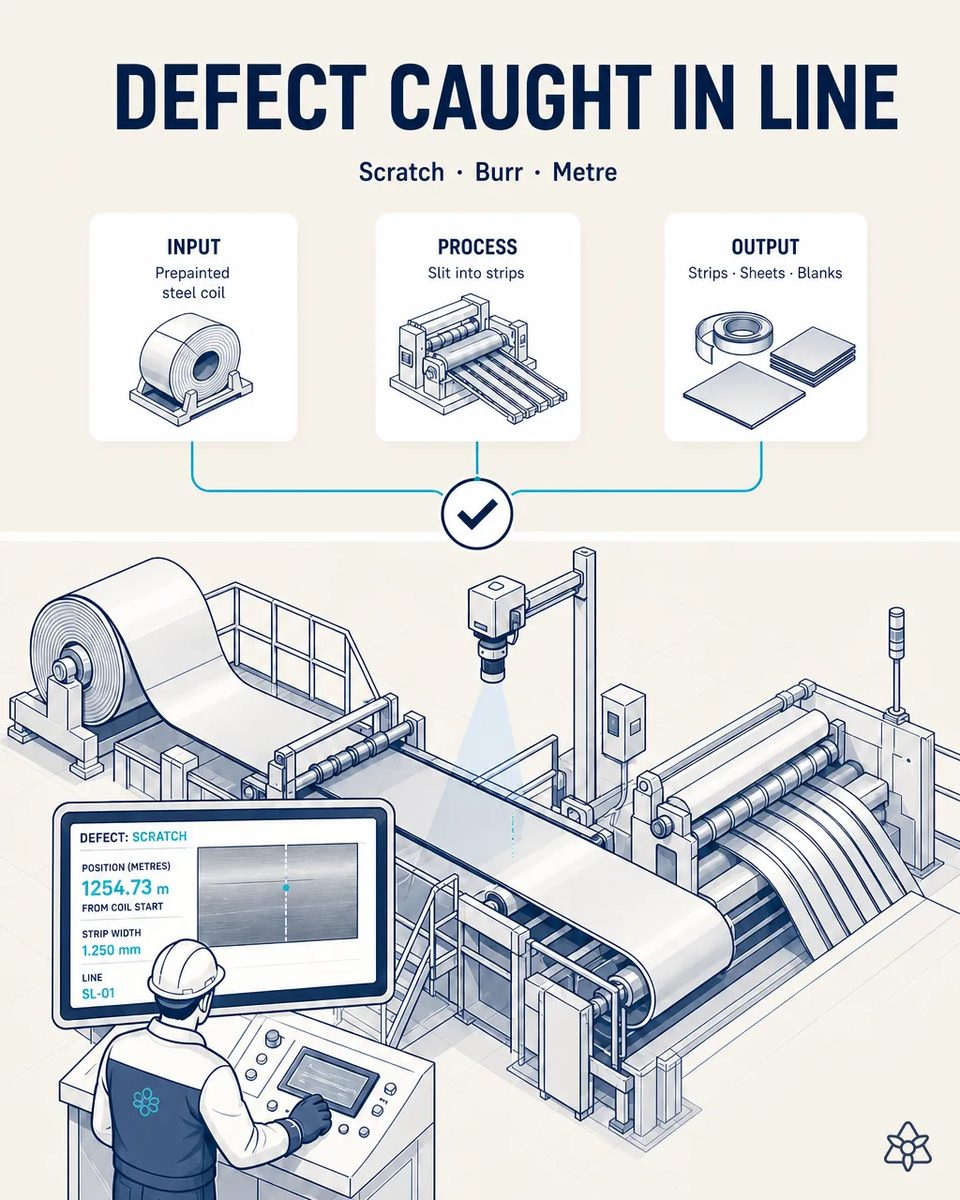
At line speed the human eye does not inspect: it samples.
A scratch, a roll mark, an embedded particle or an oil stain turns a prepainted strip into second-grade material. The surface is the product and it admits no repair. The same goes for edge burr on the slitter, which cannot be judged by eye at line speed and which the customer discovers when it breaks their die. And the worst part is where it gets discovered: the defect travels coiled inside the output coil and is not seen until the customer unwinds it in their press. By then the cost is no longer the material: it is sorting on somebody else's premises, return freight and trust.
- A longitudinal scratch, a roll mark, an embedded particle or an oil stain turns a prepainted strip into second-grade material. The surface is the product and it admits no repair.
- Edge burr on the slitter cannot be judged by eye at line speed, and the customer discovers it when it breaks their die.
- One or two percent inspected means ninety-eight percent leaving unseen, coiled inside the output coil where nobody can look.
- The defect is found when the customer unwinds it in their press. By then the cost is no longer the material: it is sorting on somebody else's premises, return freight and trust, and the whole coil is under suspicion rather than the ten meters that were actually bad.
Edge — local inference on a GPU inside the plant, meter by meter, before the strip is recoiled.
Edge — CNN vision with local inference on a GPU inside the plant, without sending images to the cloud: latency, cost and bandwidth solved at the root. Models are trained on real samples of the material this plant cuts: longitudinal scratch, roll mark, embedded particle, stain, rust, missing coating and edge burr. The system records the exact meter position of the defect and stops the line when the defect is continuous. The final decision — trim, mark or downgrade — stays with the operator.
The models are trained on samples of the material this plant cuts, not on a generic catalog, and the images never leave the plant: latency, cost and bandwidth solved at the root. The system records the exact meter of every defect and stops the line when the defect is continuous; the decision to trim, mark or downgrade stays with the operator, who now decides on evidence instead of on a glance.
Today's inspection versus Edge vision
| Aspect | Visual sampling | With iLEAN Edge |
|---|---|---|
| Coverage | 1-2% of the strip | 100% of every linear meter |
| Where the defect is found | In the customer's press | At the slitter or leveler exit |
| Position of the defect | Unknown: somewhere in the coil | The exact meter, before recoiling |
| Edge burr | Judged by eye, if at all | Classified at line speed |
| A continuous defect | A whole coil downgraded | The line stops |
| Images | — | Never leave the plant |
from 1-2% sampling to 100% control of every linear meter produced. From defects found by the customer to defects found on the line, with the exact meter located.
Impact estimate — to be validated with your numbers.
The block below is an estimate to be validated against your plant's actual data. We put it forward so the committee has an order of magnitude; we refine it during the assessment.
- Estimated payback 5-12 months, depending on your current downgrade rate and the weight of prepainted in the mix.
- A significant reduction in surface claims, because the defect is found on your line instead of in the customer's press.
- From 1-2% sampling to 100% control of every linear meter produced.
- And sorting, return freight and the conversation about trust stop being part of the cost of a scratch: the bad meters are trimmed or marked in your bay and the rest of the coil ships as first grade.
estimated payback 5-12 months depending on your current downgrade rate and the weight of prepainted in the mix, with a significant reduction in surface claims. *An estimate to be validated*.
And the fair question from the production manager
“What if it downgrades good material?” — the false positive is the real risk of any vision system, which is why the model is trained on real samples of your own prepainted and galvanized material under that line's lighting, not on a generic model. Telling a scratch from an oil stain from a reflection on a known surface at a fixed camera position is an anchored task, where the best models drop below 1.5% error [1]. And a borderline detection does not downgrade anything: it marks the meter and the operator decides on the evidence.
[1] OpenAI paper "Why Language Models Hallucinate", 2025 — on the reliability of AI in anchored tasks.
What people ask about surface and edge vision
Which defects does it detect?
Longitudinal scratch, roll mark, embedded particle, stain, rust, missing coating and edge burr. The catalog is trained on samples of the material this plant actually cuts, so it starts from your defects, not from a generic list.
Does it keep up with line speed?
Yes: inference runs on a local GPU inside the plant and resolves in milliseconds per frame. It does not depend on the plant network or on the cloud.
How many samples are needed to train it?
Fewer than feared, because a service center's surface defect catalog is short and repetitive. What is needed is that they be real samples from your lines: twenty photos of typical defects are enough to show the first model.
Does it stop the line?
Only when the defect is continuous — a roll mark repeating every turn, a scratch running the length of the strip — because then every further meter is scrap. For an isolated defect it records the meter and lets the operator decide whether to trim, mark or downgrade.
Does it work on galvanized as well as prepainted?
Yes. The defect catalog differs — missing coating and zinc-related marks weigh more on galvanized, scratches and stains on prepainted — and each material gets its own trained model, switched automatically with the active run.
More cases from this series
- A non-conformity is almost never a product failure. It is a documentation gapHeat, dimensions, photos, tests and signatures group themselves by shipment and by standard. Audits stop…
- Material comes in as coil and leaves as strip. Every transformation can lose its identityFour rings cross-checking heat, label, dimension and order from receiving to the dock. If they do not…
- The traceability of everything you will sell is born in a receiving desk that is typed in a hurryPacking list, tag and mill test certificate enter the ERP from a photo. From 45-60 min per truck to…
- No data enters your master without a person having seen it firstEarly human verification: the operator validates in two taps what the AI captured, before it crosses…
- The alert you read three hours late, read at second zeroSchedule changes and coil delays are read at second zero, cross-checked against line load and returned…
- The cutting order enters your system with a photo, not with typingThe operator photographs the cutting order and shift report: the run enters the system at second zero,…
Send us twenty photos of your typical defects.
We work on your plant's real data, not ours. Assessment with no commitment.
Request estimated ROI within 48h ‹ See all cases of steel service centers See steel