A non-conformity is almost never a product failure. It is a documentation gap
The day the auditor arrives, somebody spends days reconstructing by hand which heat was in which strip of which shipment. With Agents, every shipment generates its own pack as it is produced: mill test certificate, verified dimensions, photos of the bundle and its label, tests and signatures, ordered by standard requirement.
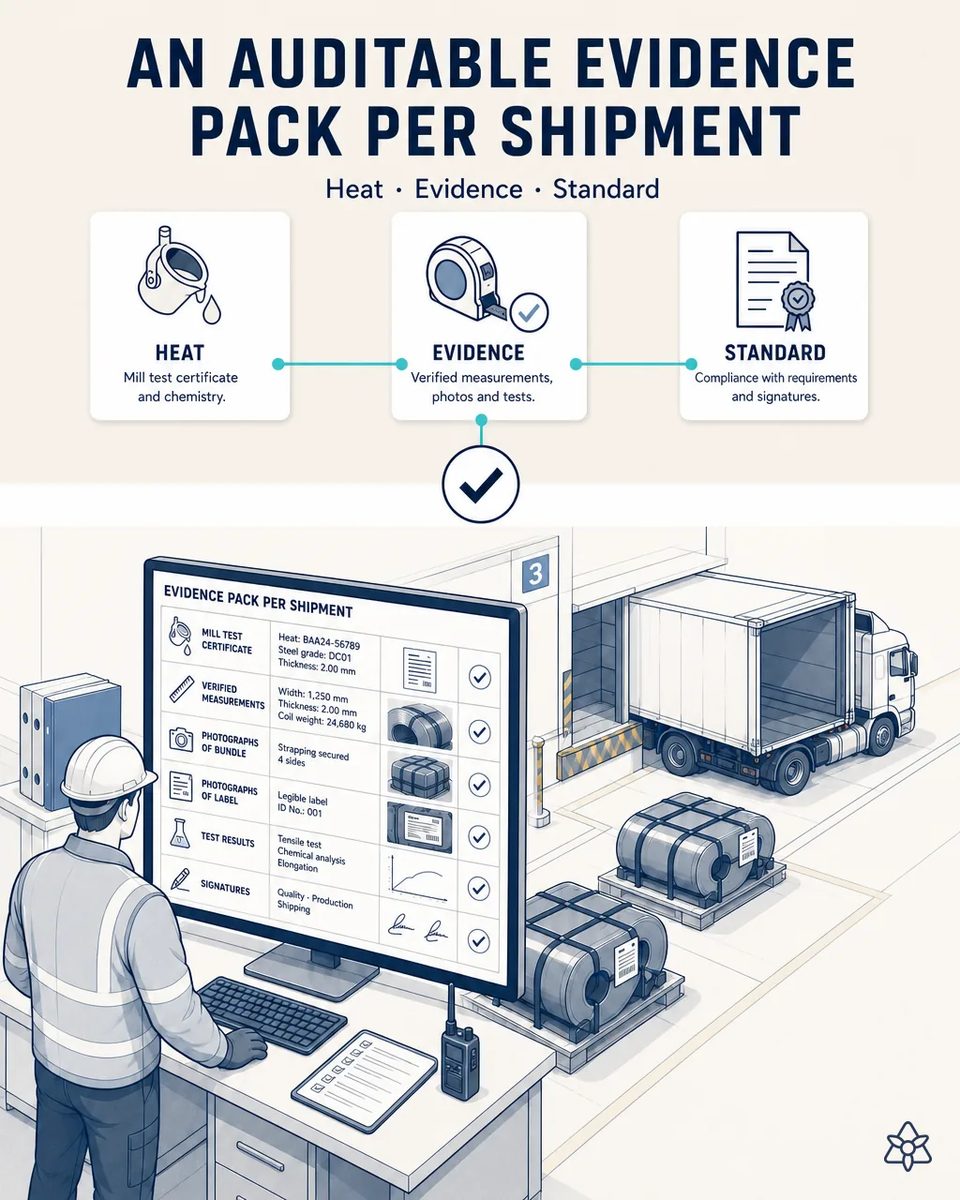
The non-conformity is almost never a product failure. It is a documentation gap.
It does not matter which auditor it is: the quality system certification body, the automotive customer auditing its material supplier, or the one reviewing export documentation. They all ask for the same thing: proof. The plant shows paper and the auditor raises a non-conformity because there are gaps. And this deserves saying plainly: in the vast majority of cases the non-conformity does not reflect a real product failure, but an administrative shortfall. A very high price gets paid for not being able to demonstrate something that was in fact done properly. A service center supplying automotive and appliance manufacturers lives audited by its customers even without holding the sector certification itself: they demand the traceability of a certified plant without the system that generates it automatically ever existing. That asymmetry is paid for in hours, every time.
- The certification body, the automotive customer auditing its material supplier, the reviewer of export documentation: they all ask for the same thing, proof.
- The plant shows paper and the auditor raises a non-conformity because there are gaps. In the vast majority of cases the product was fine; what could not be demonstrated was that it was.
- Somebody spends days reconstructing by hand which heat was in which strip of which shipment, every time.
- A service center supplying automotive and appliance makers lives audited by its customers even without holding the sector certification itself: they demand the traceability of a certified plant without the system that generates it ever existing, and that asymmetry is paid for in hours, every time.
Agents invents no data — it stitches together what the other pieces already produce.
Agents invents no new data: it stitches together what the other pieces already produce. Edge contributes the visual evidence of surface and of the knife changeover; Connect contributes identity and dimensions from receiving, from the run and from the label; the laboratory contributes the tests. Agents groups by shipment, orders by each standard's requirement, spots what is missing before the auditor does, and publishes the downloadable pack on the portal.
Edge contributes the visual evidence of surface and knife changeover; Connect contributes identity and dimensions from receiving, from the run and from the label; the laboratory contributes the tests. Agents groups by shipment, orders by each standard's requirement, spots what is missing before the auditor does, and publishes the downloadable pack on the portal. Anything rebuilt afterwards inherits the gaps of whatever nobody wrote down, and it is precisely in the rebuilding that the non-conformity appears.
Today's audit preparation versus the permanent pack
| Aspect | Today | With iLEAN Agents |
|---|---|---|
| Preparation before an audit | Several days | None: the pack already exists |
| Which heat was in which strip of which shipment | Reconstructed by hand | A query |
| A documentation gap | Found by the auditor | Flagged the moment it occurs |
| Mill test certificate for a shipment | Hunted for in email | In the pack, attached to the coil |
| For each auditing customer | Repeated in full | Same evidence, another ordering |
| How the auditor gets it | A folder of paper | A downloadable pack on the portal |
from several days of preparation before each audit to none. From the risk of a non-conformity for incomplete documentation, to a preventive warning the moment the gap occurs rather than months later.
Impact estimate — to be validated with your numbers.
The block below is an estimate to be validated against your plant's actual data. We put it forward so the committee has an order of magnitude; we refine it during the assessment.
- Estimated payback 6-12 months, depending on audit frequency.
- What gets protected is your approval as a supplier, which is the condition for invoicing in automotive and in data center enclosures.
- From several days of preparation before each audit to none, for every auditor and every customer with audit rights.
- And from the risk of a non-conformity for incomplete documentation to a preventive warning the moment the gap occurs, rather than months later.
what gets protected is your approval as a supplier, which is the condition for invoicing in automotive and in data center enclosures. Estimated payback 6-12 months depending on audit frequency. *An estimate to be validated*.
And the fair question from the production manager
“Isn't this just another document manager?” — the difference is direction. A document manager stores what somebody decides to upload, after the fact, and inherits the same gaps. Here the pack closes as the shipment is produced, and what Agents does is check that every requirement of the standard has its evidence. Matching a piece of evidence to the requirement it satisfies is an anchored task where the best models drop below 1.5% error [1], and the quality lead reviews what was flagged as missing, not the whole pack.
[1] OpenAI paper "Why Language Models Hallucinate", 2025 — on the reliability of AI in anchored tasks.
What people ask about the evidence pack
Does it serve the certification body and the customers at once?
Yes, and that is the point: the evidence is the same, what changes is the requirement list it is ordered against. That is exactly the work repeated in full for each auditor today.
What goes into a shipment's pack?
The mill test certificate of each coil, the verified dimensions, photos of the bundle and its label, the laboratory tests and the signatures of who validated what, ordered by the requirement each one satisfies.
Does it warn about a gap before the audit?
Yes, and it is the function with the most value: it detects that a shipment left without a certificate attached or without a label photo when it should have had one, not on the auditor's day. The warning goes to the quality lead while the evidence can still be produced.
Does the auditor get into our systems?
No. They access a view scoped to the shipments and the period of their audit, filter and download. A customer auditing you sees only their own shipments, never another customer's.
What about shipments from before?
They stay where they are. The pack builds from day one forward, shipment by shipment; bringing in the history is optional and is usually not worth the effort compared with letting the new packs accumulate.
More cases from this series
- Material comes in as coil and leaves as strip. Every transformation can lose its identityFour rings cross-checking heat, label, dimension and order from receiving to the dock. If they do not…
- The traceability of everything you will sell is born in a receiving desk that is typed in a hurryPacking list, tag and mill test certificate enter the ERP from a photo. From 45-60 min per truck to…
- No data enters your master without a person having seen it firstEarly human verification: the operator validates in two taps what the AI captured, before it crosses…
- The alert you read three hours late, read at second zeroSchedule changes and coil delays are read at second zero, cross-checked against line load and returned…
- The cutting order enters your system with a photo, not with typingThe operator photographs the cutting order and shift report: the run enters the system at second zero,…
- The zinc thickness you actually measure and the one your ERP shows are not the same numberHardness and zinc thickness enter the ERP from the lab spreadsheet after human validation. Typical…
Tell us how many hours went into preparing your last audit.
We work on your plant's real data, not ours. Assessment with no commitment.
Request estimated ROI within 48h ‹ See all cases of steel service centers See steel