Material comes in as coil and leaves as strip. Every transformation can lose its identity
The capital pain of any flat steel service center is the same: off-specification or misidentified material going out of the door. It gets discovered in the customer's press and triggers sorting, return freight, rework and penalties. The flagship coordinates the eleven earlier pieces into four verification rings that cross-check each other.
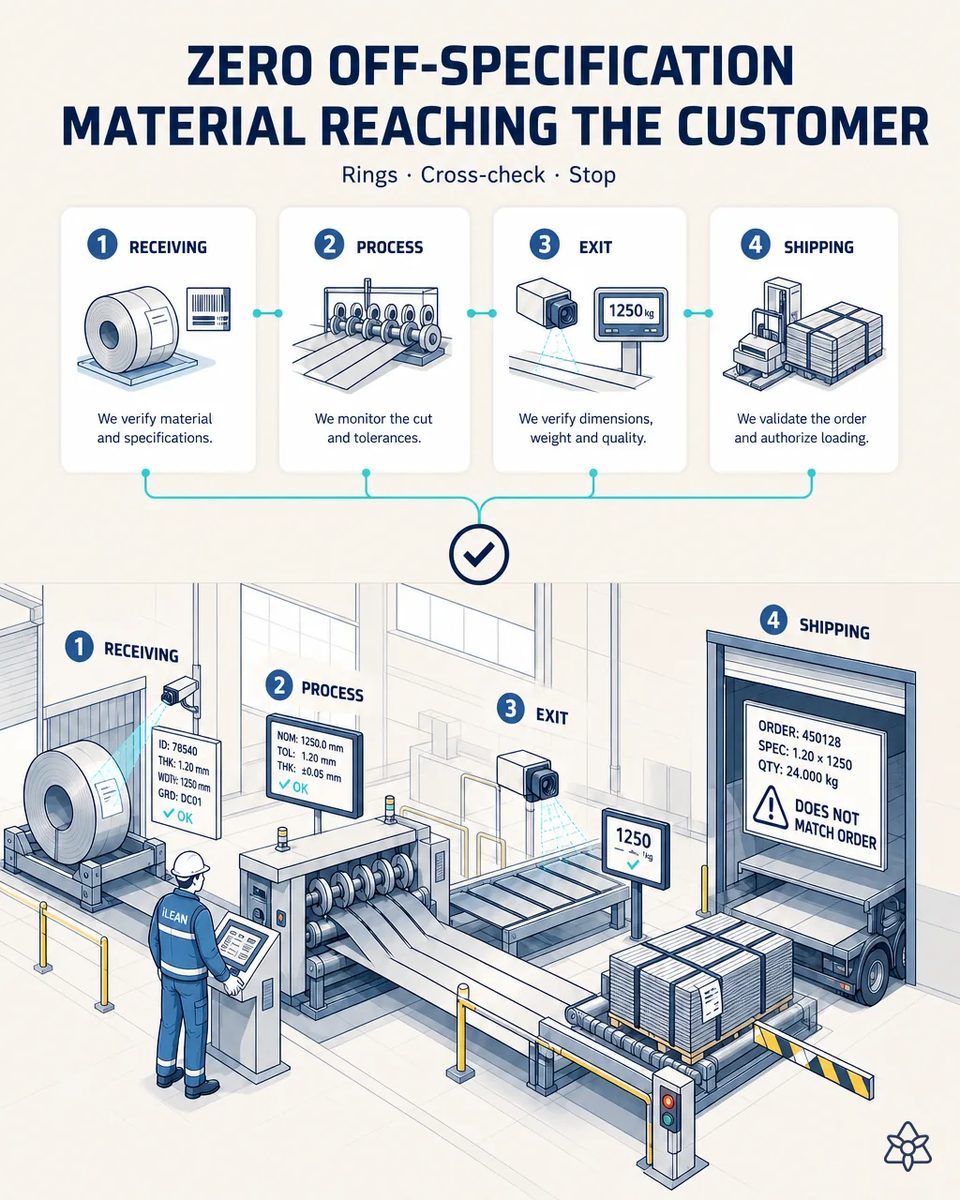
Material comes in as coil and leaves as strip, and every transformation can lose its identity.
A single coil with the wrong heat, the wrong coating or a gauge out of tolerance. If the customer is automotive, on top of the incident's invoice comes the threat of a line-stop charge that can exceed the annual margin on that account. The underlying reason is structural, not careless: material comes in as a master coil and goes out as strip, sheet or blank, and along the way it changes shape, weight and label several times. Every transformation is an opportunity to lose identity. Today the chain rests on manual typing and on people's eyesight. It works almost always. That "almost" is precisely the risk.
- A single coil with the wrong heat, the wrong coating or a gauge out of tolerance. If the customer is automotive, on top of the incident's invoice comes the threat of a line-stop charge that can exceed the annual margin on that account.
- The reason is structural, not careless: a master coil becomes strip, sheet or blank, and along the way it changes shape, weight and label several times.
- Today the chain rests on manual typing and on people's eyesight. It works almost always, and that almost is precisely the risk.
- Isolated controls are not enough, because each one passes on its own: the identity has to be cross-checked at every point where it could have changed.
Four rings that cross-check — it is all of the above, orchestrated.
Four rings, each with its own case behind it:
No single ring solves the problem: each control already exists in some form today and the bundle still leaves misidentified. The strength is in the cross-check, because what gives a lost identity away is the tag, the run, the label and the order ceasing to agree. If they disagree, the bundle does not go on the truck.
- Ring 1 · Receiving (case 7): the coil enters with its heat, grade, coating and certificate read off the physical tag, not typed.
- Ring 2 · Process (cases 1, 5 and 10): the active cutting run defines what is being cut; the knife setup is verified against that run before starting and the operator signs off the identity on the tablet. If the mounted set does not match the run, JIDOKA AI does not let it start.
- Ring 3 · Exit (cases 8 and 9): the Edge camera verifies surface and edge while scale and labeler print, with no typing, the identity coming from the active run. The label that goes on is, by construction, the right one.
- Ring 4 · Shipping (case 11): before loading, the system cross-checks what the bundle label says against what the order asks for and against what the mill test certificate states. If there is a discrepancy, the bundle does not go on the truck.
- SMED AI accelerates the changeover between runs so the four rings do not penalize productivity: the verification pays for itself with the setup time it recovers.
The four rings, and what each one closes
| Ring | Which cases it draws on | What it closes |
|---|---|---|
| 1 · Receiving | Coil receiving (7) | Heat, grade, coating and certificate read off the tag, not typed |
| 2 · Process | Cutting order (1) + tablet (5) + knife setup (10) | The run defines what is cut and the set is verified against it |
| 3 · Exit | Scale and labeler (8) + surface vision (9) | Surface and edge verified while the right label prints |
| 4 · Shipping | Evidence pack (11) | Label, order and certificate cross-checked before loading |
| Memory | Panel (2) + alerts (3) + headset (4) + lab (6) | The context that explains why a coil deviated |
| SMED AI | Knife setup (10) | The changeover time that pays for the verification |
from several claims a year found at the customer, to discrepancies found in your own bay before loading. The cost moves from the customer to the line, which is where it is worth a fraction.
Impact estimate — to be validated with your numbers.
The block below is an estimate to be validated against your plant's actual data. We put it forward so the committee has an order of magnitude; we refine it during the assessment.
- Estimated payback 6-12 months against the first claim avoided.
- Protection against the serious claim, whose unit impact across sorting, freight, rework and penalties runs into the tens of thousands.
- Protection of your approval as a supplier, whose multi-year value far exceeds any single incident.
- And the cost of a discrepancy moves from the customer's press to your own bay before loading, which is where it is worth a fraction.
protection against the serious claim — whose unit impact across sorting, freight, rework and penalties runs into the tens of thousands — and protection of your approval as a supplier, whose multi-year value far exceeds any single incident. Estimated payback 6-12 months against the first claim avoided. *An estimate to be validated* with your quality lead and your operations director.
And the fair question from the production manager
“Do we have to deploy all twelve cases to get this?” — no, and framing it that way would be the way never to start. The rings are built in layers and each case pays on its own. With coil receiving and scale and labeler you already have ring 1 and half of ring 3, which is where most misidentification is born. And the cross-check itself — does the label say what the order asks and what the certificate states — is an anchored task where the best models drop below 1.5% error [1]: JIDOKA AI stops on a verifiable mismatch between sources, not on model uncertainty.
[1] OpenAI paper "Why Language Models Hallucinate", 2025 — on the reliability of AI in anchored tasks.
What people ask about the complete system
Where do you start?
With the case that has fewest dependencies and the fastest visible result, which in this matrix is coil receiving or scale and labeler. What matters is that each layer pays on its own before the next one is added.
What does the cross-check give that each control does not?
Exactly what escapes today: the bundle that passed every individual check and still carries the wrong heat, because the check at the exit trusted what was typed at receiving. Four independent sources ceasing to agree is what gives it away.
What happens when a ring flags a discrepancy at the dock?
The bundle does not go on the truck, and the shipping lead sees which two sources disagree: label and order, or label and certificate. Resolving it takes minutes in your bay instead of weeks at the customer.
Does it replace the ERP or the quality system we already have?
No. The ERP order remains the truth of what was asked for. iLEAN cross-checks the ERP, the physical tag, the run and the label against each other and against what actually happened on the line.
Can the return be estimated before committing?
Yes: with your claim history for the last three years, what each one cost, and your audit frequency, the return per ring is estimated before deciding the order of deployment.
More cases from this series
- A non-conformity is almost never a product failure. It is a documentation gapHeat, dimensions, photos, tests and signatures group themselves by shipment and by standard. Audits stop…
- The traceability of everything you will sell is born in a receiving desk that is typed in a hurryPacking list, tag and mill test certificate enter the ERP from a photo. From 45-60 min per truck to…
- No data enters your master without a person having seen it firstEarly human verification: the operator validates in two taps what the AI captured, before it crosses…
- The alert you read three hours late, read at second zeroSchedule changes and coil delays are read at second zero, cross-checked against line load and returned…
- The cutting order enters your system with a photo, not with typingThe operator photographs the cutting order and shift report: the run enters the system at second zero,…
- The zinc thickness you actually measure and the one your ERP shows are not the same numberHardness and zinc thickness enter the ERP from the lab spreadsheet after human validation. Typical…
Tell us how many material claims you have had in the last three years and what each one cost.
We work on your plant's real data, not ours. Assessment with no commitment.
Request estimated ROI within 48h ‹ See all cases of steel service centers See steel