No data enters your master without a person having seen it first
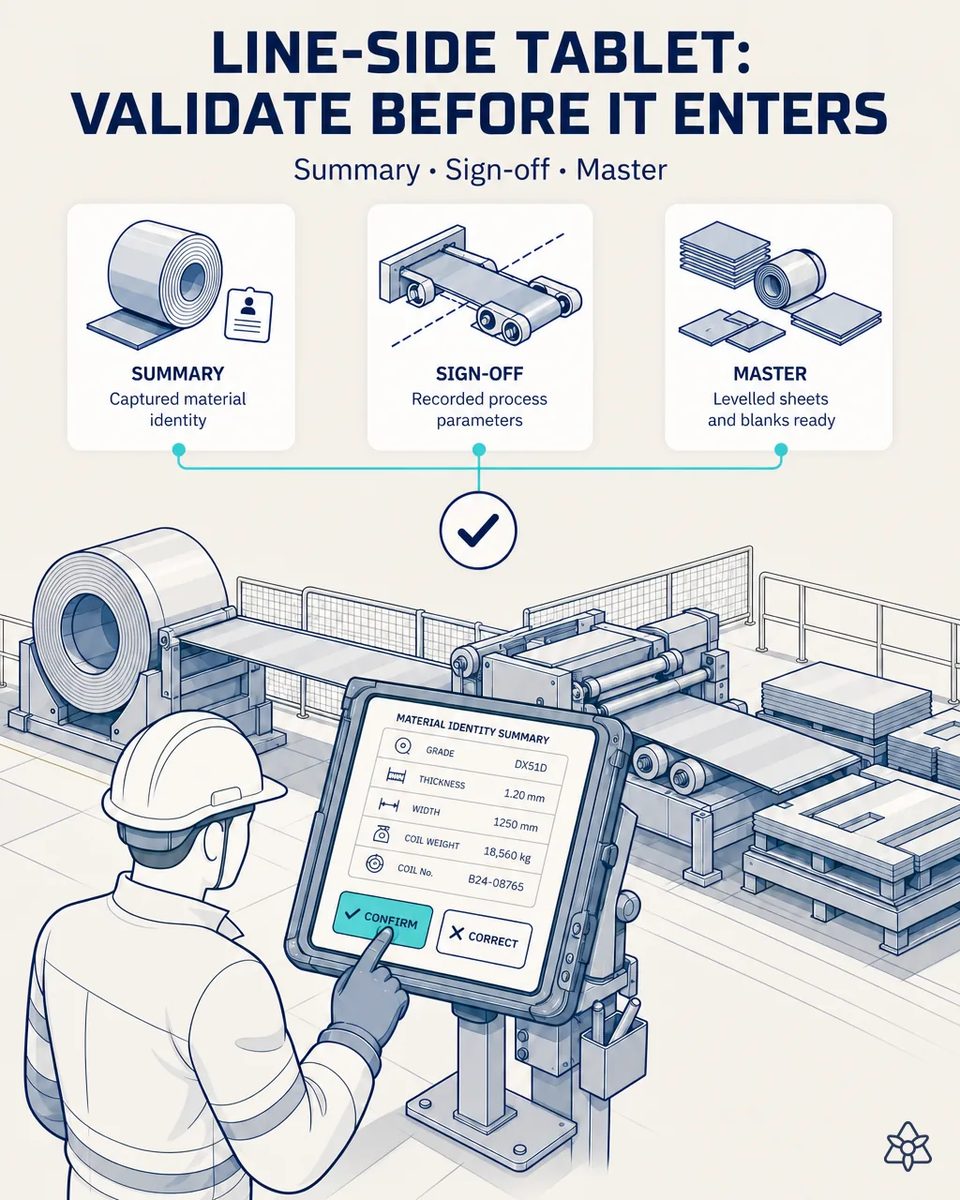
What separates iLEAN from an autonomous AI agent that writes data without a signature is a physical gate in the flow: nothing the system captures enters central memory without a human having seen it. There is an industrial tablet at every line showing a two-second visual summary, validated in two taps.
The fear that AI will write data on its own is reasonable, and it blocks everything.
In a business where the product is defined by its identity — grade, coating, gauge and heat — the fear that artificial intelligence will write data on its own and leave somebody cleaning up the ERP master is the single biggest cultural brake on digitalisation. And it is a reasonable fear. A contaminated master is worse than having no data at all: it produces wrong decisions that look well founded. But the operator does not want to type either. Every second on a keyboard is a second away from the line. Between "let the AI write on its own" and "make the operator type" there is no need to choose: there is a third option.
- In a business where the product is defined by its identity — grade, coating, gauge and heat — the biggest cultural brake on digitalization is the fear that an AI will write data on its own and leave somebody cleaning up the ERP master.
- And it is a reasonable fear: a contaminated master is worse than no data at all, because it produces wrong decisions that look well founded.
- But the operator does not want to type either. Every second on a keyboard is a second away from the line, with the crane waiting.
- Between letting the AI write on its own and making the operator type, most plants choose neither and the data stays on paper, which is the worst of the three outcomes and the most common.
Connect with early human verification — two taps at the line.
Connect in early human verification mode. An industrial tablet at every line. When the system reads the cutting order, interprets the machine panel, parses a schedule change that arrived by email or picks up a dictation from the supervisor, it all appears there as a two-second visual summary: coil, heat, grade, coating, gauge and strip pattern. Two taps: ✓ it enters the system, ✏️ it gets corrected first. The interface is built to validate in two seconds, not to enter data. Humans in command, implemented as architecture rather than as a promise.
Humans in command implemented as architecture rather than as a promise: whatever the system reads — the cutting order, the panel, an email, a dictation — appears on the tablet as a two-second visual summary, and it does not exist in the master until a person has confirmed it. It is the piece that gets the other eleven approved, because it answers the steering committee's first question before it is asked.
Today's data entry versus the validated entry
| Aspect | Today | With iLEAN |
|---|---|---|
| Who writes to the master | A person, typing | A person, confirming |
| Time at the tablet per coil | Minutes at a terminal | Two seconds, two taps |
| What appears as the author | Whoever typed it, later | Whoever looked at the coil |
| A wrong grade or coating | Discovered in the customer's press | Corrected before it enters |
| Where the summary comes from | — | Order photo, panel, email or dictation |
| Can the AI write on its own | The fear | No, by architecture |
from unvalidated data contaminating the master — or data never captured out of distrust — to data captured and validated within seconds, with effortless traceability of who signed what.
Impact estimate — to be validated with your numbers.
The block below is an estimate to be validated against your plant's actual data. We put it forward so the committee has an order of magnitude; we refine it during the assessment.
- No standalone payback — this is an enabling piece, and the case analysis says so: it is not directly monetizable.
- Its value is strategic: without early human verification the other eleven pieces never get approved at steering level, because no sensible management team lets a system write into its master with nobody in front of it.
- From unvalidated data contaminating the master — or data never captured out of distrust — to data validated within seconds.
- And effortless traceability of who signed what, on which line and at what time, which is what gets asked for when a claim lands and what today has to be reconstructed from a folder.
an enabling piece, not directly monetizable. Without early human verification the other eleven pieces of the matrix never get approved at steering level, because no sensible management team lets a system write into its master with nobody in front of it. *Strategic value*.
And the fair question from the production manager
“If a person signs in the end, what is the AI saving?” — the work is not in deciding, it is in assembling. Today somebody would have to go to a terminal, find the coil and type grade, coating, gauge, width and heat. With the gate, the extraction — an anchored task where the best models drop below 1.5% error [1] — arrives assembled, and the operator only confirms or corrects. Every correction is stored: the system learns where its reading fails on your documents.
[1] OpenAI paper "Why Language Models Hallucinate", 2025 — on the reliability of AI in anchored tasks.
What people ask about the line-side tablet
Can the AI write to the ERP without a tap?
No, and it is not configurable: it is the architecture. Data crosses into the master only after human confirmation on the tablet, whatever the source it came from.
What does the operator see?
A two-second summary: coil, heat, grade, coating, gauge, width and strip pattern. Two buttons: confirm, or correct first. The interface is built to validate, not to enter data, and it is readable with gloves on and from a meter away.
What gets recorded?
What summary was shown, who confirmed it, when, on which line, and what they corrected if anything. That is what serves later when a customer asks who released that coil and on what information.
Does it slow the line down?
No. Two taps take less time than reading a display and typing a number, and the tablet is at the line, not in an office. If the operator is busy the summary waits; nothing enters until they get to it.
Is it mandatory before deploying the rest?
In practice yes: it is the piece that makes everything else approvable, because it guarantees the master is not contaminated. It is usually the first thing a steering committee asks to see, and the demo takes less time than the question.
More cases from this series
- A non-conformity is almost never a product failure. It is a documentation gapHeat, dimensions, photos, tests and signatures group themselves by shipment and by standard. Audits stop…
- Material comes in as coil and leaves as strip. Every transformation can lose its identityFour rings cross-checking heat, label, dimension and order from receiving to the dock. If they do not…
- The traceability of everything you will sell is born in a receiving desk that is typed in a hurryPacking list, tag and mill test certificate enter the ERP from a photo. From 45-60 min per truck to…
- The alert you read three hours late, read at second zeroSchedule changes and coil delays are read at second zero, cross-checked against line load and returned…
- The cutting order enters your system with a photo, not with typingThe operator photographs the cutting order and shift report: the run enters the system at second zero,…
- The zinc thickness you actually measure and the one your ERP shows are not the same numberHardness and zinc thickness enter the ERP from the lab spreadsheet after human validation. Typical…
Come and see the two-second validation screen.
We work on your plant's real data, not ours. Assessment with no commitment.
Request estimated ROI within 48h ‹ See all cases of steel service centers See steel