The alert you read three hours late, read at second zero
A service center lives off two streams of alerts arriving by email and messaging that nobody reads in real time: from customers and from mills. Each lands in one person's inbox and gets opened two or three hours later, when the run is already set up and the knives are already mounted. Connect reads the message instantly, cross-checks it against real line load and returns the concrete action.
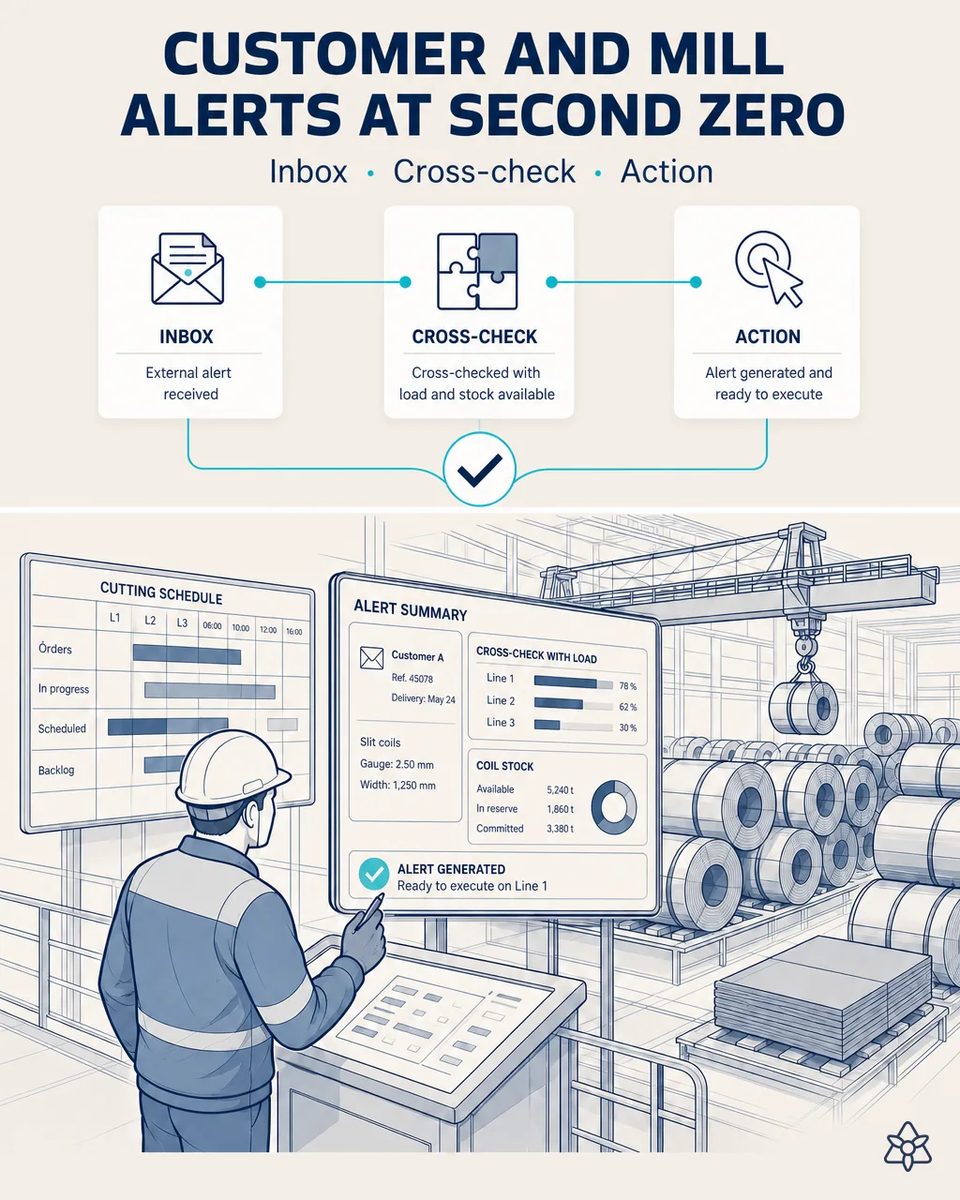
The alert is read when the knives are already mounted.
From customers come pulled-forward shipments, strip width changes and warnings that their press is down waiting for material. From mills come coil delays, reassigned heats and widths delivered that are not the ones ordered. Cutting schedules in a service center are a jigsaw of widths: each run combines different orders to make the most of the master coil. An alert read late is not an administrative nuisance, it is a knife set mounted for nothing and a whole setup lost. Or worse: a customer with a stopped press. And it is not solved by asking people to check their email more often. It is solved by putting something in place that listens all the time.
- From customers come pulled-forward shipments, strip width changes and the warning that their press is down waiting for material. From mills come coil delays, reassigned heats and a width delivered that is not the one ordered.
- Each one lands in one person's inbox, competing with a hundred other messages, and gets opened two or three hours later.
- A cutting schedule is a jigsaw of widths that combines several orders on one master coil. An alert read late is a knife set mounted for nothing and a whole setup lost. Or a customer with a stopped press.
- It is not solved by asking people to check their email more often. It is solved by putting something in place that listens all the time.
Connect in chaotic-sources mode — silent copy, around the clock.
Connect in chaotic sources mode. A dedicated mailbox and a business messaging number sit silently in copy, around the clock. When a message arrives, the LLM extracts the intent — pull-forward, specification change, supply delay, claim — and the entities: customer, order, heat, width, gauge. It then cross-checks against the ERP and against real line load, and returns a proposed action to the operations manager: which run to resequence, which alternative coil in the warehouse covers that specification, and which customer to notify. Not a notification that an email arrived: the action.
The difference between reading the alert and acting on it is the cross-check: it is not enough to know sooner, you need to know which run it hits, which coil in the warehouse covers the new specification and which customer has to be told. That is what comes back, to the operations manager, as a proposed action.
Today's alert versus the cross-checked alert
| Aspect | Today, in the inbox | With iLEAN Connect |
|---|---|---|
| When it is read | 2-4 hours later | In seconds |
| A width change from a customer | Discovered with the knives mounted | Caught before the setup |
| A coil delay from the mill | A line waiting for material | An alternative coil proposed from stock |
| Rescheduling against | This morning's snapshot | Real line load |
| What you receive | One more email | Which run to resequence and whom to notify |
| Who decides | Whoever opens the email | The operations manager — iLEAN proposes |
from 2-4 h of human latency to seconds. Rescheduling against real line load rather than against this morning's snapshot.
Impact estimate — to be validated with your numbers.
The block below is an estimate to be validated against your plant's actual data. We put it forward so the committee has an order of magnitude; we refine it during the assessment.
- Estimated payback 3-7 months, depending on the real frequency of schedule changes.
- Measured in knife setups avoided: every alert caught before the changeover is a setup not lost.
- And in deliveries saved: the customer with a stopped press gets material from an alternative coil instead of an apology.
- From 2-4 hours of human latency to seconds, with the schedule resequenced against real line load rather than against this morning's snapshot.
estimated payback 3-7 months depending on the real frequency of schedule changes, measured in knife setups avoided and deliveries saved. *An estimate to be validated*.
And the fair question from the production manager
“Are you going to read my team's email?” — no. iLEAN sits in copy on a dedicated mailbox and a business messaging number: it only sees what customers and mills send to those operational channels. On extraction, classifying the intent of a message — pull-forward, width change, coil delay, claim — and pulling out order, heat, width and gauge is an anchored task where the best models drop below 1.5% error [1], and the resequencing is executed by a person.
[1] OpenAI paper "Why Language Models Hallucinate", 2025 — on the reliability of AI in anchored tasks.
What people ask about reading customer and mill alerts
Does it tell a pull-forward from a routine confirmation?
Yes, and that is what matters most: a customer with a stopped press is flagged top priority because its cost grows by the hour, while an order acknowledgment interrupts nobody. The priority rules are set with your operations manager at commissioning, customer by customer.
Does it know which cutting run is affected?
When it is crossed with the ERP and the schedule, yes. That is the difference between an email that says a width changed and an action that says which run to resequence before the knives go on.
What does it do with a mill coil delay?
It checks which orders depended on that coil and whether another coil in the warehouse covers the same grade, coating, gauge and width. If there is one, it proposes the swap; if not, it tells you which customer to warn and how many days of margin remain before their press feels it.
Does it replace the ERP's order entry or EDI?
No. The formal order keeps arriving through its channel and stays the reference. This case covers the change communicated by hand — the email at seven in the morning, the message from the mill's logistics desk — which is what breaks the day and what no system reads.
Does it work with messages in another language?
Yes. A service center buying from mills abroad gets delay notices in more than one language, and intent extraction does not depend on the language of the message.
More cases from this series
- A non-conformity is almost never a product failure. It is a documentation gapHeat, dimensions, photos, tests and signatures group themselves by shipment and by standard. Audits stop…
- Material comes in as coil and leaves as strip. Every transformation can lose its identityFour rings cross-checking heat, label, dimension and order from receiving to the dock. If they do not…
- The traceability of everything you will sell is born in a receiving desk that is typed in a hurryPacking list, tag and mill test certificate enter the ERP from a photo. From 45-60 min per truck to…
- No data enters your master without a person having seen it firstEarly human verification: the operator validates in two taps what the AI captured, before it crosses…
- The cutting order enters your system with a photo, not with typingThe operator photographs the cutting order and shift report: the run enters the system at second zero,…
- The zinc thickness you actually measure and the one your ERP shows are not the same numberHardness and zinc thickness enter the ERP from the lab spreadsheet after human validation. Typical…
Tell us how many knife setups you lost last month to an alert read too late.
We work on your plant's real data, not ours. Assessment with no commitment.
Request estimated ROI within 48h ‹ See all cases of steel service centers See steel