The cutting order enters your system with a photo, not with typing
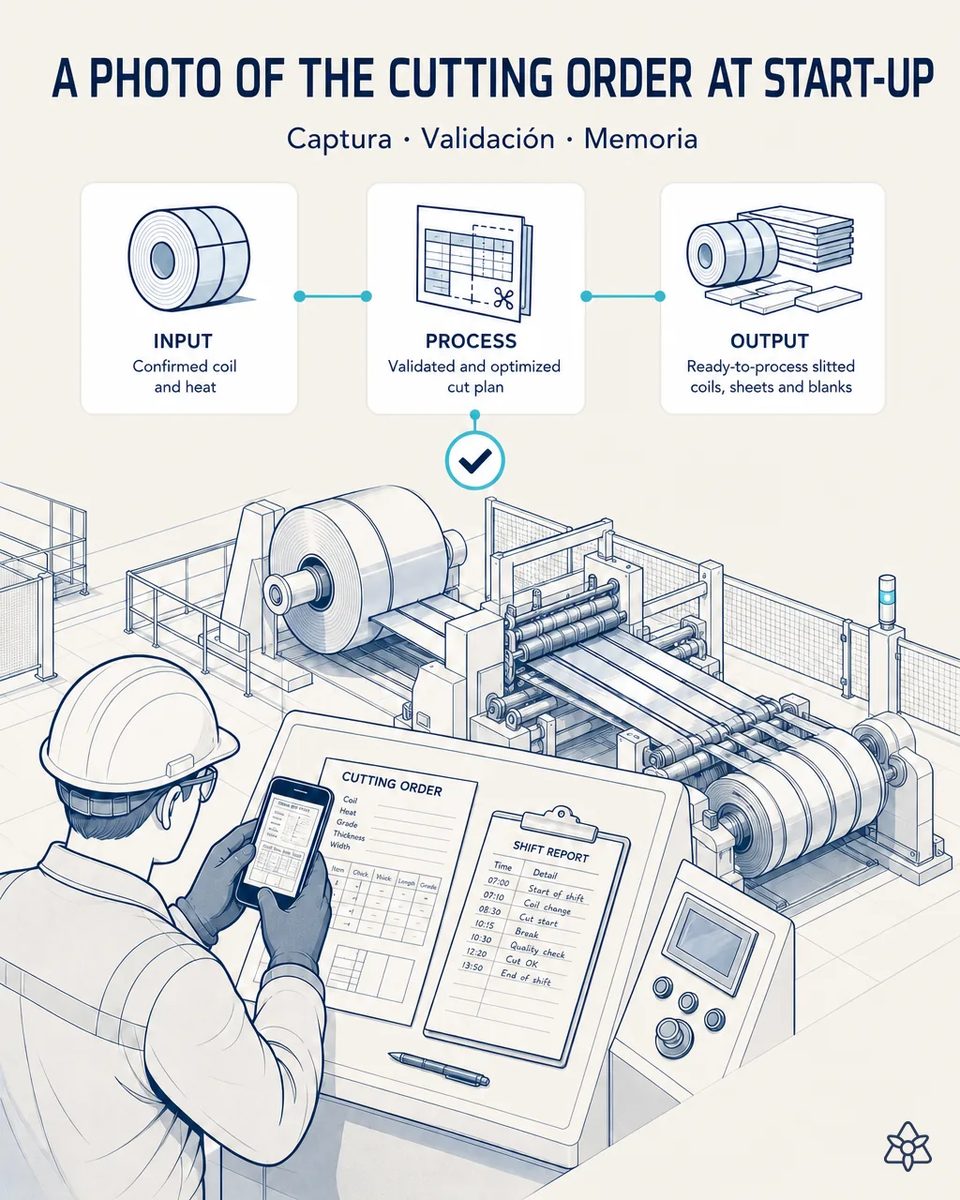
In a service center the slitter operator starts every run with two pieces of paper: the cutting order and the shift report filled in by hand. Between them sits everything that defines the job. Today they live in a folder for eight to twenty-four hours. With Connect, two photos taken on a phone are enough for the run to exist in central memory at second zero.
The number that explains coil yield is written on paper and typed the next day, if at all.
The cutting order is printed from ERP data, but what actually happens gets written on top of it by hand: that the coil came in with camber and needed extra trimming, that the strip pattern was changed to use the width better, that the last strip came out of tolerance. That is precisely the data that explains real coil yield, and it is the data that gets lost. The paper is typed up the following day, partially, or not at all. When somebody asks why the month's yield dropped two points, the number that would have explained it no longer exists. The result is a plant measuring its most important indicator — how much of every coil it recovers — with a month-end estimate instead of a record.
- The cutting order prints from the ERP with the strip pattern and the theoretical weights. What actually happened — camber, extra edge trim, a pattern changed on the fly to use the width better, the last strip out of tolerance — gets written on top by hand.
- The shift report carries the downtime reasons, the exit weights and the scrap. It is filled in at the end of the shift, from memory, in a folder.
- Between the run closing and somebody typing it, eight to twenty-four hours pass. Over a weekend, more. Part of it never gets typed.
- So when the month's yield drops two points, the run-level number that would explain it does not exist, and the plant measures its most important indicator with an estimate.
Connect in photo mode — one photo when the coil goes on, one when the run closes.
Connect in photo-to-analog mode. The operator takes two photos with a phone: one when the coil goes on, one when the run closes. A grounded LLM recognizes the structure of both documents and extracts the fields — coil number, heat, grade, coating, gauge, strip pattern, entry weight, exit weight, trim and downtime reason — storing them structured in central memory, linked to the run and the shift. Before crossing to the master, the summary goes through the line-side tablet for the operator to confirm in two taps. Flow: photo → grounded extraction → human validation → central memory → ERP.
It asks the operator for no new habit: they keep filling in the same order and the same report, and add a photo. That is why it is usually the first case a service center approves, and why the yield baseline appears in the first month instead of after a system rollout.
Today's cutting run versus the captured cutting run
| Aspect | Today, on paper | With iLEAN Connect |
|---|---|---|
| When the run exists in a system | 8-24 h later, or never | Second zero |
| Yield per coil and per run | A month-end estimate | Live data, run by run |
| Handwritten deviation on the order | Lost unless somebody types it | Extracted and tied to the run |
| Downtime reason | A line on the shift report | A structured field per run |
| Explaining a yield drop | An argument in the morning meeting | A query by coil, heat or customer |
| Operator's habit | — | Unchanged: one photo at start, one at close |
from 8-24 h of latency and partial transcription, to second zero with 100% of runs recorded. Yield per coil and per run goes from a monthly estimate to live data.
Impact estimate — to be validated with your numbers.
The block below is an estimate to be validated against your plant's actual data. We put it forward so the committee has an order of magnitude; we refine it during the assessment.
- Estimated payback 4-9 months, depending on the number of cutting runs per shift.
- Administrative transcription time recovered by production and planning.
- From 8-24 hours of latency and partial transcription to 100% of runs recorded at second zero.
- And a real yield baseline per coil, per run and per customer, which appears for the first time and is what every improvement plan is measured against.
estimated payback 4-9 months depending on runs per shift, plus the administrative transcription time recovered and a real yield baseline appearing for the first time. *An estimate to be validated*.
And the fair question from the production manager
“What if it misreads a heat number off a handwritten note?” — reading fields from a document with a known structure is an anchored task, where the best models drop below 1.5% error [1]. And there are two nets behind it: the summary goes to the line-side tablet and the operator confirms or corrects before anything crosses, and the coil and heat numbers are cross-checked against what the ERP already has in stock, so a number that does not exist is flagged rather than accepted.
[1] OpenAI paper "Why Language Models Hallucinate", 2025 — on the reliability of AI in anchored tasks.
What people ask about photographing the cutting order
Do we have to change the cutting order layout?
No. The order keeps printing from your ERP as it does today, and the model recognizes its structure as it is. The same goes for the shift report, even if each shift fills it in slightly differently.
Does it read the strip pattern changed on the fly?
That is the part with the most value, because a pattern changed at the machine is exactly the change that explains real yield. Handwritten annotations are extracted like any printed field, and a low-confidence value is flagged for the operator to confirm.
What about the entry and exit weights?
They are extracted from the two photos and the difference gives trim and scrap per run, coil by coil. If the plant already has the scale stitched to the ERP, the real weight replaces the handwritten one automatically and the yield figure stops depending on anyone's arithmetic.
Do we need the ERP integration from day one?
No. The case works from the first run against iLEAN's central memory, and the push to the ERP is connected afterwards, once the yield data has shown its value.
Does it work with a leveler or a blanking line too?
Yes, the pattern is the same: a work order that prints from the ERP and a report filled in by hand. You start with the slitter because that is where yield is decided, and the leveler and blanking line follow with the same two photos once the operators have seen it work.
More cases from this series
- A non-conformity is almost never a product failure. It is a documentation gapHeat, dimensions, photos, tests and signatures group themselves by shipment and by standard. Audits stop…
- Material comes in as coil and leaves as strip. Every transformation can lose its identityFour rings cross-checking heat, label, dimension and order from receiving to the dock. If they do not…
- The traceability of everything you will sell is born in a receiving desk that is typed in a hurryPacking list, tag and mill test certificate enter the ERP from a photo. From 45-60 min per truck to…
- No data enters your master without a person having seen it firstEarly human verification: the operator validates in two taps what the AI captured, before it crosses…
- The alert you read three hours late, read at second zeroSchedule changes and coil delays are read at second zero, cross-checked against line load and returned…
- The zinc thickness you actually measure and the one your ERP shows are not the same numberHardness and zinc thickness enter the ERP from the lab spreadsheet after human validation. Typical…
Tell us how many cutting runs pass through your slitter each shift.
We work on your plant's real data, not ours. Assessment with no commitment.
Request estimated ROI within 48h ‹ See all cases of steel service centers See steel