The zinc thickness you actually measure and the one your ERP shows are not the same number
A service center selling tight tolerances has its own laboratory: hardness, chemical and physical testing and zinc coating thickness, coil by coil. The laboratory works. The problem is that its data lives in a spreadsheet the ERP cannot see, and sales promises specifications by looking at the ERP.
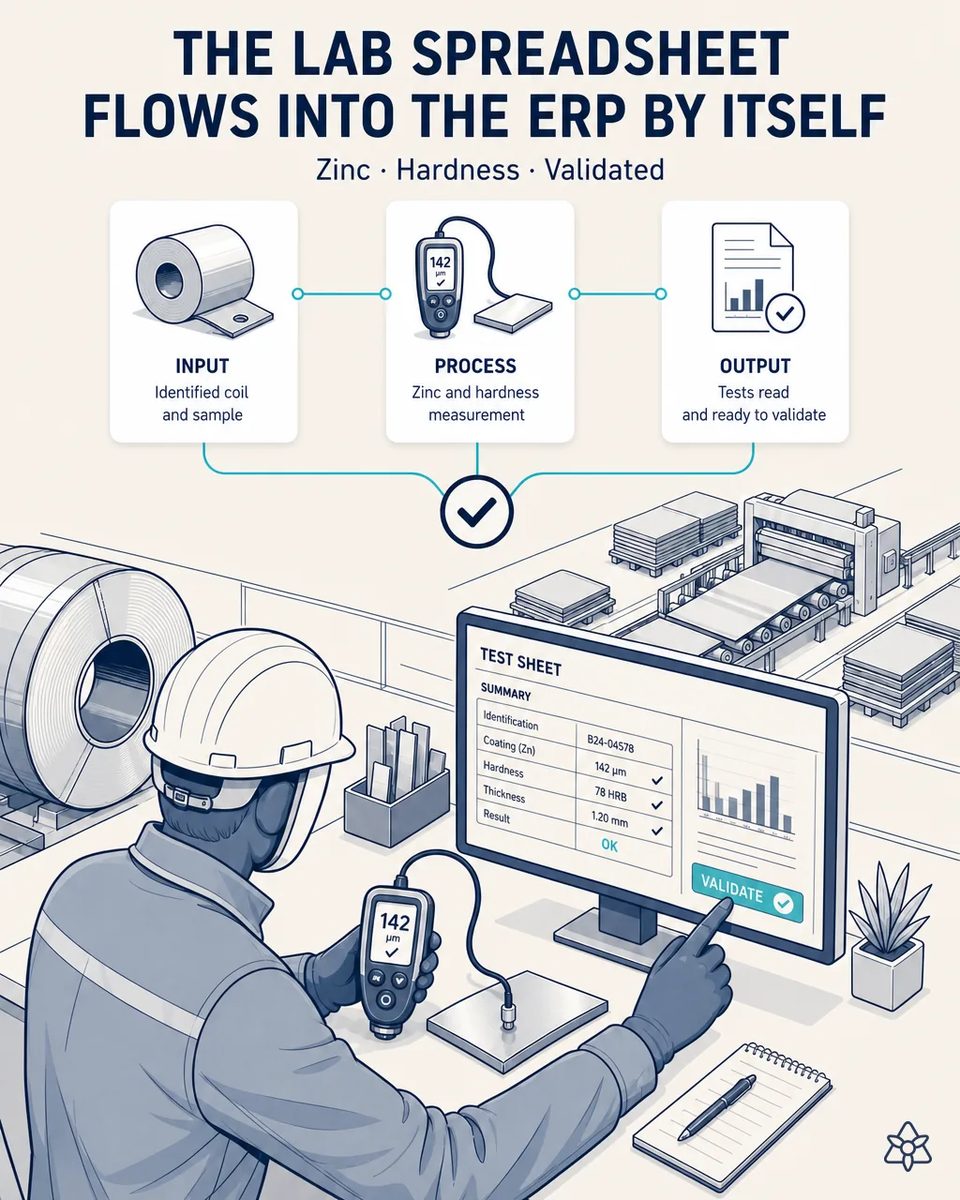
Two parallel worlds, and sales promises specifications by looking at the wrong one.
There are two parallel worlds. The real spreadsheet, in a shared folder, where the actually measured zinc thickness sits. And the official ERP, transcribed weeks later by somebody who spends several hours a month copying and pasting, and introducing errors. When those two worlds diverge, the divergence is not discovered in a meeting: it is discovered in the customer's press, in the form of a claim. And there is a second, quieter, recurring cost: the ERP is licensed per active user, so every person in the laboratory who logs in purely to enter test results is consuming a full annual license to act as a keyboard.
- The real spreadsheet, in a shared folder, holds the zinc coating thickness and hardness actually measured coil by coil. The official ERP holds a version transcribed weeks later by somebody copying and pasting.
- Sales promises tolerances by looking at the ERP. When the two worlds diverge, the divergence is discovered in the customer's press, as a claim.
- Several hours a month of a quality technician go into transcription, and every paste is a chance to attach a hardness value or a coating thickness to the wrong heat, which is the error that surfaces months later and cannot be traced back.
- And a quieter cost: the ERP is licensed per active user, so every laboratory person who logs in purely to enter results consumes a full annual license to act as a keyboard.
Connect in inward-listening mode — the folder, not the person.
Connect in listening-inwards mode. The system watches the shared folder — the folder, not the person — reads the delta when the file is saved and parses it with a grounded LLM. It presents the summary on screen and, once the quality lead validates, writes it to the ERP through the API, anchored to the heat number and the coil number. The laboratory keeps working exactly as before.
The laboratory keeps working exactly as before, in the sheet it has today. What changes is that the moment the file is saved, the new results are read, shown to the quality lead and, once validated, written to the ERP against the heat and coil number. The gap between what was measured and what the ERP shows goes to zero, and sales starts promising the zinc thickness that was actually measured.
Today's laboratory versus the connected laboratory
| Aspect | Today | With iLEAN Connect |
|---|---|---|
| Gap between measurement and ERP | Weeks | Second zero |
| Manual transcription | Several hours a month | Zero |
| Zinc thickness sold versus measured | Two different numbers | One number, heat by heat |
| Result attached to the wrong heat | Found in the customer's press | Cross-checked before the push |
| Sheet format | Has to be respected | Tolerated as is, even as it changes |
| Quality module licenses | Typically four | One, the lead who validates |
from weeks of lag to second zero; from several hours a month transcribing to none; from an auditor holding laboratory data that was never cross-checked, to automatic matching heat by heat.
Impact estimate — to be validated against your annual ERP invoice.
The block below is an estimate to be validated against your plant's actual data. We put it forward so the committee has an order of magnitude; we refine it during the assessment.
- Estimated payback 4-9 months, including the operational saving.
- 💰 CFO angle: if four laboratory and quality people log into the ERP only to enter tests, that is four licenses; with Connect only the validating lead logs in. 50-80% reduction in quality/laboratory module licenses, recurring every year.
- Several hours a month of an expensive technician recovered.
- And an auditor who finds laboratory data matched automatically heat by heat against the mill certificate, instead of a spreadsheet nobody cross-checked and an ERP that disagrees with it.
CFO angle — if the laboratory and quality team logs into the ERP only to enter tests, each person consumes a license. With Connect only the validating lead needs to log in: typically from 4 licenses to 1, a 50-80% reduction in quality/laboratory module licenses, recurring every year. Estimated payback 4-9 months including the operational saving. *An estimate to be validated* against your annual ERP invoice.
And the fair question from the production manager
“That spreadsheet has been modified by three technicians over ten years — does it hold up?” — that is the anticipated case: parsing does not depend on fixed positions, it interprets columns, units, merged cells and margin notes without asking anyone to standardize anything. It is an anchored task, where the best models drop below 1.5% error [1], and the quality lead validates on screen before anything is pushed to the ERP.
[1] OpenAI paper "Why Language Models Hallucinate", 2025 — on the reliability of AI in anchored tasks.
What people ask about connecting the laboratory spreadsheet
Do we have to standardize the sheet?
No, and it is better not to. Asking the laboratory to change its sheet is the fast route to the system going unused. iLEAN reads the one that exists, in the format it has today.
Which results does it cover?
Whatever the laboratory records: hardness, zinc coating thickness, chemical and mechanical tests, coil by coil. Each value is anchored to the heat number and the coil number that appear on the same row, so it lands on the right coil in the ERP.
Can licenses really be reduced?
It depends on your ERP contract, which is why it is framed as an estimate to validate against last year's invoice. The logic is that anyone logging in purely to type stops needing to: the technician measures, the sheet is saved, and only the validating lead touches the ERP.
What if a result sits outside the mill certificate's range?
The discrepancy is highlighted in the summary before the quality lead validates. Today that comparison is done by nobody, because the certificate lives in an email and the result lives in a spreadsheet.
Does it watch the folder or the person?
The folder. The file is read when it is saved; there is no tracking of who opens what or how long they spend on it. Only the delta since the last save is parsed, so a sheet with years of history does not get reprocessed every time.
More cases from this series
- A non-conformity is almost never a product failure. It is a documentation gapHeat, dimensions, photos, tests and signatures group themselves by shipment and by standard. Audits stop…
- Material comes in as coil and leaves as strip. Every transformation can lose its identityFour rings cross-checking heat, label, dimension and order from receiving to the dock. If they do not…
- The traceability of everything you will sell is born in a receiving desk that is typed in a hurryPacking list, tag and mill test certificate enter the ERP from a photo. From 45-60 min per truck to…
- No data enters your master without a person having seen it firstEarly human verification: the operator validates in two taps what the AI captured, before it crosses…
- The alert you read three hours late, read at second zeroSchedule changes and coil delays are read at second zero, cross-checked against line load and returned…
- The cutting order enters your system with a photo, not with typingThe operator photographs the cutting order and shift report: the run enters the system at second zero,…
Bring last year's ERP invoice and we will calculate the license saving in one meeting.
We work on your plant's real data, not ours. Assessment with no commitment.
Request estimated ROI within 48h ‹ See all cases of steel service centers See steel