The most expensive moment of your day depends today on one person's eyesight
The run changeover on a slitter is pure downtime on installed capacity already paid for, and its verification is visual and human. If the knife set is mounted wrong, the whole setup has to be repeated. If a roll has a particle stuck to it, an entire prepainted coil gets marked. Edge turns both checks into objective evidence.
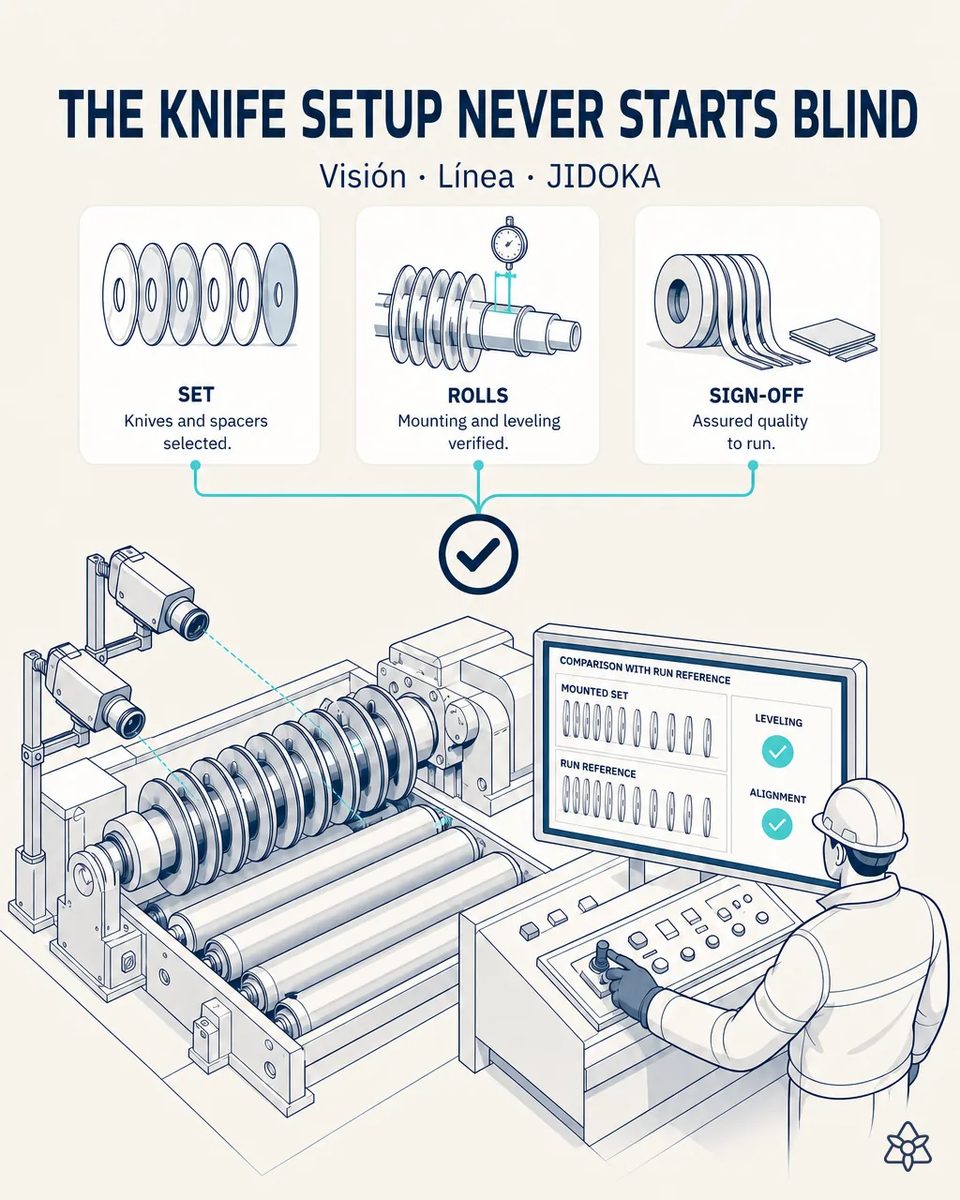
The most expensive moment of the day is signed off with no evidence behind it.
The arbor has to be stripped and the knife and spacer set matching the new width pattern has to be mounted. The cost of getting it wrong is not the first out-of-tolerance strip that gets scrapped: it is doing the whole setup again. And there is a second check, just as critical and far quieter: leaving the rolls clean. A single steel particle stuck to a roll marks every meter of the prepainted coil that follows. It is the classic task done properly 95% of the time, and that remaining 5% is a downgraded coil. Both depend on the operator's skill and eyesight, and on a signature with no objective evidence behind it.
- The arbor is stripped and the knife and spacer set matching the new width pattern is mounted. The cost of getting it wrong is not the first out-of-tolerance strip: it is doing the whole setup again.
- And a second check, just as critical and far quieter: leaving the rolls clean. A single steel particle stuck to a roll marks every meter of the prepainted coil that follows.
- It is the classic task done properly 95% of the time, and the remaining 5% is a downgraded coil.
- Both checks depend on the operator's skill and eyesight, and on a signature with no objective evidence behind it. When a coil comes back marked, the investigation runs into a ticked box and nothing else.
Edge plus JIDOKA AI — the line does not start until every camera clears and the lead signs.
Edge plus JIDOKA AI. Fixed cameras over the knife arbor and over the rolls. Trained networks recognize the mounted set against the active run's reference, and tell a clean roll from a roll with residue. The line does not start until every camera clears and the lead signs off on that evidence. SMED AI uses the same record to sequence the changeover itself: which set to prepare before stopping and in what order to mount.
The cameras do not decide alone: they compare the mounted set against the reference of the active run and tell a clean roll from a roll with residue, and it is the lead who signs on that evidence. SMED AI uses the same record to sequence the changeover: which set to prepare before stopping and in what order to mount it.
Today's changeover versus the validated changeover
| Aspect | Today | With iLEAN Edge |
|---|---|---|
| Verifying the mounted set | One person's eyesight | Compared against the run reference |
| Roll cleanliness | A glance, 95% of the time | Residue detected before start |
| Signature | A ticked box | On visual evidence, point by point |
| A repeated setup | Discovered on the first strip | Does not happen |
| Changeover time | Unmeasured, varies by shift | Measured and comparable |
| Sequencing the changeover | Each operator's routine | SMED AI: what to prepare, in what order |
from signing blind to signing on visual evidence point by point; from repeated setups due to incorrect mounting to none. And changeover time becomes measured and comparable across shifts and operators, which is the precondition for reducing it.
Impact estimate — to be validated with your numbers.
The block below is an estimate to be validated against your plant's actual data. We put it forward so the committee has an order of magnitude; we refine it during the assessment.
- Estimated payback 5-10 months, counted on setup minutes recovered and on prepainted coils not downgraded.
- In a plant with spare capacity, setup minutes convert directly into sellable tonnage with no CAPEX.
- From repeated setups due to incorrect mounting to none, and from signing blind to signing on evidence.
- And changeover time becomes measured and comparable across shifts and operators, which is the precondition for reducing it.
estimated payback 5-10 months, counted on setup minutes recovered — which in a plant with spare capacity convert directly into sellable tonnage with no CAPEX — and on prepainted coils not downgraded. *An estimate to be validated*.
And the fair question from the production manager
“What if the camera blocks the line for no reason?” — that is the right objection, because the changeover sits on the shift's critical path. Comparing a mounted set against the reference image of that specific run, at a fixed camera position, is an anchored task where the best models drop below 1.5% error [1]. And in case of doubt the system does not block silently: it shows the lead the frame and the reference side by side, and the lead signs or corrects. It stops on a verifiable mismatch, not on model uncertainty.
[1] OpenAI paper "Why Language Models Hallucinate", 2025 — on the reliability of AI in anchored tasks.
What people ask about validating the knife setup
What exactly is checked?
That the knives and spacers mounted on the arbor match the width pattern of the active run, position by position, and that the rolls carry no residue or stuck particle. The points are defined at commissioning with your slitter lead, and the reference for each run is generated from the cutting order, not drawn by hand.
Doesn't it make the changeover longer?
The check takes seconds once the set is mounted. What lengthens the changeover today is the repeat when the set was wrong, and the margin added for lack of evidence. On a slitter the changeover sits on the critical path of the shift, so seconds of check against a repeated setup is not a close call.
Can it be skipped in a hurry?
An exception can be defined with a lead's signature and it is recorded as such. What cannot happen is starting up with no trace of who decided to skip it.
What does SMED AI add?
With every changeover measured, it sequences the next one: which set to stage before the line stops, in what order to mount, and where the time goes. That is what turns a measured changeover into a shorter one.
Does it cover the leveler too?
The roll cleanliness check applies to any line running prepainted. The set comparison is specific to the slitter arbor, which is where the expensive mistake lives.
More cases from this series
- A non-conformity is almost never a product failure. It is a documentation gapHeat, dimensions, photos, tests and signatures group themselves by shipment and by standard. Audits stop…
- Material comes in as coil and leaves as strip. Every transformation can lose its identityFour rings cross-checking heat, label, dimension and order from receiving to the dock. If they do not…
- The traceability of everything you will sell is born in a receiving desk that is typed in a hurryPacking list, tag and mill test certificate enter the ERP from a photo. From 45-60 min per truck to…
- No data enters your master without a person having seen it firstEarly human verification: the operator validates in two taps what the AI captured, before it crosses…
- The alert you read three hours late, read at second zeroSchedule changes and coil delays are read at second zero, cross-checked against line load and returned…
- The cutting order enters your system with a photo, not with typingThe operator photographs the cutting order and shift report: the run enters the system at second zero,…
Tell us how long a knife setup takes on your slitter and how much it varies between shifts.
We work on your plant's real data, not ours. Assessment with no commitment.
Request estimated ROI within 48h ‹ See all cases of steel service centers See steel