Your cutting line panel has been silent for twenty years. It can speak now
Cutting lines last for decades and are often bought second hand: it is normal for the slitter to run a fifteen or twenty year old proprietary panel, isolated from the network. Replacing the line costs millions and months of downtime. An industrial camera pointed at the panel digitizes its parameters without touching the PLC, opening the cabinet or compromising the manufacturer's warranty.
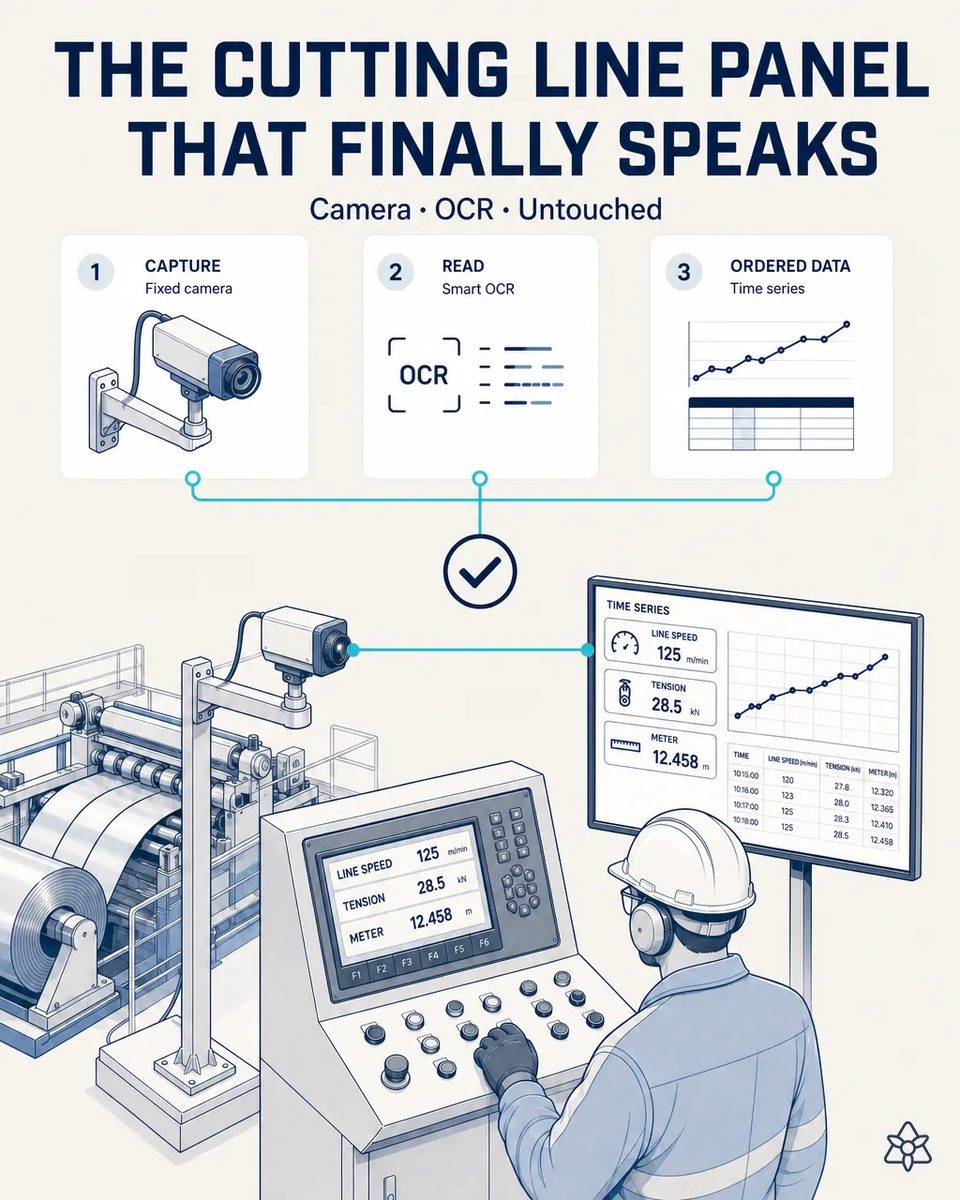
The parameters that explain cut quality are on a screen nobody records.
The slitter panel shows line speed, recoiler tension, meter counter, knife pressure and shear status. These are the parameters that explain cut quality. And nobody records them. When a claim comes in for edge burr or wavy strip, there is no way to correlate the defect with the conditions under which that particular coil was cut. People argue from memory, and memory does not produce a corrective action: it produces an argument. The classic alternatives — replace the line, or try to integrate the PLC — run into two realities: the CAPEX runs into the millions with months of downtime, and touching machine control means opening the cabinet and negotiating the warranty with the manufacturer.
- Line speed, recoiler tension, knife pressure, meter counter and shear status: the slitter panel shows them all, second by second, and none of them leave the screen.
- When a claim comes in for edge burr or wavy strip, there is no way to correlate the defect with the conditions under which that particular coil was cut. People argue from memory, and memory does not produce a corrective action.
- Replacing the line is a CAPEX in the millions with months of downtime. Integrating the PLC means opening the cabinet and negotiating the warranty with a manufacturer that may no longer exist.
- So the plant keeps a line that works perfectly well and stays blind about it, year after year, while every burr claim gets settled by whoever argues best in the meeting.
Connect in photo mode on the panel — solved from outside, not inside.
Connect in photo-on-panel mode. A fixed industrial camera with a stable frame points at the screen. OCR with a grounded LLM reads every frame, structures it as a time series and cross-references it with the active cutting run: which heat and which customer were on the line at that moment. Installation is entirely non-intrusive: nothing is wired into the PLC, no cabinet is opened, no risk is introduced into machine control. The machine stays itself; the only change is that its data now exists outside the screen.
Nothing is wired into the PLC, no cabinet is opened and no port is enabled: the only thing that changes is that the panel's data now exists outside the screen, cross-referenced with which heat and which customer were on the line at that moment. Keeping the old slitter stops meaning going blind, and the decision to replace it can be taken on tonnage and condition rather than on the absence of data.
Today's slitter versus the slitter being read
| Aspect | Today | With iLEAN Connect |
|---|---|---|
| Speed, tension and pressure | Visible, volatile, unrecorded | A time series per run |
| Correlating a burr claim with conditions | Impossible | Minutes |
| Which heat and customer were on the line | Reconstructed from paper | Cross-referenced automatically |
| The machine's control | — | Untouched: no PLC, no cabinet |
| Manufacturer's warranty | At risk with any integration | Unaffected |
| Replacing the line | Urgent because it is blind | Deferrable |
from zero correlation between cutting conditions and defect, to root cause analysis per run in minutes. Replacing the line stops being urgent because keeping it no longer means going blind.
Impact estimate — to be validated with your numbers.
The block below is an estimate to be validated against your plant's actual data. We put it forward so the committee has an order of magnitude; we refine it during the assessment.
- Estimated payback 5-10 months.
- Deferral of a line replacement CAPEX in the millions, because keeping the line no longer means going blind.
- Scrap reduction through the correlation between cutting parameters and edge defects that is impossible to make today.
- And a root cause per run in minutes when a claim for burr or wavy strip comes in, instead of an argument: the tension and speed of that coil, at that meter, laid next to the defect.
estimated payback 5-10 months, plus deferral of a line replacement CAPEX in the millions and reduced scrap through correlation between parameters and edge defects. *An estimate to be validated*.
And the fair question from the production manager
“Does a camera reading a panel hold up in front of a customer?” — here the task is anchored: fixed screen, fields in known positions and expected physical ranges, where the best models drop below 1.5% error [1]. And the system discards any frame whose value falls outside the possible range for that line — a tension of zero at full speed, a meter counter going backwards — instead of accepting it, which is what would invalidate the series in a claim.
[1] OpenAI paper "Why Language Models Hallucinate", 2025 — on the reliability of AI in anchored tasks.
What people ask about reading the slitter panel
Does it work with a fifteen or twenty-year-old proprietary panel?
That is exactly the panel it is designed for. Nothing is installed on the machine and nothing is asked of its controller: the camera only sees what the operator sees, whether the panel is a monochrome display or a touchscreen.
Does it affect the manufacturer's warranty?
No, and that is the point. The PLC is not touched, the cabinet is not opened and no port is enabled, so there is nothing to negotiate with the manufacturer and nothing for a service technician to object to.
What can be read from the panel?
Whatever it shows: line speed, recoiler tension, knife pressure, meter counter, shear status and alarms. Each value becomes a time series linked to the active cutting run, so a burr claim can be laid over the tension curve of that exact coil.
How does it know which coil was on the line?
Because the run is active in central memory, either from the cutting order photo or from the ERP. Every frame is stamped with the coil, the heat and the customer of that moment, so the series can be filtered by any of the three when a claim comes in.
Does it work on the leveler and the blanking line?
Yes, the same camera pattern applies to any line with a panel and no network: leveler roll settings, blanking press counts. You start with the slitter because that is where edge quality is decided.
More cases from this series
- A non-conformity is almost never a product failure. It is a documentation gapHeat, dimensions, photos, tests and signatures group themselves by shipment and by standard. Audits stop…
- Material comes in as coil and leaves as strip. Every transformation can lose its identityFour rings cross-checking heat, label, dimension and order from receiving to the dock. If they do not…
- The traceability of everything you will sell is born in a receiving desk that is typed in a hurryPacking list, tag and mill test certificate enter the ERP from a photo. From 45-60 min per truck to…
- No data enters your master without a person having seen it firstEarly human verification: the operator validates in two taps what the AI captured, before it crosses…
- The alert you read three hours late, read at second zeroSchedule changes and coil delays are read at second zero, cross-checked against line load and returned…
- The cutting order enters your system with a photo, not with typingThe operator photographs the cutting order and shift report: the run enters the system at second zero,…
Tell us how old your slitter panel is and what it shows.
We work on your plant's real data, not ours. Assessment with no commitment.
Request estimated ROI within 48h ‹ See all cases of steel service centers See steel