The bundle label is your product. And today it is produced by typing
When that strip reaches the customer, the only thing that will say what it is and where it came from is the label stuck on top. It is the last physical piece before the customer and the first thing anyone looks at in a claim. And it is produced by typing a weight read off a display. Connect stitches scale and labeler to the ERP so nobody types there again.
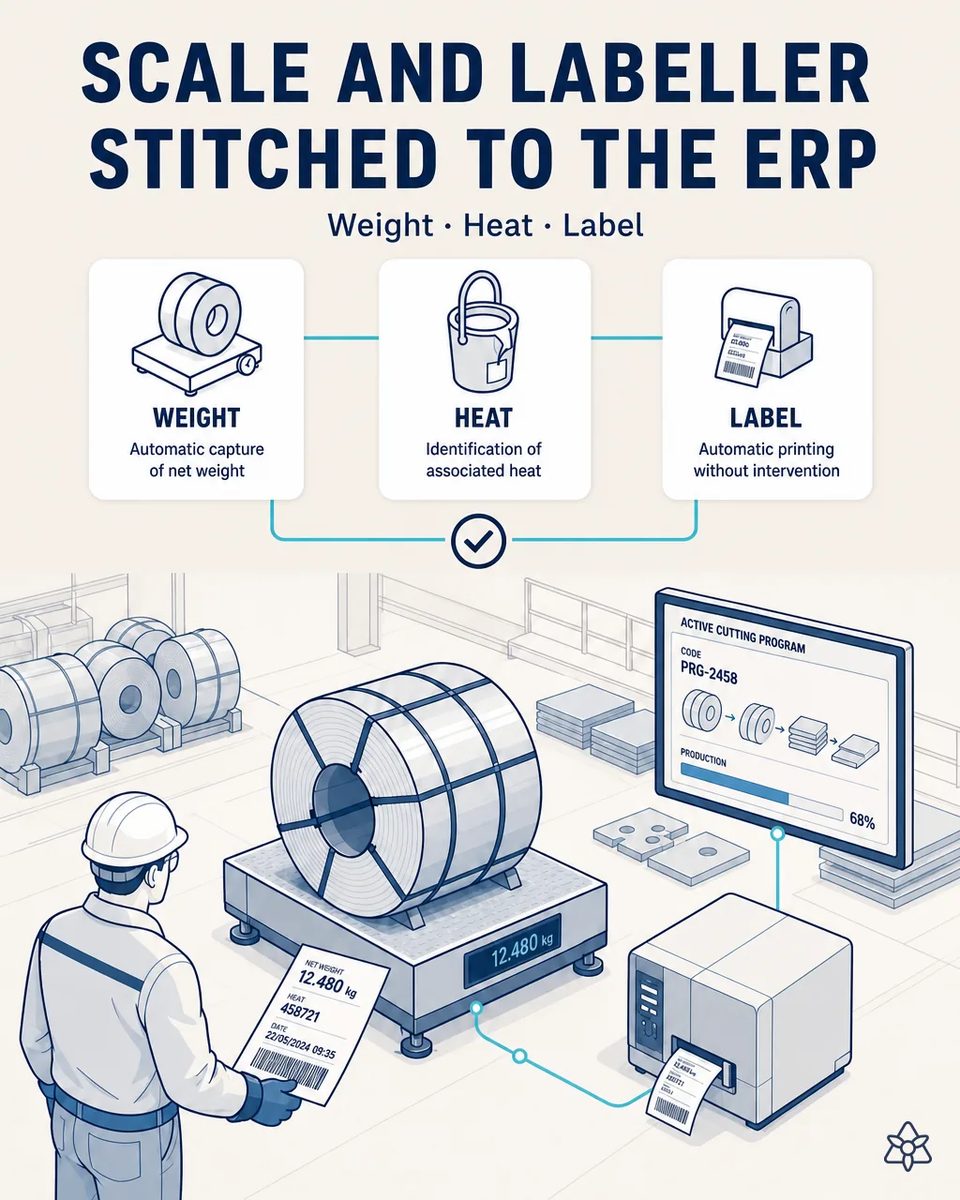
The bundle label is your product, and today it is produced by typing.
Somebody weighs the bundle, reads the number off the display, types it into the labeling system together with the order and the heat, and prints. One wrong digit in the weight or the heat turns a correct bundle into unidentifiable material. And a correct bundle with the wrong label is, in practice, rejected material: the customer does not argue about what the steel is, but about what the label says. What is striking is that both machines are relatively modern and already expose an API or a data port. They are isolated not because it is technically impossible, but because integrating them properly takes time and is never the priority of the quarter. The classic "almost integrated, but not".
- Somebody weighs the bundle, reads the number off the display, types it into the labeling system together with the order and the heat, and prints.
- One wrong digit in the weight or the heat turns a correct bundle into unidentifiable material. The customer does not argue about what the steel is, but about what the label says.
- Both machines are relatively modern and already expose an API or a data port. They are isolated not because it is technically impossible, but because integrating them was never the priority of the quarter.
- Meanwhile the real weight of every bundle — the number that would give coil yield automatically — is typed into a label and never reaches anything else.
Connect stitches scale and labeler to the ERP through their APIs, replacing neither.
Connect stitches two modern systems through the API, replacing neither. With the cutting run active, the ERP publishes order, heat, grade, coating and dimensions; the scale publishes the real bundle weight; the labeler prints the combination. Changing the run means a change in the ERP, not typing on the labeler panel.
With the cutting run active, the ERP publishes order, heat, grade, coating and dimensions; the scale publishes the real weight; the labeler prints the combination. The label that goes on is the right one by construction, and as a side effect the real weight of every bundle turns coil yield into a number nobody balances by hand.
The isolated scale and labeler versus the stitched ones
| Aspect | Today | With iLEAN Connect |
|---|---|---|
| Weight on the label | Read off the display and typed | Published by the scale |
| Heat and order on the label | Typed with the weight | Published by the ERP from the active run |
| Labeling errors | Several a month, some with a claim | Zero human error at source |
| Changing the run | Typing on the labeler panel | A change in the ERP |
| Coil yield | A spreadsheet balanced by hand | Calculated from real bundle weights |
| Either machine | — | Neither is replaced |
from several labeling errors a month — some with a claim attached — to zero human error at source in identification. Plus a side effect worth the project on its own: by recording the real weight of every bundle, coil yield is calculated automatically, without the spreadsheet somebody balances by hand today.
Impact estimate — to be validated with your numbers.
The block below is an estimate to be validated against your plant's actual data. We put it forward so the committee has an order of magnitude; we refine it during the assessment.
- Estimated payback 3-6 months — the fastest in this matrix.
- A sharp reduction in claim risk from incorrect identification, which is the claim where the customer is always right.
- A yield-per-coil metric that appears automatically from the real weight of every bundle, without the spreadsheet somebody balances by hand today.
- And the changeover on the labeler disappears: changing the run is a change in the ERP, not typing on a panel.
fast payback, estimated 3-6 months, with a sharp reduction in claim risk from incorrect identification and a yield-per-coil metric appearing that today is calculated by hand. *An estimate to be validated*.
And the fair question from the production manager
“Isn't a classic integration cleaner?” — it is, the day the project reaches the top of the list, and that is the problem: this is the textbook case of two modern machines still isolated because there was never time. Here the identity on the label comes from the ERP through the API, not from a model reading anything, so the question of model error does not even arise at that point. Where a model does step in — matching a customer's free-text labeling requirement to the fields the ERP publishes — it is an anchored task where the best models drop below 1.5% error [1], and the label template is validated once per customer, not per bundle.
[1] OpenAI paper "Why Language Models Hallucinate", 2025 — on the reliability of AI in anchored tasks.
What people ask about stitching scale and labeler
Do we have to replace the scale or the labeler?
Neither. Connect leans on the API or data port both machines already expose, and on what the ERP publishes when the run becomes active.
What if the scale reads a weight that does not fit the run?
A bundle whose weight is far outside what the strip pattern predicts is flagged before the label prints. Today that check is done by nobody, because the weight is just a number to type.
Does the label carry the customer's own format?
Yes. Each customer's label layout — their part number, their barcode symbology, their field order — is configured once; the data that fills it comes from the ERP and the scale every time, so the format is never retyped.
How does coil yield come out of this?
Because the real weight of every bundle is recorded against the run and the master coil it came from. Entry weight minus the sum of bundles minus trim is yield, calculated for every coil without a spreadsheet.
Does the same pattern work for other isolated machines?
Yes: any modern island with an interface that is fed by hand today fits the same way, the strapping machine or the packaging line included. You start with scale and labeler because that is where the product's identity is printed.
More cases from this series
- A non-conformity is almost never a product failure. It is a documentation gapHeat, dimensions, photos, tests and signatures group themselves by shipment and by standard. Audits stop…
- Material comes in as coil and leaves as strip. Every transformation can lose its identityFour rings cross-checking heat, label, dimension and order from receiving to the dock. If they do not…
- The traceability of everything you will sell is born in a receiving desk that is typed in a hurryPacking list, tag and mill test certificate enter the ERP from a photo. From 45-60 min per truck to…
- No data enters your master without a person having seen it firstEarly human verification: the operator validates in two taps what the AI captured, before it crosses…
- The alert you read three hours late, read at second zeroSchedule changes and coil delays are read at second zero, cross-checked against line load and returned…
- The cutting order enters your system with a photo, not with typingThe operator photographs the cutting order and shift report: the run enters the system at second zero,…
Tell us which scale and which labeler you run.
We work on your plant's real data, not ours. Assessment with no commitment.
Request estimated ROI within 48h ‹ See all cases of steel service centers See steel