The customer's alert arrives before the mold change
A schedule pull-in, a delay on a special color resin or a quality alert arrive by email in one person's inbox. They get read when that person can, and by then the plant has already fitted the mold for the part that is no longer needed. With Connect the message is read at second zero, cross-referenced with the live orders and delivered as a concrete action.
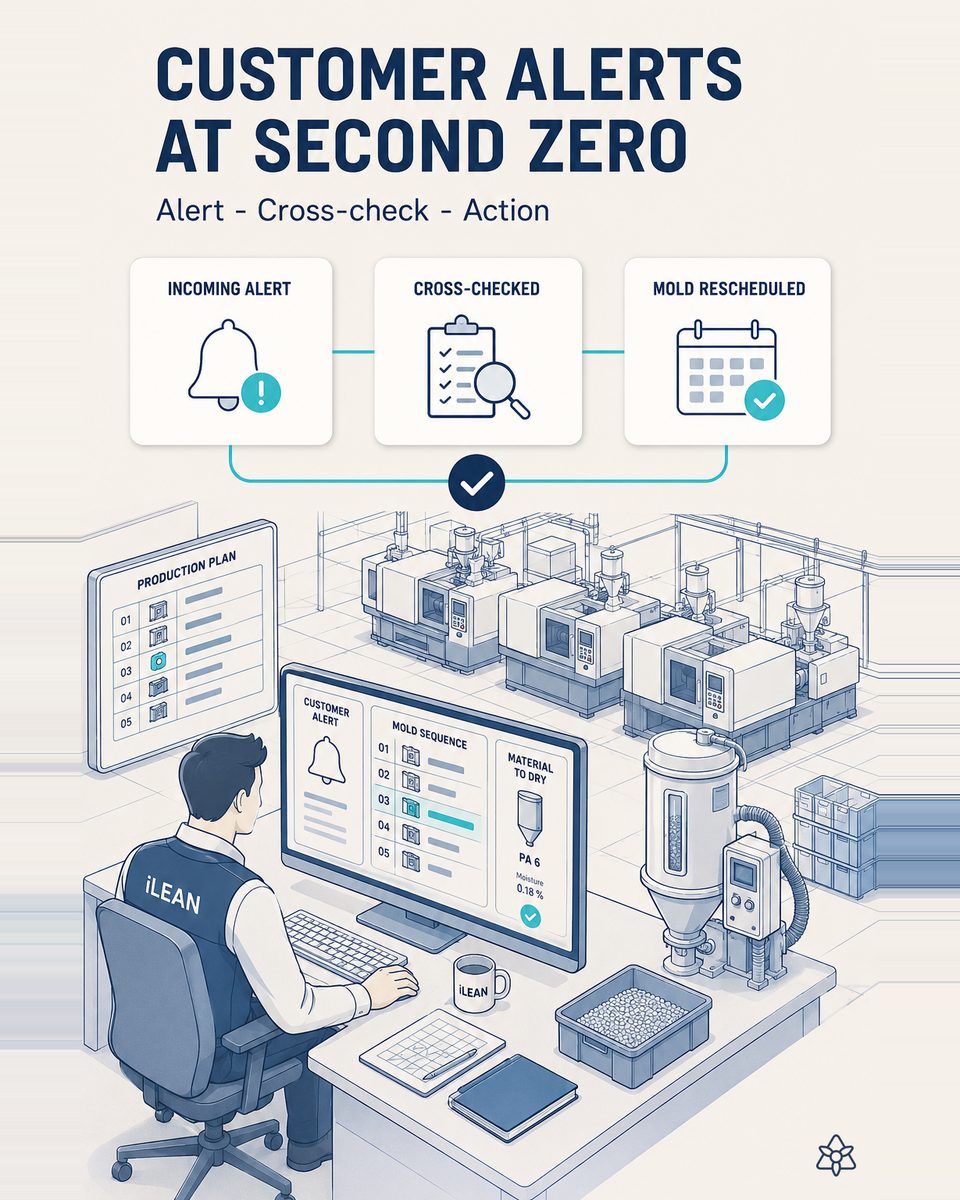
Critical information travels to individual inboxes, not to the system that plans.
In a shop where the mold change is the most frequent operation of the day, two to four hours of latency are paid for with an entire changeover: machine hours, a purge nobody needed and material dried for nothing. Critical customer information travels in natural language toward individual inboxes, not toward the system that plans.
- Two to four hours of latency are paid for with an entire mold change: machine hours, a purge nobody needed and material dried for nothing.
- The mold change is the most frequent operation of the day in a custom shop, so the error multiplies.
- What arrives is natural language — an email, a message — into one specific person's inbox.
Connect in chaotic-sources mode — it reads a corporate mailbox, not people.
Connect in chaotic-sources mode.
What reaches the production manager is not “an email has arrived”: it is which mold no longer needs fitting, which one to bring forward and what material has to be dry in time. The decision stays human.
- Dedicated mailbox in silent copy 24/7 and the messaging number already used with logistics and the resin supplier.
- Intent extraction — pull-in, postponement, quantity change, quality alert, supply delay — and entities: part, quantity, lead time.
- Cross-reference with the open ERP orders and the mold sequence, which is what turns a message into a decision.
- The concrete action returned to the production manager, not a notification.
- Nothing asked of the customer: they keep writing where they write today.
Alert read when somebody can vs. alert cross-referenced instantly
| Aspect | Current handling | With iLEAN Connect |
|---|---|---|
| Latency to action | 2-4 h of human latency | Seconds |
| What reaches production | The forwarded email | Which mold not to fit and which to bring forward |
| Unnecessary mold change | Found once it is finished | Avoided before starting it |
| Material dried for nothing | Absorbed as a diffuse cost | Only what is really needed gets dried |
| Customer channel | Email and messaging, unchanged | Email and messaging, unchanged |
| Who decides | Whoever reads the email, when they read it | The manager, with the proposal in front of them |
From 2-4 h of human latency to seconds; from mold changes executed against an outdated schedule to a sequence replanned with current information.
Impact estimate for your plant — to validate against your numbers.
The block below is an estimate to be validated against your plant's actual data. We put it forward so the committee has an order of magnitude; we refine it during the assessment.
- Custom shop where the mold change is the most frequent operation of the day.
- Pilot on the customer mailbox, which is where what changes the schedule comes in.
- Indicative payback between 3 and 7 months depending on how often customers change the schedule.
- A concrete calibration metric: how many mold changes a month were made against information already out of date.
Estimated payback 3 to 7 months depending on how often customers change the schedule. Calibration metric: how many mold changes a month were made against information already out of date. Estimate to validate.
And the fair question from the production manager
“What if it misreads an email and the sequence gets replanned wrongly?” — it replans nothing on its own: it proposes to the production manager, who decides. The AI task is anchored — extracting part, quantity and lead time from a text — and there the best models drop below 1.5% error [1]. What changes is when the plant finds out, not who is in charge.
[1] OpenAI paper "Why Language Models Hallucinate", 2025 — on the reliability of AI in anchored tasks.
What people ask about reading customer alerts with AI
Does this read our people's email?
No. Connect is copied on a dedicated corporate mailbox and a company messaging number, not on personal inboxes. It is a channel that already exists and that somebody reviews by hand today. People are not observed and private conversations are not read.
Do we have to ask the customer to use a portal?
No, and that is what makes the case viable. Any project starting with “the customer must change how they notify us” dies in the attempt: the large customer has their own system and the small one will not use yours. Connect works with whatever arrives — prose, an attached PDF, a message — and organizes the handling, not the input.
How is this different from a mail rule?
A rule tells you a message arrived; this tells you what to do about it. The difference is the cross-reference against open orders and the mold sequence: the output is not “the customer is pulling part X forward”, it is “the mold you were going to fit this afternoon is no longer needed, bring part X forward and have its material dry by 16:00”.
Who approves the sequence change?
The production manager, always. The system prepares the proposal with the data already cross-referenced and puts it in front of whoever holds the responsibility. That is what lets planning adopt the tool instead of defending itself against it.
How do you measure whether it pays off?
With a figure almost no plant has measured: how many mold changes a month were executed against information that was already out of date when they were made. Counting that for one month sizes the case better than any estimate.
More cases from this series
- Evidence is not rebuilt, because it is not lostPhotos, parameters, batch, cavity and signatures from every changeover, organized by standard: the…
- Four rings so your part never stops the customer's lineFour verification rings from the resin sack to the pallet so your part never stops the customer's line…
- The machine stays exactly as it is, but now it speaksAn external camera reads the extruder panel with no network: process curve digitized meter by meter…
- Nothing crosses into the system without a human signing itNothing enters the ERP without a human signing it: the startup summary appears on the tablet and the…
- One production count, and let it be the real oneCycle, downtime and real count go up to the ERP and the order comes down to the machine: one production…
- Lab data enters the ERP on its ownThe test and dimensional sheet enters the ERP after human validation: zero transcription and up to 80%…
Tell us how many mold changes a month you make against outdated information.
We work on your plant's real data, not ours. Assessment with no commitment.
Request estimated ROI within 48h ‹ See all cases of technical plastics See plastics