Four rings so your part never stops the customer's line
The core pain of a technical plastics plant is always the same: that its part stops the customer's line. The part is worth cents, the hour of stopped line is worth thousands, and the containment means inspecting product at the customer's premises for days. The full system coordinates four verification rings that cross-check each other, from the resin sack to the pallet.
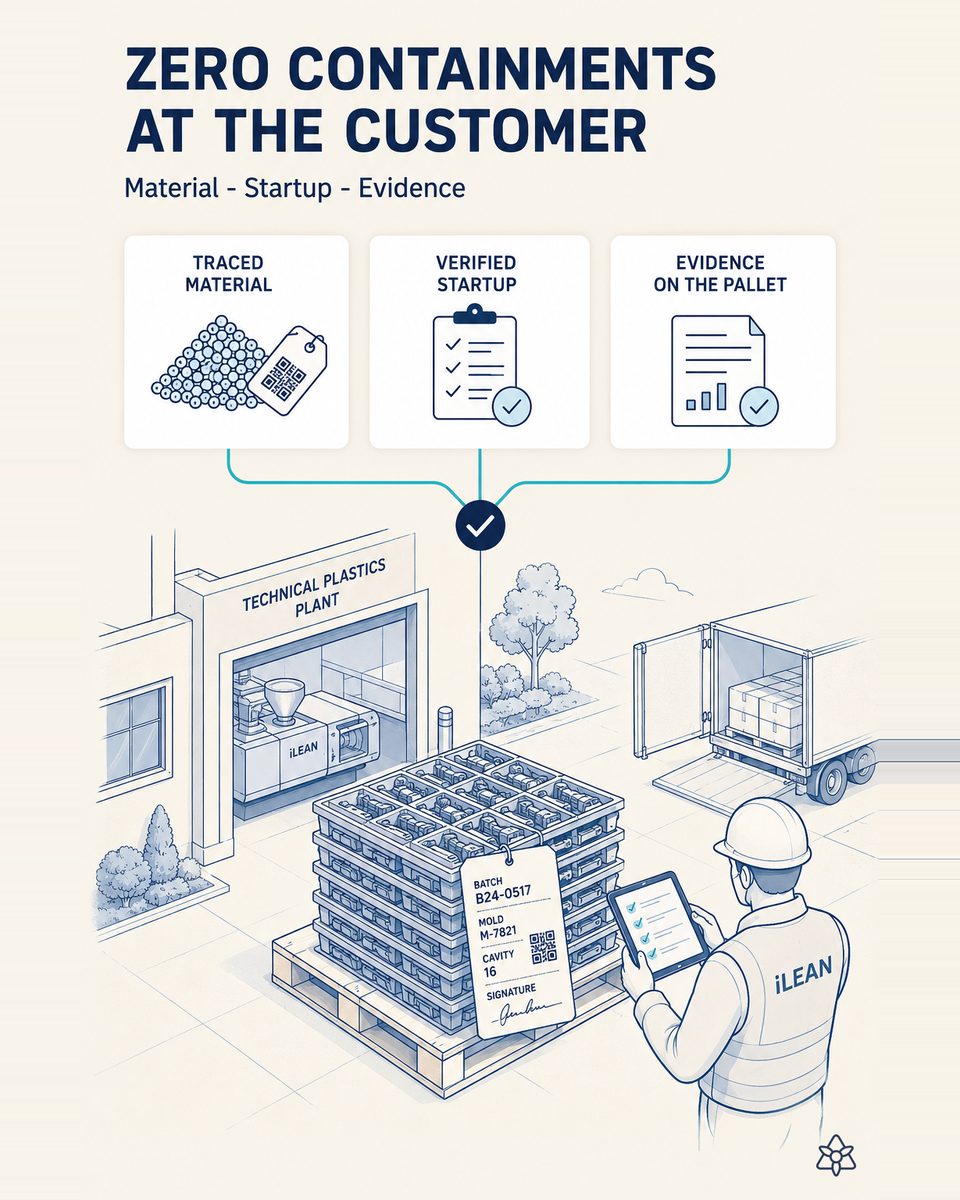
A containment does not put the batch under review. It puts the relationship under review.
A containment does not put the batch under review, it puts the commercial relationship under review. And because traceability does not allow bounding, far more product gets contained than is really affected, with its direct cost in travel and inspection and its larger indirect cost in trust.
- The part is worth cents; the hour of stopped line is worth thousands.
- The containment means inspecting product at the customer's premises, for days.
- Because traceability does not allow bounding, far more product gets contained than is really affected.
- Direct cost in travel and inspection, and a larger indirect one in trust.
Four coordinated rings, from the resin sack to the pallet.
Four coordinated rings, each resting on the pieces before it.
The first avoided containment usually pays for the entire system. And the multi-year value of the customer relationship is of another order of magnitude than the incident.
- Traced material: the resin batch enters traced from receiving by photo, and the order defines mold, material, color and active cavities.
- Verified startup: the cameras confirm the right mold and a purged screw, the technician signs the first article on that evidence and JIDOKA AI blocks startup if something does not add up.
- Production inspected at 100%: the Edge camera reviews every part and ties each detection to its cavity; on a drift, the line stops and alerts before filling a whole pallet.
- Evidence that travels with the product: every pallet ships with its dossier — batch, mold, cavity, parameters, signatures and photos — generated by Agents. In parallel, SMED AI speeds up the mold change so the verification is not paid for in productivity: the goal is a changeover that is faster *and* verified, not one that is safer but slower.
Reacting to the claim vs. four rings
| Aspect | Today | With the four rings |
|---|---|---|
| Where it is detected | At the customer | Inside the plant |
| Scope of a claim | Over-contained | By batch and cavity |
| Resin batch | Keyed in fast at receiving | Traced by photo |
| Startup | Signed blind | Signed on evidence |
| Inspection | 1-2% sampling | 100% with cavity |
| Response to the customer | Days of negotiation | Evidence the same day |
From resolving claims by inspecting en masse and negotiating, to detecting inside the plant, bounding the scope by batch and cavity and delivering evidence the same day.
Impact estimate — to validate against your numbers.
The block below is an estimate to be validated against your plant's actual data. We put it forward so the committee has an order of magnitude; we refine it during the assessment.
- Custom plants supplying parts that go directly onto a customer's assembly line.
- Indicative payback between 6 and 12 months, though that is not the strongest way to frame it.
- The first avoided containment usually pays for the entire system.
- Validate it against the containment history of the last three years and its real cost per incident.
Estimated payback 6 to 12 months, though the honest way to frame it is different: the first avoided containment usually pays for the entire system, and the multi-year value of the customer relationship is of another order of magnitude than the incident. Estimate to validate against the containment history and its real cost.
And the fair question from the production manager
“Do we have to deploy all four rings to get value?” — no, and it would be a bad idea. Each ring works on its own and pays for itself on its own; what the four together give is the ability to bound. The usual order is receiving and startup first, because they are the cheapest and they feed everything else, and inline vision on the reference that generates the most claims.
[1] OpenAI paper "Why Language Models Hallucinate", 2025 — on the reliability of AI in anchored tasks.
What people ask about the four rings
Where do you start?
With traced material and verified startup, usually. They are the cheapest pieces, they are the first link — if the resin batch enters badly linked, nothing downstream works — and they already cut the two most expensive mistakes: the contaminated batch and the batch made with the wrong mold. Inline vision comes next, on whichever reference generates the most claims.
What if the containment is not our fault?
That is precisely one of the things this changes. Today a charge gets argued without data and often accepted because the opposite cannot be proven. With every pallet shipping with its dossier — batch, mold, cavity, parameters, signatures and photos — the answer takes hours and comes with evidence, whichever way it points.
Doesn't all this verification slow production down?
It is the honest objection, and it is why SMED AI travels with this case. The goal is a changeover that is faster and verified. The checks add seconds at points that were already being looked at; what they remove is entire batches that have to be reprocessed.
How long does the full deployment take?
Ring by ring, over months rather than weeks, and that is deliberate. Each ring goes live, gets validated on a line and gets replicated. A plant that tries to deploy the four at once ends up with four half-finished projects, which is the usual failure mode of this kind of program.
How do we quantify what a containment costs us?
Take the last three years and add up, per incident: travel and inspection hours, product scrapped or reprocessed, the charge accepted, and the commercial time it consumed. That number is almost always much larger than people expect, because the indirect part never gets counted — and it is the number this case has to be measured against.
More cases from this series
- Evidence is not rebuilt, because it is not lostPhotos, parameters, batch, cavity and signatures from every changeover, organized by standard: the…
- The customer's alert arrives before the mold changeEmails and messages with delivery changes or quality alerts, read instantly and cross-referenced with…
- The machine stays exactly as it is, but now it speaksAn external camera reads the extruder panel with no network: process curve digitized meter by meter…
- Nothing crosses into the system without a human signing itNothing enters the ERP without a human signing it: the startup summary appears on the tablet and the…
- One production count, and let it be the real oneCycle, downtime and real count go up to the ERP and the order comes down to the machine: one production…
- Lab data enters the ERP on its ownThe test and dimensional sheet enters the ERP after human validation: zero transcription and up to 80%…
Put four rings between your plant and your customer's line.
We work on your plant's real data, not ours. Assessment with no commitment.
Request estimated ROI within 48h ‹ See all cases of technical plastics See plastics