Nothing crosses into the system without a human signing it
It is what separates an IRIS system from an autonomous agent that enters data on its own: no capture reaches the master record without passing through a person. In a technical plastics plant that takes shape at the first article approval after the mold change, where a formal human decision already exists. We are not adding a step: we are giving it evidence.
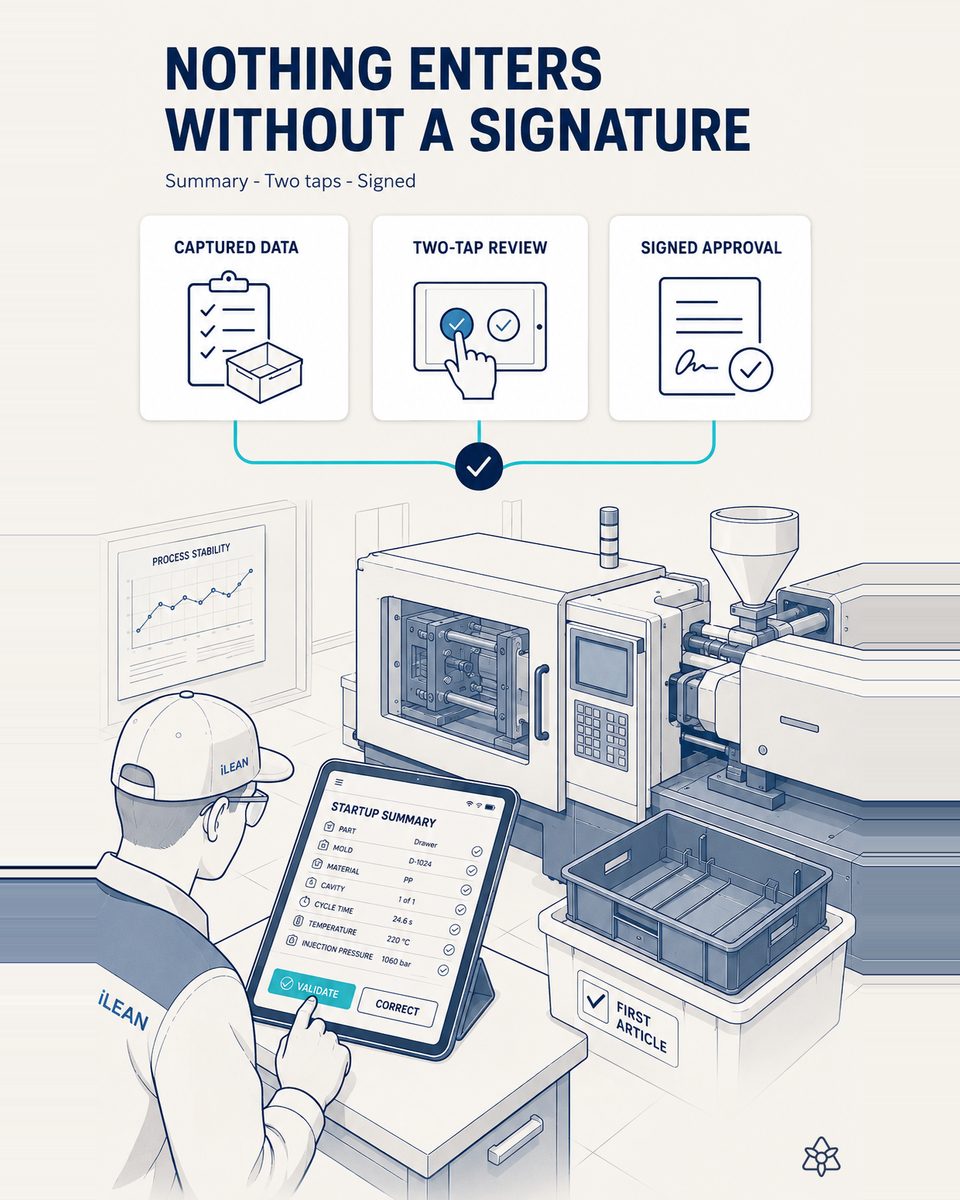
Two opposite brakes that leave the data uncaptured.
The biggest cultural brake on digitizing the plant is the fear — a legitimate one — of polluting the ERP master with unvalidated data. The other brake is the opposite: the operator does not want to type, their job is to get the part right. Between the two, a lot of data never gets captured at all.
- The fear — a legitimate one — of polluting the ERP master with unvalidated data is the biggest cultural brake on digitizing the plant.
- The opposite brake: the operator does not want to type. Their job is to get the part right, not to enter data.
- Between the two, a lot of data never gets captured, and the plant stays on paper the year its customer starts asking for traceability.
Connect in early human verification mode — we do not add a step, we give evidence to the one that already exists.
Connect in early human verification mode.
In a technical plastics plant there is already a formal human decision after every mold change: the first article approval. That is where it fits, without inventing a new procedure.
- The summary of everything captured at startup appears on the tablet at the machine: mold fitted, material and color, resin batch, active cavities and parameters read from the panel.
- Next to the part that has just come out, which is what the technician is looking at anyway at that moment.
- Two taps: confirm, or correct whatever does not add up.
- The interface is designed to validate in two seconds, not to enter data.
- Only then is the startup signed and the data crosses into the central system.
Autonomous agent vs. early human verification
| Aspect | AI writing to the master on its own | With early human verification |
|---|---|---|
| Who is accountable | Nobody clearly | Whoever signed the first article |
| Committee approval | Not obtained | Data governance is settled |
| Load on the operator | None, but no control either | Two taps on what they already look at |
| Step added to the process | None, but no guarantee | None: the approval already existed |
| Unvalidated data in the ERP | Possible | Impossible by design |
| Audit evidence | Technical log | Signed, structured approval |
From unvalidated data polluting the ERP — or data not captured out of distrust — to captured, validated and signed data with latency of seconds and a clean master.
Why it is an enabler and does not sell on its own
The block below is an estimate to be validated against your plant's actual data. We put it forward so the committee has an order of magnitude; we refine it during the assessment.
- It has no isolatable return of its own and we are not going to invent one.
- Without it, the rest of the matrix does not get signed off in committee: it is the requirement, not an extra.
- And it has a side effect that is worth money: it turns every first article approval into structured evidence reusable in an audit, with no additional work.
- It leans on a decision that is already taken today, so it adds no step to the process.
An enabling piece, with no return of its own. Without it, the rest of the matrix does not get signed off in committee. It also turns every first article approval into structured evidence reusable in an audit, with no additional work. Estimate to validate.
And the fair question from the production manager
“Isn't this putting manual work back in?” — validating is not typing. The screen shows a summary meant to be read in two seconds, next to the part the technician is already looking at. And we did not invent the first article approval: it already happens after every mold change. The only change is that it now leaves structured evidence instead of a signature on paper.
[1] OpenAI paper "Why Language Models Hallucinate", 2025 — on the reliability of AI in anchored tasks.
What people ask about data governance on the floor
Why not let the AI write straight into the ERP?
Because the question of who answers when the data is wrong has no good answer if nobody has seen it. The master feeds production, quality, warehouse and costing: bad data does not sit still. Verification costs two seconds per startup and turns a diffuse risk into a signature with a name and a timestamp.
Doesn't it add a step to the mold change?
No, and that is the point. The first article approval already exists in any technical plastics plant: after fitting the mold somebody looks at the part and decides whether to release production. What we do is put the evidence in front of that decision, not create a new procedure.
Where does the tablet go?
At the machine, where the person approving the first article is. In an office the validation would pile up and stop being early, which is exactly what gives it its value.
What if nobody validates?
The data does not enter the central system: it stays in the queue, visible, and is not accepted by administrative silence. That is deliberate, because a system that validates by timeout ends up being a system with no validation.
Does it work as evidence for a customer audit?
Yes, and it is better evidence than the paper signature. Every approval keeps who signed, at what time, with which mold, which resin batch and which parameters, plus the photo of the part. That is exactly the material a customer audit asks for and that today has to be rebuilt.
More cases from this series
- Evidence is not rebuilt, because it is not lostPhotos, parameters, batch, cavity and signatures from every changeover, organized by standard: the…
- Four rings so your part never stops the customer's lineFour verification rings from the resin sack to the pallet so your part never stops the customer's line…
- The customer's alert arrives before the mold changeEmails and messages with delivery changes or quality alerts, read instantly and cross-referenced with…
- The machine stays exactly as it is, but now it speaksAn external camera reads the extruder panel with no network: process curve digitized meter by meter…
- One production count, and let it be the real oneCycle, downtime and real count go up to the ERP and the order comes down to the machine: one production…
- Lab data enters the ERP on its ownThe test and dimensional sheet enters the ERP after human validation: zero transcription and up to 80%…
Tell us how you govern the data entering your ERP today and we will show you how the first article signature fits.
We work on your plant's real data, not ours. Assessment with no commitment.
Request estimated ROI within 48h ‹ See all cases of technical plastics See plastics