One production count, and let it be the real one
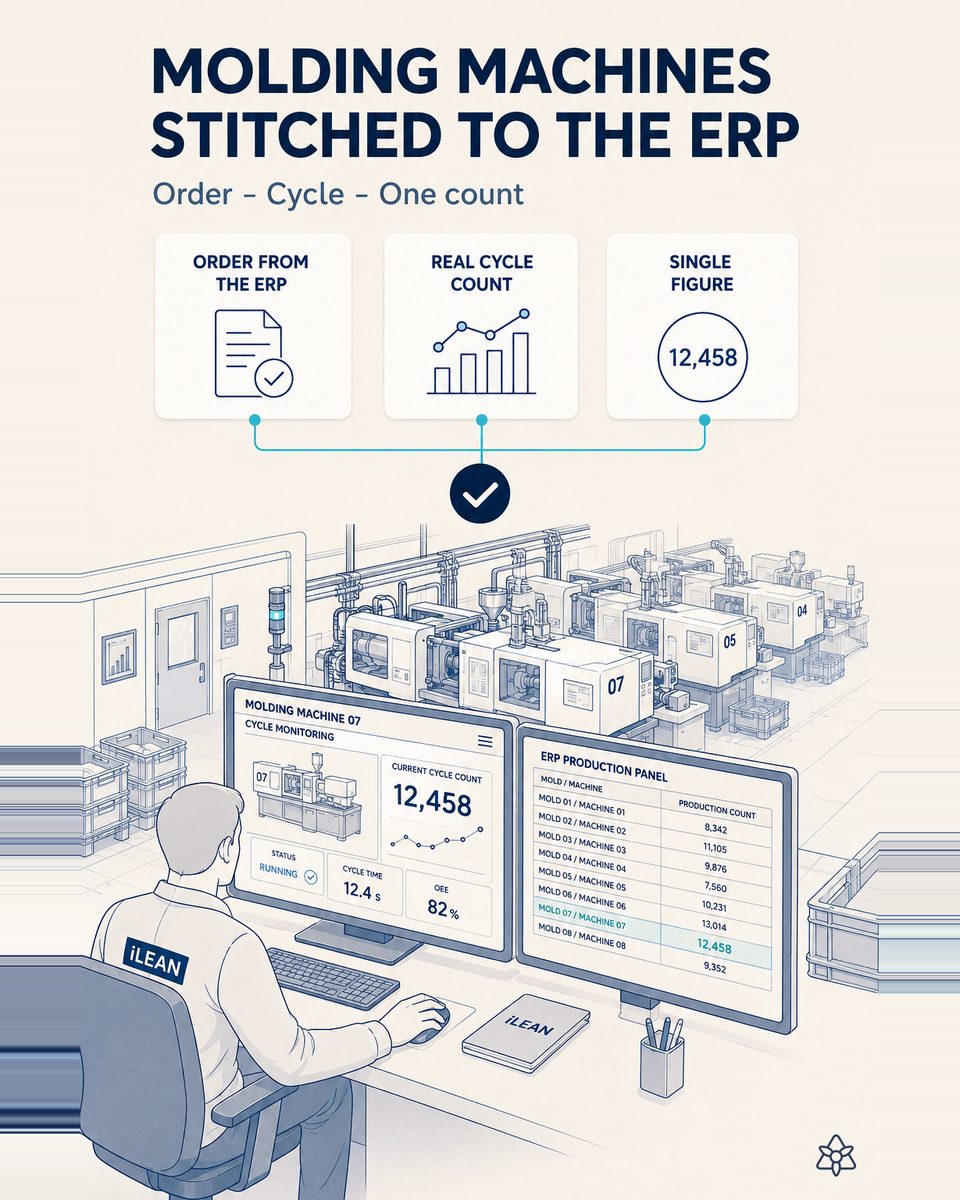
Almost every injection plant has a cycle monitoring system five to fifteen years old, with a data interface available, living isolated and showing cycle and downtime on its own screen. Connect stitches it to the ERP in both directions, without replacing anything and without touching the machine control.
Two truths about the same production, and neither is usable for deciding.
The real count is kept by the machine and the official one is keyed in by a person on the report. The two numbers never match and the discrepancy gets settled by arguing in the morning meeting. With that, the real cost per part is an estimate and there is no reliable OEE, because downtime reasons are anecdotal. The reason it stays that way is never technical: it is that integrating it properly takes time and there is always something more urgent.
- The real count is kept by the machine and the official one is keyed in by a person on the report. The two never match.
- The discrepancy is settled by arguing in the morning meeting, not by checking a figure.
- The real cost per part is an estimate and there is no reliable OEE, because downtime reasons are anecdotal.
- The reason it stays that way is never technical: integrating it properly takes time and there is always something more urgent.
Connect stitches two modern systems through the API, in both directions.
Connect stitches two modern systems through the API.
The production order comes down from the ERP to the monitoring system, and the real count, cycle, downtime reasons and active cavities go up to the ERP. Without replacing anything and without touching the machine control.
- The ERP production order comes down to the monitoring system: the machine knows what it is running and for which order.
- The real count, cycle time, downtime reasons and active cavities go up to the ERP.
- It is bidirectional, which is what turns two islands into a system.
- Without replacing anything: the monitoring system you already have stays where it is.
- Where a machine exposes no interface, the camera on the panel covers the same data with no integration: the two pieces complement each other depending on the age of each machine.
Two figures that never match vs. one real count
| Aspect | Isolated monitoring | With iLEAN Connect |
|---|---|---|
| Production count | Two, and they never match | One, the machine's |
| Discrepancy | Argued in the meeting | Does not exist |
| Cost per part | An estimate | On the real count |
| Downtime reasons | Anecdotal | Recorded by machine and mold |
| OEE | Not reliable | Per line, with the machine's own data |
| Production order | Keyed into the monitoring system | Comes down from the ERP on its own |
From two truths about the same production to a single real count per machine and per mold; from anecdotal downtime reasons to OEE per line with data from the machine itself.
Impact estimate — to validate against your numbers.
The block below is an estimate to be validated against your plant's actual data. We put it forward so the committee has an order of magnitude; we refine it during the assessment.
- Cycle monitoring system five to fifteen years old, with a data interface available, living isolated.
- Indicative payback between 3 and 6 months: among the fastest in the matrix.
- Above all through recovered clerical time and capacity decisions taken on real data.
- It is also what makes any later conversation about OEE or cost per part credible.
Estimated payback 3 to 6 months, among the fastest in the matrix, above all through recovered clerical time and capacity decisions taken on real data. Estimate to validate.
And the fair question from the production manager
“What if the integration destabilizes the monitoring system?” — neither the machine control nor the monitoring logic is touched: its data interface is used, which exists precisely for this. And it is tested first on one machine, during an already planned stop. If something does not fit, it shows on that machine and not across the plant.
[1] OpenAI paper "Why Language Models Hallucinate", 2025 — on the reliability of AI in anchored tasks.
What people ask about stitching monitoring to the ERP
Does the monitoring system have to be replaced?
No. These systems are usually five to fifteen years old and almost always expose a data interface: what is missing is not technical capability, it is the integration project that never reaches the top of the priority list. Connect uses that interface and the system stays where it is.
And machines with no interface?
They are covered by the camera on the panel, which is another case in this same matrix. The two pieces complement each other depending on the age of the equipment, and a normal plant needs both because machines from very different eras live side by side. What matters is that the data ends up in the same place, whether it comes through an API or a camera.
Why bidirectional and not just pushing data up?
Because if data only goes up, somebody still has to key into the monitoring system which order is running. By bringing the order down from the ERP, the machine knows which order it produces for and the count is allocated by itself. That is where the discrepancy disappears, not only in the upload.
How long until OEE is reliable?
The real count is immediate once the integration is live. OEE takes a little longer, because downtime reasons need to be collected with some judgment for a few weeks before the breakdown is meaningful. But from day one the argument about how many parts were made is over.
Can we start with a few machines?
That is the recommended way. You stitch one machine or one cell, check that the count adds up and that the order comes down properly, and replicate from there. The integration is the same for all machines sharing the monitoring system.
More cases from this series
- Evidence is not rebuilt, because it is not lostPhotos, parameters, batch, cavity and signatures from every changeover, organized by standard: the…
- Four rings so your part never stops the customer's lineFour verification rings from the resin sack to the pallet so your part never stops the customer's line…
- The customer's alert arrives before the mold changeEmails and messages with delivery changes or quality alerts, read instantly and cross-referenced with…
- The machine stays exactly as it is, but now it speaksAn external camera reads the extruder panel with no network: process curve digitized meter by meter…
- Nothing crosses into the system without a human signing itNothing enters the ERP without a human signing it: the startup summary appears on the tablet and the…
- Lab data enters the ERP on its ownThe test and dimensional sheet enters the ERP after human validation: zero transcription and up to 80%…
Tell us which monitoring system you have and we will say within 48h what it would take to stitch it to the ERP.
We work on your plant's real data, not ours. Assessment with no commitment.
Request estimated ROI within 48h ‹ See all cases of technical plastics See plastics