Evidence is not rebuilt, because it is not lost
A plant serving white goods, automotive and medical devices lives under three documentary regimes at once, plus the customs one. Every audit starts with two weeks of somebody rebuilding evidence. With Edge capturing at the moment and Agents organizing by standard, the dossier exists before anyone asks for it.
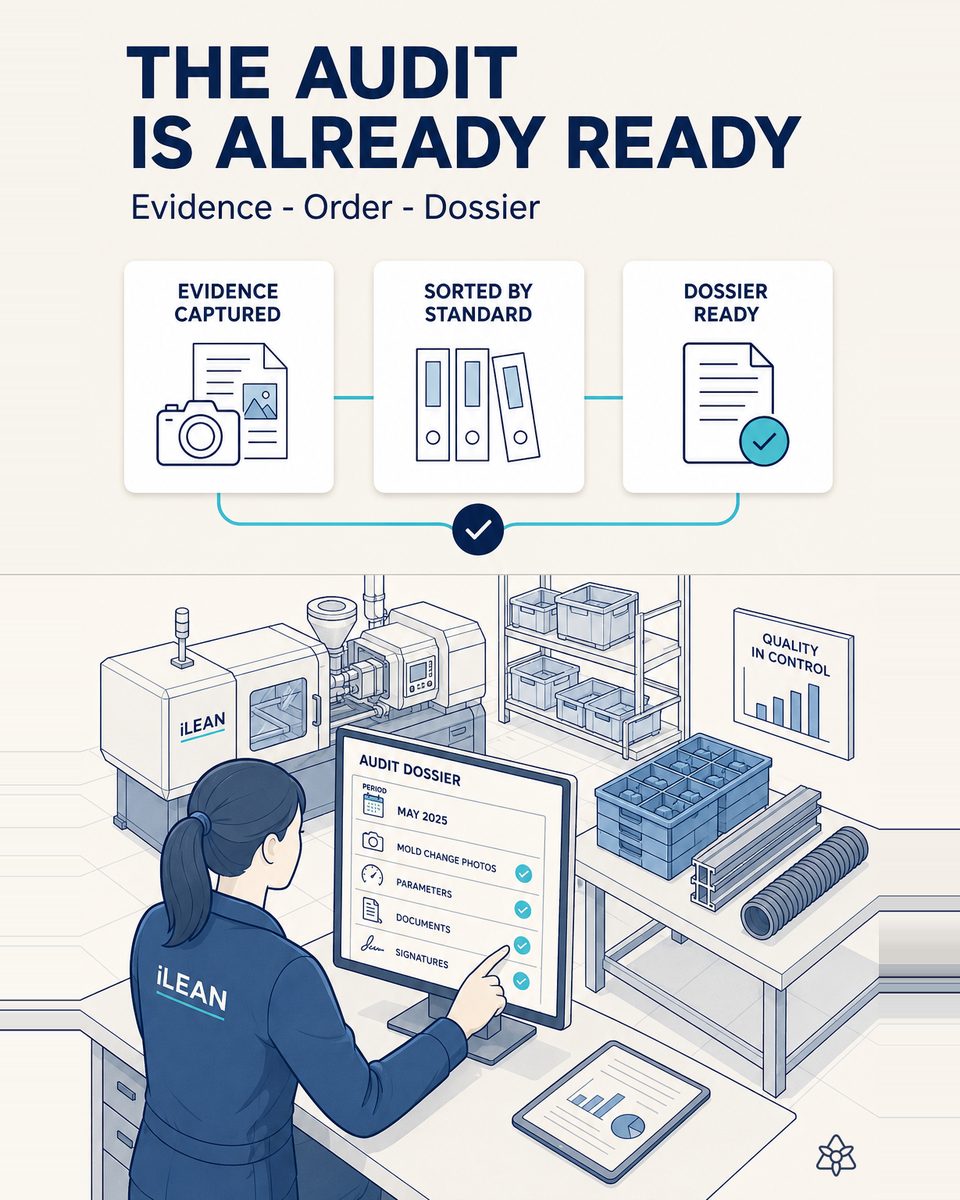
The evidence exists. Scattered, which is the same as not existing.
Which resin batch, which mold, which cavity, who signed the startup, what was done when that part came out of tolerance. The evidence exists, but scattered across paper, spreadsheets and people's memory. Rebuilding it costs weeks of qualified staff and still leaves holes the auditor writes up as a nonconformity. The customer audit, the most frequent one, is also the most delicate: each documentary hole is not just a nonconformity, it is a commercial conversation that goes straight to the top.
- Which resin batch, which mold, which cavity, who signed the startup — all of it is somewhere, across paper, spreadsheets and people's memory.
- Rebuilding it costs weeks of qualified staff and still leaves holes.
- The auditor writes those holes up as a nonconformity.
- The customer audit is the most delicate: each hole is a commercial conversation that goes straight to the top.
Edge captures at the moment, Agents organizes by standard.
Edge captures the evidence at the moment; Agents organizes it.
Those certifications are what grant access to each market. That is why the argument is not the two weeks recovered per audit: it is that losing one is equivalent to losing the market.
- Captured at the moment of the mold change and the first-article approval: before and after photos of each critical point, parameters, material batch, cavity, signatures.
- Organized by the applicable standard, by period, reference or batch.
- Downloadable dossier, generated on its own.
- When the audit arrives, you log in and download it — there is nothing to rebuild.
Rebuilt evidence vs. evidence already prepared
| Aspect | Today | With iLEAN Agents |
|---|---|---|
| Preparation per audit | Two weeks of qualified staff | Zero |
| Where the evidence lives | Paper, spreadsheets, memory | Organized by standard |
| Documentary holes | Written up as nonconformity | Eliminated |
| Three standards at once | Three parallel rebuilds | One dossier per standard |
| Bounding a claim | Contain extra just in case | By batch and cavity in minutes |
| Customer audit | A commercial conversation | A download |
From two weeks of qualified staff per audit to zero; from the risk of a nonconformity for a documentary hole to its elimination; from containing extra product “just in case” to bounding the scope by batch and cavity in minutes.
Impact estimate — to validate against your numbers.
The block below is an estimate to be validated against your plant's actual data. We put it forward so the committee has an order of magnitude; we refine it during the assessment.
- Plants under several documentary regimes at once — white goods, automotive, medical devices — plus the customs one.
- Indicative payback between 6 and 12 months depending on audit frequency.
- The main argument is not the recovered time: those certifications enable each market.
- It also bounds the scope of a claim by batch and cavity, which is where the over-containment cost comes from.
Estimated payback 6 to 12 months depending on audit frequency. The underlying argument is not the recovered time: those certifications are what grant access to each market, and losing one is equivalent to losing the market. Estimate to validate.
And the fair question from the production manager
“Isn't this just a document manager?” — a document manager stores what somebody uploads. Here nobody uploads anything: the evidence gets generated where the work happens, by the cameras at the mold change and the signature on the tablet at first-article approval. Agents' job is to sort it by the applicable standard, which is the part that today eats the two weeks.
[1] OpenAI paper "Why Language Models Hallucinate", 2025 — on the reliability of AI in anchored tasks.
What people ask about the audit evidence pack
Does it work for several standards at once?
That is exactly the case it is built for. A plant serving white goods, automotive and medical devices lives under three documentary regimes, and today each audit is a separate rebuild of the same underlying facts. The evidence is captured once and organized as many times as needed, one dossier per standard.
Do we need to have Edge deployed first?
For the richest evidence — mold change photos, verified startup — yes, because that is what generates it. But the case works partially from earlier: signatures on first-article approval, resin batches captured by photo at receiving and lab results integrated with the ERP already produce a dossier much more complete than today's. It grows as the other pieces get deployed.
How far back does it go?
As far back as capture has been running. It does not reconstruct history that was never recorded, and it is worth being clear about that: the first audit after deployment still covers a period partly documented the old way. From the second one onwards, the whole period is already prepared.
Can the customer be given direct access?
That is a decision to take deliberately rather than by default, and it depends on the customer. What is normally done is generating the dossier for the requested period and sending it, which already turns days into minutes. Standing access is possible, but it is a commercial decision, not a technical one.
Does it help with a claim, not just an audit?
It is the same material used from the other side. When a customer complains, the question is always which batches are affected, and the answer today is 'we cannot bound it' — so more product gets contained than necessary. With the evidence organized by batch and cavity, that answer takes minutes and the containment covers what is really affected.
More cases from this series
- Four rings so your part never stops the customer's lineFour verification rings from the resin sack to the pallet so your part never stops the customer's line…
- The customer's alert arrives before the mold changeEmails and messages with delivery changes or quality alerts, read instantly and cross-referenced with…
- The machine stays exactly as it is, but now it speaksAn external camera reads the extruder panel with no network: process curve digitized meter by meter…
- Nothing crosses into the system without a human signing itNothing enters the ERP without a human signing it: the startup summary appears on the tablet and the…
- One production count, and let it be the real oneCycle, downtime and real count go up to the ERP and the order comes down to the machine: one production…
- Lab data enters the ERP on its ownThe test and dimensional sheet enters the ERP after human validation: zero transcription and up to 80%…
Have the evidence pack ready before anybody asks for it.
We work on your plant's real data, not ours. Assessment with no commitment.
Request estimated ROI within 48h ‹ See all cases of technical plastics See plastics