Lab data enters the ERP on its own
An in-house lab generates every shift dimensional readings, part weight, life and performance tests and resin moisture. Those are the data describing whether the process is under control, and they live in spreadsheets the ERP cannot see. Connect reads the sheet when it is saved, structures it and, after validation, pushes it to the ERP.
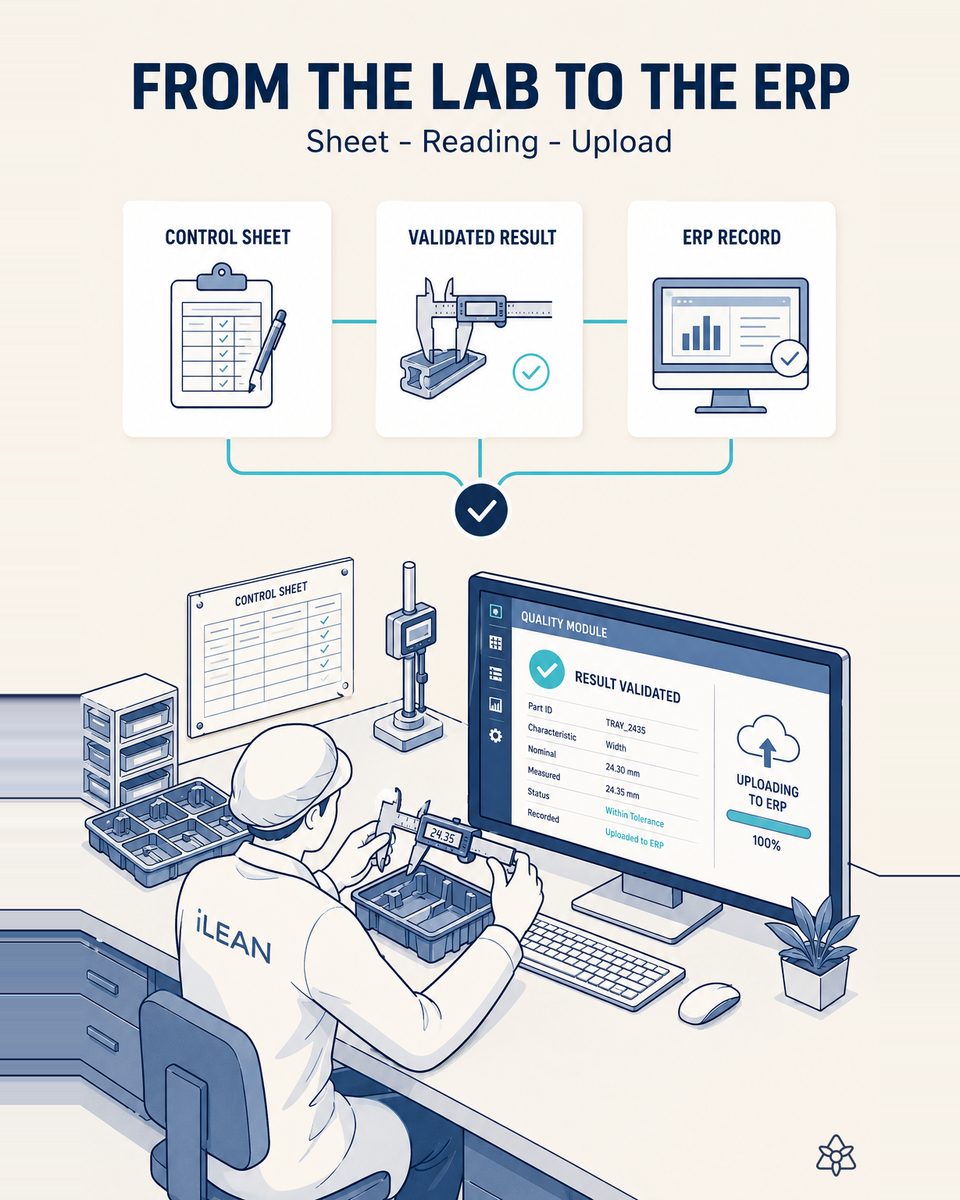
When the customer complains, the answer is pulled from the sheet, not from the ERP.
Two parallel worlds. The real spreadsheet, with live data per batch, and the official ERP, with data transcribed weeks later by somebody who spends half a day a month copying and pasting. There is one detail that sums it up: when the customer complains, the answer is pulled from the sheet, not from the ERP. That is the system that really rules, and it is the one integrated with nothing.
- The real spreadsheet carries dimensional readings, part weight, life and performance tests and resin moisture, per batch and per shift.
- The official ERP gets a version transcribed weeks later by somebody who spends half a day a month copying and pasting.
- One detail sums it up: when the customer complains, the answer comes from the sheet. That is the system that really rules, and it is integrated with nothing.
Connect in listen-inward mode — it watches the folder, not the person.
Connect in listen-inward mode.
The lab keeps working in its usual sheet. What disappears is the person who was transcribing, and with them the ERP licenses that existed only to capture results.
- It watches the shared folder — not the person — and reads the delta when the file is saved.
- Structures it with an anchored model against the known schema of the sheet and stores it in central memory.
- Validation by the quality lead before anything crosses into the ERP.
- Push through the API to the quality module, without migrating anything or changing the lab's tool.
- Automatic cross-reference of the result against resin batch and process parameters, which is what nobody does today.
Two parallel worlds vs. a single data point
| Aspect | With manual transcription | With iLEAN Connect |
|---|---|---|
| Lag test → ERP | Weeks | Second zero |
| Effort | Half a day a month of qualified staff | None |
| Where the customer answer comes from | The spreadsheet | The system, with the sheet behind it |
| Material ↔ process ↔ result | Never cross-referenced | Automatic |
| Quality module licenses | One per person capturing | One, the person who validates |
| The lab's work | Their sheet, plus typing into the ERP | Their sheet, nothing else |
From weeks of lag between the test and the ERP to zero latency; from half a day a month transcribing to zero; from uncrossed lab data to automatic material ↔ process ↔ result cross-referencing.
Impact estimate — to validate against your ERP invoice.
The block below is an estimate to be validated against your plant's actual data. We put it forward so the committee has an order of magnitude; we refine it during the assessment.
- In-house lab generating every shift dimensional readings, part weight, life tests and resin moisture.
- CFO angle: the ERP charges per named user. If five people in lab and metrology log in only to capture results, that is five licenses.
- With Connect only the person who validates logs in. Typical reduction of 50 to 80% in quality and lab module licenses, recurring every year.
- Indicative payback between 4 and 9 months on top of that saving.
CFO angle — the ERP charges per named user. If five people in lab and metrology log in only to capture results, that is five licenses; with Connect only the person who validates logs in. Typical reduction of 50 to 80% in quality and lab module licenses, recurring every year. Estimated payback 4 to 9 months on top of that saving. Estimate to validate against the real ERP invoice.
And the fair question from the production manager
“What if it parses a dimension wrongly and uploads a bad result?” — reading a cell against a known schema is an anchored task, where the best models drop below 1.5% error [1]. And the order matters: anything out of tolerance is flagged and put in front of the lead before anything is uploaded.
[1] OpenAI paper "Why Language Models Hallucinate", 2025 — on the reliability of AI in anchored tasks.
What people ask about moving the lab to the ERP
Does the spreadsheet have to change?
No, and it is a design condition. That sheet has worked for years and is maintained by whoever knows why each column is where it is. Asking for it to be migrated to a new form is the fastest way to make sure the project never starts. Connect adapts to the sheet's schema; the sheet does not adapt to Connect.
Does this monitor the lab staff?
No. The system watches the file in the shared folder and reads the delta when it is saved, exactly as a backup would. It does not monitor people or record individual activity.
How exactly are licenses reduced?
The quality module is billed per named user. Today everybody who needs to capture results logs into the ERP, even though their real work is in the sheet. With Connect only the person validating the push logs in; the rest stay in their sheet without needing access. And that saving repeats every year without renegotiating the framework contract.
What does cross-referencing the test with the resin batch add?
It is what turns a quality figure into an actionable one. A dimension drifting or a part weight moving stops being a mystery when you can look at it against the material batch and the process parameters of that same batch. Today they are three data points living in three places that nobody cross-references.
And the answer to the customer when they complain?
That is the most visible change. Today it comes from the spreadsheet because the ERP runs weeks behind, which means the official system is useless for what actually matters. When the push is immediate and validated, the answer comes from the system, with the test, the batch and the parameters already cross-referenced.
More cases from this series
- Evidence is not rebuilt, because it is not lostPhotos, parameters, batch, cavity and signatures from every changeover, organized by standard: the…
- Four rings so your part never stops the customer's lineFour verification rings from the resin sack to the pallet so your part never stops the customer's line…
- The customer's alert arrives before the mold changeEmails and messages with delivery changes or quality alerts, read instantly and cross-referenced with…
- The machine stays exactly as it is, but now it speaksAn external camera reads the extruder panel with no network: process curve digitized meter by meter…
- Nothing crosses into the system without a human signing itNothing enters the ERP without a human signing it: the startup summary appears on the tablet and the…
- One production count, and let it be the real oneCycle, downtime and real count go up to the ERP and the order comes down to the machine: one production…
Work out how many ERP licenses exist only to capture lab results.
We work on your plant's real data, not ours. Assessment with no commitment.
Request estimated ROI within 48h ‹ See all cases of technical plastics See plastics