Edge ejects the defective closure before bagging
A high-cavity press produces dozens of pieces per shot with cycle times under 2 seconds. Manual sampling can only check a fraction. Lines without an automated camera leave control gaps right after a mold or color change — exactly when rejects tend to spike.
Sampling checks a fraction while the press makes dozens of closures per shot.
A high-cavity press produces dozens of pieces per shot with cycle times under 2 seconds. Manual sampling can only check a fraction. Lines without an automated camera leave control gaps right after a mold or color change — exactly when rejects tend to spike.
- A high-cavity closure press makes dozens of pieces per shot with cycles under 2 seconds. Hourly manual sampling can only look at a small fraction of that.
- Lines without an automated camera depend on 1-5% sampling, which statistically misses intermittent defects coming from a single cavity. A cavity that fails one shot in fifty can run for hours before a sample catches it.
- The control gap is widest right after a mold or color change, exactly when rejects tend to spike: residual color, flash on a worn parting line, a short shot from a cold hot-runner tip.
- A defective closure that reaches the bag reaches the bottler's capper. A damaged thread or a broken tamper band becomes a leak or a torque complaint at their filling line.
Edge — piece-by-piece verdict in milliseconds, at the line, nothing sent to the cloud.
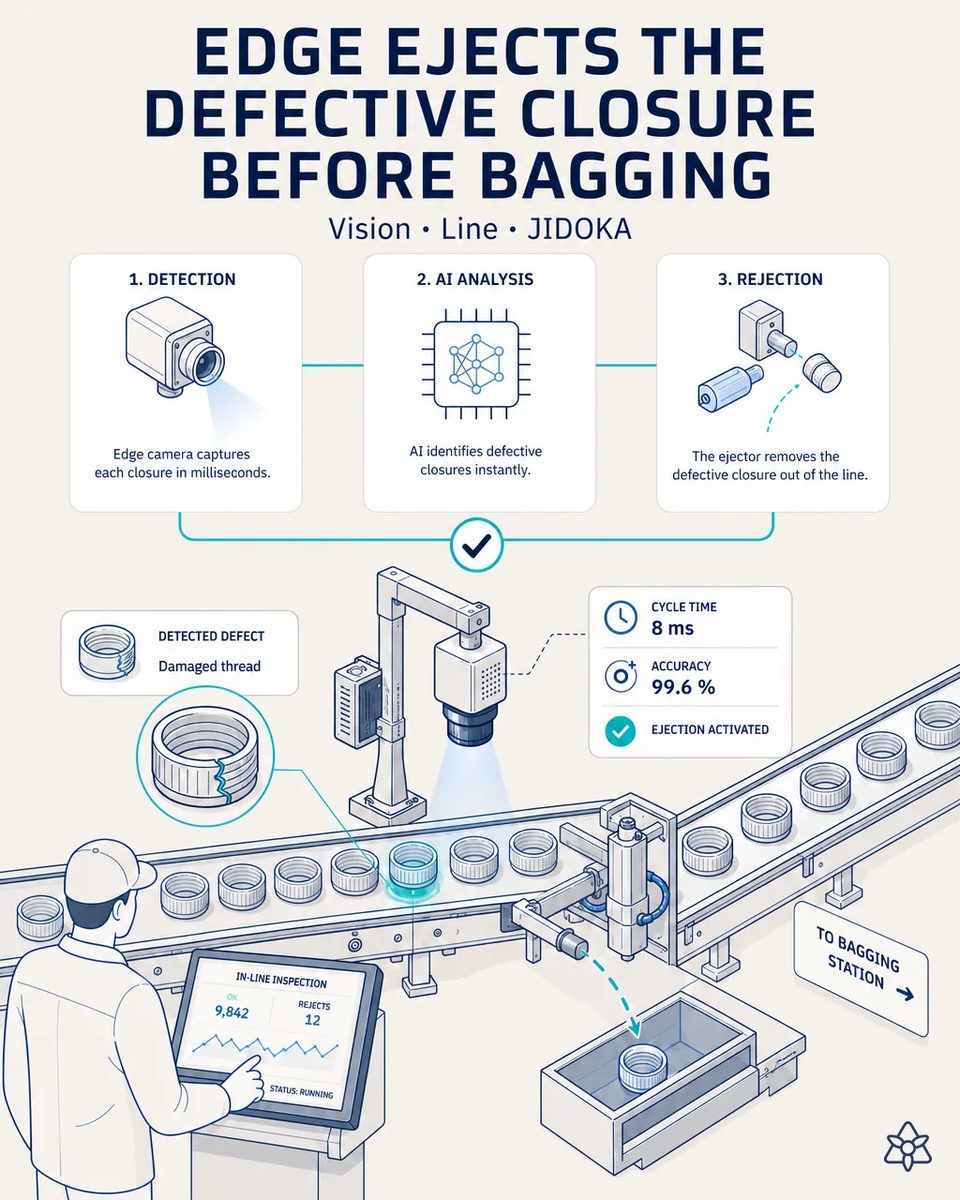
ILEAN Edge places a camera over the line with a CNN trained on good and bad examples of that specific closure — thread, short-shot, flash, stain. The defective piece is ejected in milliseconds, before reaching the outbound bag or octabin, with nothing sent to the cloud.
The network is trained on good and bad examples of that specific closure under that line's lighting, not on a generic catalog. It decides in milliseconds at the line, ejects the defective piece and keeps the reject record by type, so the next mold maintenance knows which cavity to look at. Sampling does not disappear: it stops being the only barrier between the press and the bottler. The lab keeps its tests; the line gets a guard that never blinks between samples. And the toolroom gets a defect map per cavity it never had before.
Manual sampling versus Edge on every closure
| Aspect | Manual sampling | With iLEAN Edge |
|---|---|---|
| Share of closures checked | 1-5% sample | 100% on that line |
| Damaged thread or broken tamper band | Found by the bottler | Ejected before bagging |
| Short shot and flash | Seen only if sampled | Classified by type |
| First shots after a color change | The weakest moment | Full control from the first shot |
| Decision time per closure | — | Milliseconds, at the line |
| Closure images leaving the plant | — | None |
1-5% manual sampling → 100% control of parts on that line.
Impact estimate — to be validated against your current reject ratio.
The block below is an estimate to be validated against your plant's actual data. We put it forward so the committee has an order of magnitude; we refine it during the assessment.
- Estimated payback 5-12 months, depending on your current reject ratio and claim history. The more claims a closure has caused, the faster the return.
- From 1-5% sampling to 100% control of the closures on that line. Every closure is seen, not a statistical handful.
- Defective pieces are ejected before the outbound bag or octabin, so they never reach a bottler's capper. A claim that never happens is the saving that weighs most.
- Rejects are recorded by defect type, which points maintenance at the cavity or hot-runner tip that causes them instead of a general mold overhaul.
Payback 5-12 months · from 1-5% sampling to 100% control. From 1-5% sampling to 100% control on that line. Estimated payback of 5 to 12 months depending on the current reject ratio. Estimate to validate.
And the fair question from the production manager
“What if it starts ejecting good closures?” — the false positive is the real risk of any vision system, which is why the network is trained on good and bad examples of your own closures under that line's lighting. Classifying a known part against known defect types is an anchored task, where the best models drop below 1.5% error [1]. Borderline cases are escalated for a person to decide, and each decision feeds back into training. The false positive rate is measured and shown, not assumed.
[1] OpenAI paper "Why Language Models Hallucinate", 2025 — on the reliability of AI in anchored tasks.
What people ask about ejecting defective bottle closures
Which closure defects can the Edge camera detect?
The ones it is trained on for that closure: damaged thread, short shot, flash, stains, color deviation and broken tamper-evident bridges. New defect types are added by training with examples. Each defect type is recorded separately, so the reject statistics mean something to the toolroom.
Can it keep up with a sub-2-second cycle and dozens of cavities?
Yes. Inference runs at the line in milliseconds per piece, which is what lets it inspect every closure the press produces. The ejector is timed to the conveyor, so the defective closure is removed and its neighbors are not.
Do closure images go to the cloud?
No. The model runs on Edge hardware at the line. Images do not leave the plant and the line keeps working without connectivity. That also keeps the decision time stable, independent of the network.
How many examples are needed to train on our closure?
Enough good pieces and enough of each defect to cover their variation; the reject bins of a few shifts usually provide them. The work is in collecting them well, not in the volume. Training data is collected during normal production, without stopping the press.
Can it tell which cavity produced the defective closure?
When the cavity number is molded in and visible, it is read with the verdict. That turns a reject count into a maintenance action on a specific cavity. When it is not visible, the reject pattern over time still points to the cavity that misbehaves.
More cases from this series
- Connect listens to the lab's Excel and pushes it to the ERPILEAN absorbs the lab's quality-control Excel and pushes it to the ERP after validation. Saves ERP…
- External camera on a legacy press panelAn external camera reads a veteran press's panel without touching it; its parameters are digitized batch…
- Human-verification tablet next to the pressEvery iLEAN capture passes through a tablet by the press; the technician confirms with two taps before…
- Photo to the order at mold startupThe technician photographs the production order and startup sheet; the batch exists in the system at…
- Photo to the delivery note and the resin octabin labelPhoto the delivery note and resin octabin label; iLEAN extracts the batch and pushes it to the ERP after…
- ILEAN silently copied on the resin supplier's emailILEAN silently reads the resin supplier's alert and suggests replanning before the press goes idle.
Send us the defects your sampling missed in the last bottler complaint.
We work on your plant's real data, not ours. Assessment with no commitment.
Request estimated ROI within 48h ‹ See all cases of plastic closures See packaging