Photo to the delivery note and the resin octabin label
A truck arrives with resin octabins. The receiving supervisor has to type batch after batch into the ERP while the truck racks up billable demurrage. If he rushes, batches get entered wrong and show up weeks later when a customer complains and nobody can trace which octabin produced which closure.
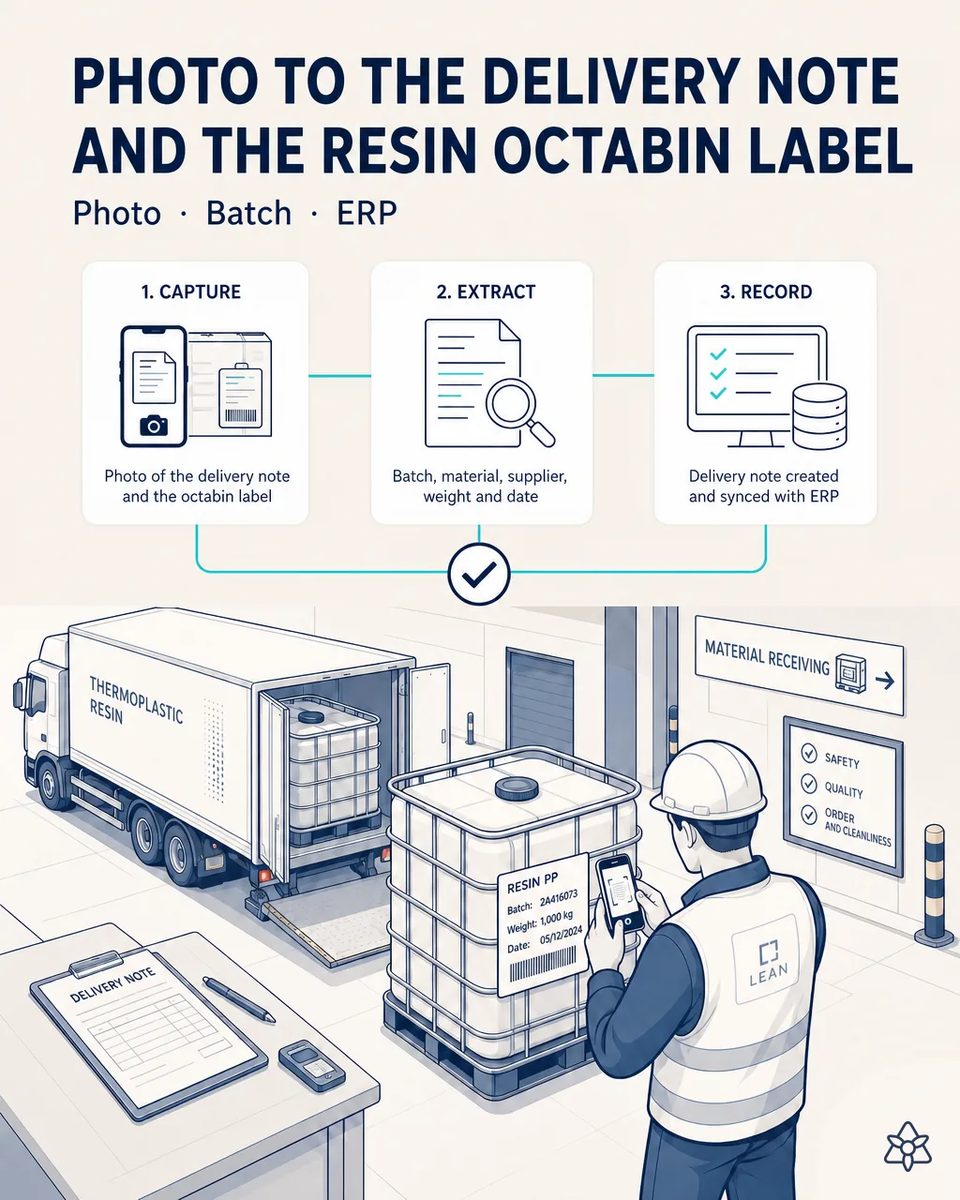
Every octabin batch is typed by hand while the truck waits.
A truck arrives with resin octabins. The receiving supervisor has to type batch after batch into the ERP while the truck racks up billable demurrage. If he rushes, batches get entered wrong and show up weeks later when a customer complains and nobody can trace which octabin produced which closure.
- A truck arrives with resin octabins. The receiving supervisor has to type batch after batch into the ERP: supplier, grade, resin batch, weight per octabin. With twenty or more octabins per truck, the typing alone takes most of the unload.
- Meanwhile the truck sits at the dock and demurrage starts to bill. At around 45 minutes per unload, receiving becomes a bottleneck on busy days.
- If he rushes, a batch number gets entered wrong. Nobody notices until weeks later, when a bottler complains and no one can trace which octabin produced which closures.
- The receiving module needs 2-3 active ERP licenses just for this data entry, paid every month whether trucks come or not. Those licenses exist for typing, not for deciding.
Connect in photo-to-analog mode — delivery note and octabin label, one tap.
With Connect's photo-to-analog mode, he photographs the delivery note and the octabin label. Vision AI extracts batch, quantity, supplier and resin reference. The supervisor validates with one tap on the tablet and Connect pushes everything to the ERP via API — truck unloading no longer blocks him.
The supervisor stops being a typist. He photographs the delivery note and the octabin label, checks a summary on the tablet and confirms: resin batch, quantity, supplier and reference enter the ERP through the API. The truck leaves, and the batch is traceable down to the closure. Receiving stops being the weakest link of the closure plant's traceability. And the supervisor goes back to checking material, not typing it. Checking the octabins for damage or moisture is the part of receiving that actually needs his eyes.
Resin receiving today versus receiving by photo
| Aspect | Today | With iLEAN Connect |
|---|---|---|
| Resin truck at the dock | About 45 min | About 5 min |
| Resin batch entry | Typed octabin by octabin | Extracted from the label |
| Batch typo at receiving | Found when a bottler complains | Caught at the one-tap check |
| Octabin-to-closure traceability | Broken by entry errors | Batch linked from receiving |
| ERP receiving licenses for octabin entry | 2-3 active users | −50 to −70% typical |
| Resin supplier documents | — | Unchanged, any format |
Truck idle 45 min → 5 min; -50/-70% receiving-module licenses.
Impact estimate — to be validated with your resin deliveries per week.
The block below is an estimate to be validated against your plant's actual data. We put it forward so the committee has an order of magnitude; we refine it during the assessment.
- Estimated payback 3-8 months, combining licenses and dock time. Both savings start with the first truck.
- A typical 50-70% reduction in receiving-module licenses: today 2-3 licenses are active for entry; with Connect only the supervisor validates. The rest of the team keeps read access where it needs it.
- Truck time at the dock drops from 45 minutes to about 5, which cuts billable demurrage and frees the dock for the next delivery. On days with several trucks, that is the difference between a queue and a flow.
- Correct resin batches from the first minute protect the trace from octabin to closure when a claim arrives, which is the question that matters most to a bottler. A complaint can be traced back to the octabin in minutes instead of days.
Payback 3-8 months · −50 to −70% receiving-module licenses. The receiving module typically requires 2-3 active licenses; with Connect, only the supervisor validates. Typical 50-70% reduction in receiving-module licenses. Estimated payback 3-8 months. Estimate to validate.
And the fair question from the production manager
“Every resin supplier prints a different delivery note and label — will it cope?” — yes, without asking any supplier to change anything. Reading the table of a delivery note and the batch on an octabin label is an anchored task, where the best models drop below 1.5% error [1]; barcodes are read where they exist and printed text where they do not. And the supervisor validates with one tap before anything enters the ERP. A delivery with a doubtful field never enters silently.
[1] OpenAI paper "Why Language Models Hallucinate", 2025 — on the reliability of AI in anchored tasks.
What people ask about photographing resin delivery notes
Does it read the octabin label barcode or the printed text?
Both. It uses the barcode where there is one and reads the printed batch, grade and weight where there is not, and cross-checks them against the delivery note. A label damaged in transport is flagged, and the supervisor types only the field that could not be read.
What if the delivery note and the octabin label disagree?
The mismatch is flagged on the tablet before confirmation, which is exactly the moment to catch it, with the truck still at the dock. Short deliveries and wrong grades are caught before the octabins go into the warehouse.
Does it work for masterbatch and liner compound deliveries too?
Yes. Any incoming material with a delivery note and a label follows the same flow; resin is simply the largest volume a closure plant receives. Packaging for finished closures, such as bags and boxes, can follow the same flow if it matters for traceability.
Does the resin supplier have to change anything?
No. No portal, no template, no new label. The model works with the documents they already send. New suppliers are handled the same way from their first delivery.
How is the octabin linked to the closures made from it?
The resin batch enters the ERP at receiving, and the startup photo or the press record ties it to the order. That chain is what answers a bottler's complaint. Without a correct batch at receiving, every link after it is a guess.
More cases from this series
- Connect listens to the lab's Excel and pushes it to the ERPILEAN absorbs the lab's quality-control Excel and pushes it to the ERP after validation. Saves ERP…
- External camera on a legacy press panelAn external camera reads a veteran press's panel without touching it; its parameters are digitized batch…
- Human-verification tablet next to the pressEvery iLEAN capture passes through a tablet by the press; the technician confirms with two taps before…
- Photo to the order at mold startupThe technician photographs the production order and startup sheet; the batch exists in the system at…
- ILEAN silently copied on the resin supplier's emailILEAN silently reads the resin supplier's alert and suggests replanning before the press goes idle.
- Connect voice mode for the shift leadThe shift lead dictates incidents while walking between presses; iLEAN structures them and replies…
Tell us how long your resin trucks wait at the dock today.
We work on your plant's real data, not ours. Assessment with no commitment.
Request estimated ROI within 48h ‹ See all cases of plastic closures See packaging