External camera on a legacy press panel
Not every press in a closures plant is latest-generation. The veteran ones are still productive, but their panel is proprietary and network-isolated. Swapping a press costs hundreds of thousands of euros and weeks of downtime. But its screen shows pressure, temperature and cycle time — vital data that dies on the screen today.
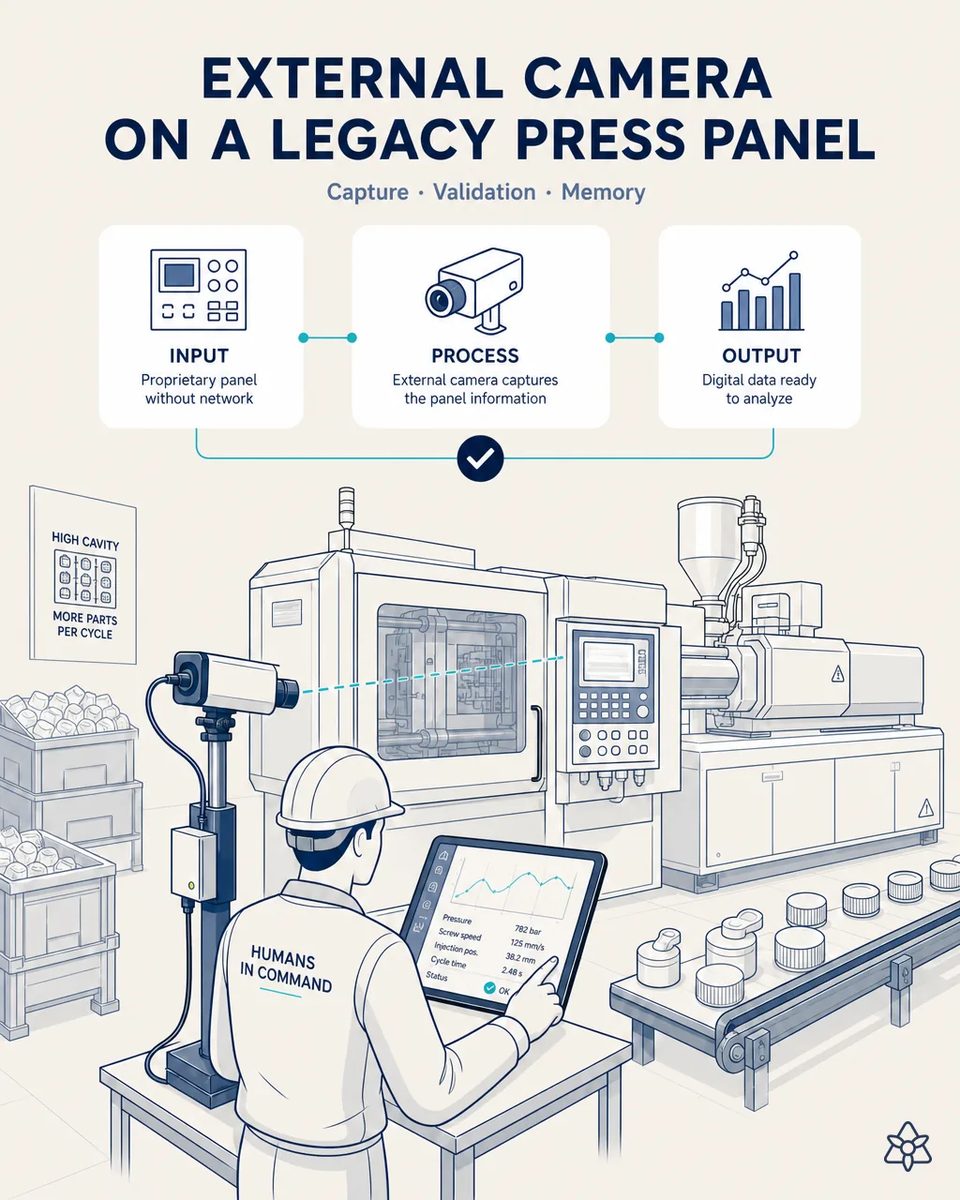
The veteran press shows everything on screen and records nothing.
Not every press in a closures plant is latest-generation. The veteran ones are still productive, but their panel is proprietary and network-isolated. Swapping a press costs hundreds of thousands of euros and weeks of downtime. But its screen shows pressure, temperature and cycle time — vital data that dies on the screen today.
- Most closure plants run a mixed fleet: latest-generation presses next to veteran machines that still mold good caps at a competitive cycle. Their panel is proprietary and isolated from any network by design.
- Replacing one costs hundreds of thousands of euros and weeks without that capacity, so the business case to retire a press that still works rarely closes.
- Meanwhile the screen shows injection pressure, barrel and hot-runner temperatures, holding time and cycle time. That data dies on the screen: at best a technician copies one reading onto the startup sheet. The figures that would explain a defect are visible for a few seconds and then overwritten.
- When a batch shows short shots or out-of-range removal torque three weeks later, nobody can say which parameters it ran with. Root cause turns into an argument between process and quality instead of a query.
Connect in photo mode on the panel — read from outside, nothing installed in the press.
With iLEAN Connect photo mode, a fixed industrial camera points at the panel. OCR with an anchored model reads each frame and structures the time series per batch. Cross-referenced with the ERP, the system knows which order ran with which parameters. If a defect shows up 3 weeks later, root-cause analysis takes minutes, not days.
The camera does not connect to the press controller, does not open ports and does not touch any warranty. It reads what the screen already shows, frame by frame, and turns it into a time series per batch. That is the difference between a project maintenance blocks and one it signs off. And the press keeps molding while it is being read.
Veteran press today versus veteran press being read
| Aspect | Today | With iLEAN Connect |
|---|---|---|
| Pressure, temperatures, cycle time | Visible on screen, then gone | Time series per batch |
| Link to the active order | None | Crossed with the ERP order |
| Short shot found weeks later | Days of guesswork | Root cause in minutes |
| Hot-runner temperature drift | Noticed when rejects rise | Visible as a trend |
| Press controller | — | Untouched, no ports opened |
| Capex to replace a veteran press | Pushed by lack of data | Deferred with evidence |
Zero parameter-defect correlation → root-cause analysis per batch in minutes, with no machine replacement.
Impact estimate — to be validated against your veteran press fleet.
The block below is an estimate to be validated against your plant's actual data. We put it forward so the committee has an order of magnitude; we refine it during the assessment.
- Estimated payback 5-10 months, before counting any deferred press replacement.
- Avoided capex: a press that still molds good closures does not need to be replaced just to get its process data out of a closed panel. Replacing it becomes a choice backed by data, not a way of getting data.
- Less scrap, because parameter-defect correlation becomes possible: short shots, flash or weight drift can finally be tied to the settings that produced them.
- Root-cause analysis on a defect found weeks later goes from days of reconstruction to minutes per batch, with the series of that press on the table. Process and quality look at the same curve instead of defending two memories.
Payback 5-10 months · avoids machine-replacement CAPEX. Payback of 5 to 10 months, avoided press-replacement CAPEX, and reduced scrap through parameter-defect correlation. Estimate to validate.
And the fair question from the production manager
“Can a camera reading an old screen really count as process evidence?” — yes, because the task is anchored: the panel never moves, each value sits in a known position and has a physically possible range, and there the best models drop below 1.5% error [1]. A frame whose reading falls outside the possible range is discarded instead of stored, so a reflection or a hand in front of the screen never becomes a fake barrel temperature.
[1] OpenAI paper "Why Language Models Hallucinate", 2025 — on the reliability of AI in anchored tasks.
What people ask about reading a veteran closure press panel
Does the press manufacturer need to be involved?
No. Nothing is installed on the press and its software is not touched, so there is no warranty or support question to negotiate. The camera sits on its own stand in front of the panel. Maintenance usually approves it in the same meeting.
Which parameters does the camera capture?
Whatever the panel displays: typically injection pressure, barrel and hot-runner zone temperatures, holding time and cycle time. If a value lives on a secondary screen page, the capture reads it whenever that page is shown. Units and decimal positions are configured once per press model.
How does it know which closure batch was running?
Each reading is timestamped and crossed with the active order in the ERP or in iLEAN's memory, so every parameter series belongs to a mold, a color and a batch. That link is what makes a series useful in a bottler complaint.
Does it help with cycle-time losses as well as defects?
Yes. With the real cycle time recorded per batch, the gap between the theoretical cycle and what the press actually ran becomes visible and comparable across molds. On a press with dozens of cavities, a tenth of a second per cycle adds up to thousands of closures a day.
Can we start with a single veteran press?
That is the usual way: the oldest press with the most unexplained rejects. Once its series proves useful, the same setup is repeated on the rest of the veteran fleet. Each press added reuses the same configuration pattern, so the second one is faster than the first.
More cases from this series
- Connect listens to the lab's Excel and pushes it to the ERPILEAN absorbs the lab's quality-control Excel and pushes it to the ERP after validation. Saves ERP…
- Human-verification tablet next to the pressEvery iLEAN capture passes through a tablet by the press; the technician confirms with two taps before…
- Photo to the order at mold startupThe technician photographs the production order and startup sheet; the batch exists in the system at…
- Photo to the delivery note and the resin octabin labelPhoto the delivery note and resin octabin label; iLEAN extracts the batch and pushes it to the ERP after…
- ILEAN silently copied on the resin supplier's emailILEAN silently reads the resin supplier's alert and suggests replanning before the press goes idle.
- Connect voice mode for the shift leadThe shift lead dictates incidents while walking between presses; iLEAN structures them and replies…
Tell us how many veteran presses you run with panels nobody reads.
We work on your plant's real data, not ours. Assessment with no commitment.
Request estimated ROI within 48h ‹ See all cases of plastic closures See packaging